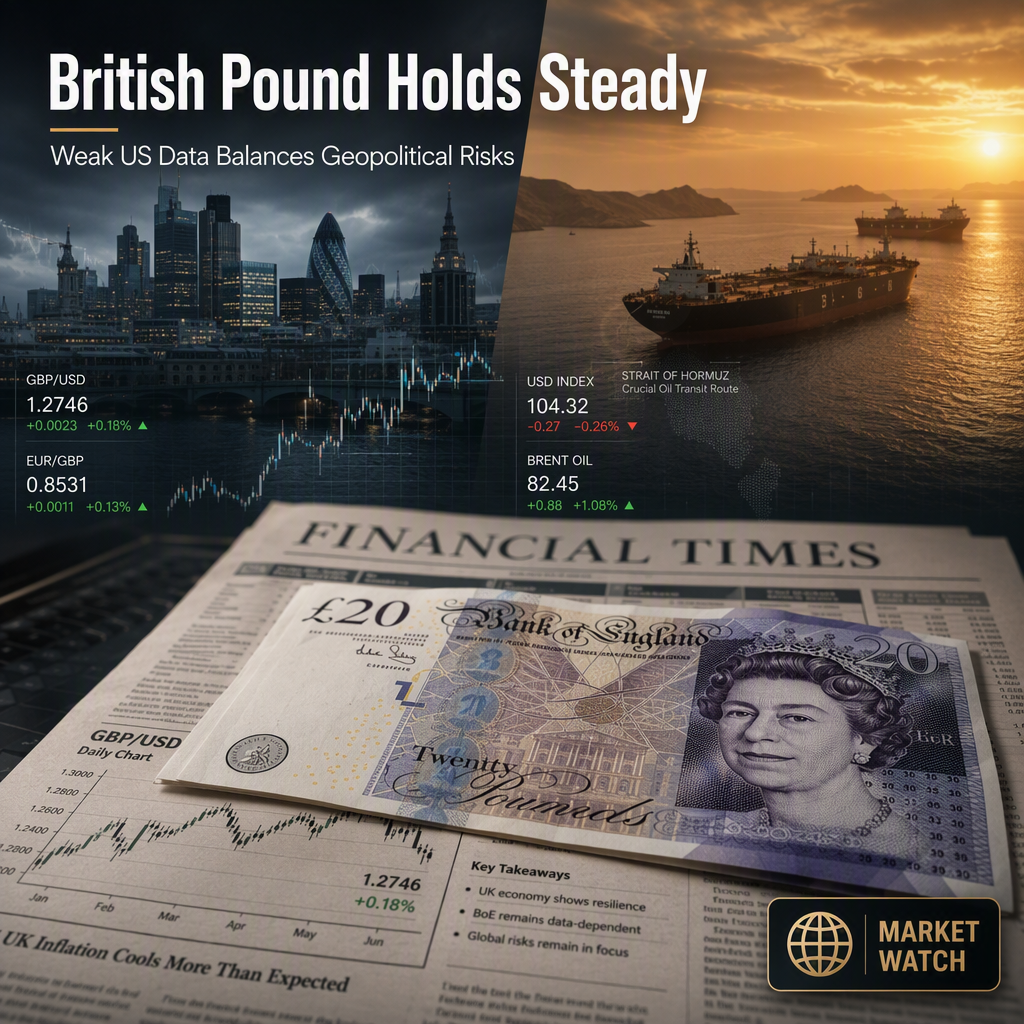
The British Pound remained steady on Tuesday, trading at 1.35846 against the US Dollar, as weak US economic data counterbalanced rising geopolitical tensions in the Middle East [1]. US President Donald Trump confirmed that there are no ongoing talks with Iran, the US naval blockade remains in effect, and the Strait of Hormuz is open and operating [1]. Iranian officials reiterated their commitment to dialogue but rejected equating negotiation with surrender, with Iran's Foreign Minister stating that 'America is begging to negotiate with us now,' according to Al Jazeera [1].
On the economic front, US Housing Starts in July fell by 12.4% month-over-month, dropping from 1.415 million in June to 1.239 million, attributed to higher mortgage rates and elevated home prices since the onset of the Middle East conflict [1]. US Industrial Production for July also missed expectations, rising only 0.2% month-over-month compared to the anticipated 0.3% [1].
In the UK, labor market data showed weakness, with the unemployment rate rising to 4.9% in June, above the estimated 4.8% [1]. This data did not significantly impact expectations for the Bank of England's interest rate path, with market participants focusing on the upcoming Consumer Price Index (CPI) data scheduled for Wednesday [1]. Forecasts suggest UK headline inflation will rise to 2.9% year-over-year from 2.6%, while core CPI is expected to decrease slightly to 2.5% from 2.6% [1]. Money markets currently assign a 72% probability that the BoE will hold rates at its September 17 meeting, with the odds for a hold in December close to 78% [1].
Technical analysis indicates that GBP/USD maintains a bullish near-term bias, trading above key moving averages and trend-line supports, with the Relative Strength Index at 63.9 signaling constructive upside momentum as long as the pair remains above the mid-1.35 region [1]. Initial support is identified at 1.3502, with resistance at 1.3603; a sustained move above this level could open the door for further gains [1].
In the US, traders are awaiting the release of the FOMC's latest meeting minutes for additional guidance on the Federal Reserve's interest rate trajectory [1].
CONCLUSION
The British Pound's stability reflects a balance between weak US economic data and ongoing geopolitical risks in the Middle East. Market participants are closely watching upcoming UK inflation data and central bank decisions, while technical indicators suggest a constructive outlook for GBP/USD as long as key support levels hold.