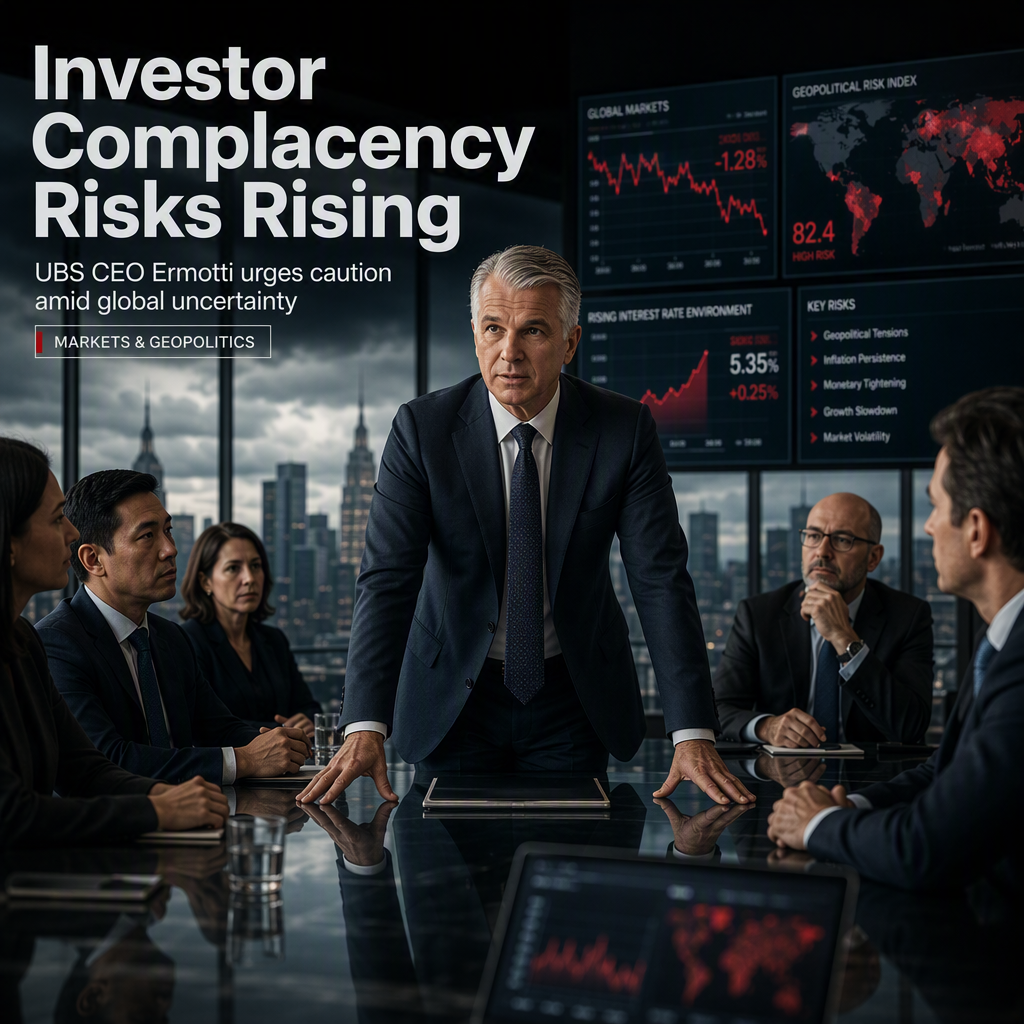
UBS CEO Sergio Ermotti cautioned on September 10, 2026, that investors have become complacent despite mounting geopolitical and economic risks. Ermotti highlighted that financial markets have shown less volatility than expected, even as new issues emerge without resolution of existing ones, citing ongoing conflicts such as the Iran and Ukraine wars, U.S.-China rivalry affecting supply chains, rising borrowing costs, and persistent inflation as key headwinds [1].
Ermotti noted that strong investment in artificial intelligence, data centers, and other new technologies has helped support economic growth and financial markets, but warned that the environment remains complicated. He observed that wealthy investors are increasingly diversifying their portfolios across sectors and geographies, rather than making large directional bets, as a hedge against uncertainty. Despite this, UBS clients' overall asset allocation has not changed materially over the past year, and the push for diversification does not represent a wholesale retreat from U.S. assets. Flows into global emerging markets were characterized as deployment of excess cash rather than a reduction in U.S. or dollar positions, with the dollar still seen as a reference currency [1].
Ermotti also addressed the impact of higher interest rates, stating that persistent inflation above central-bank targets is likely to prompt further policy tightening. He expects major central banks, including the European Central Bank, Federal Reserve, and Bank of Japan, to raise rates in the coming months, with the ECB potentially starting the hike process and the Fed following with a couple of hikes. This suggests that investors should not anticipate a quick return to lower borrowing costs [1].
Overall, Ermotti's comments reflect a cautious outlook, emphasizing the need for balanced portfolio strategies and diversification in response to ongoing global uncertainties and the likelihood of higher-for-longer interest rates.
CONCLUSION
UBS CEO Sergio Ermotti's warning underscores the risks posed by geopolitical tensions, persistent inflation, and rising interest rates. Investors are responding by diversifying portfolios, but remain anchored to U.S. assets and the dollar. The market takeaway is a shift toward caution and balance, with expectations for continued policy tightening by major central banks.