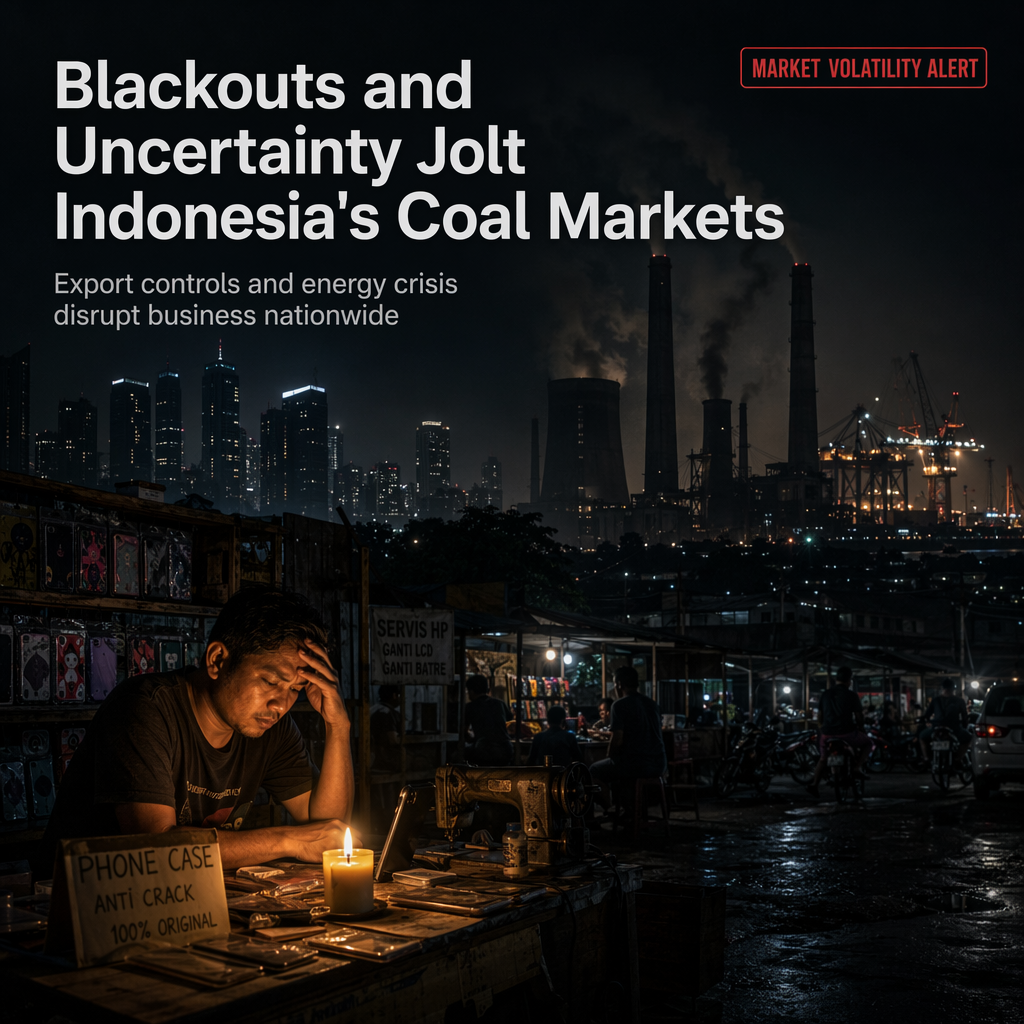
Indonesia has been experiencing widespread rolling blackouts in recent weeks, affecting regions including Greater Jakarta and disrupting daily life and business operations across the country [1]. The crisis is primarily attributed to a significant gap between domestic and export coal prices, which has incentivized Indonesian coal producers to prioritize exports over local supply. This shift has led to shortages for domestic power plants and exacerbated the blackout situation [1].
In response to the crisis, the Indonesian government implemented export controls on coal, aiming to stabilize domestic supply after a mine disaster in China and surging global demand. However, these controls have rattled international commodity buyers and have not fully alleviated local shortages, resulting in higher domestic coal prices and continued power generation challenges [1]. The government has also announced a $1.48 billion stimulus package to mitigate the effects of fuel shortages, power outages, and a weakening currency, with the goal of supporting affected industries and stabilizing the energy supply [1].
The crisis has had a pronounced impact on businesses, from small vendors—such as a phone case seller in Kediri, East Java, who resorted to using candles during outages—to large manufacturers, highlighting the broad economic disruption [1]. Market sentiment has turned volatile, with coal prices trading near multi-year highs due to export restrictions and strong international demand. Technical analysis indicates a bullish short-term trend for coal, but analysts caution that volatility is likely to persist until there is greater clarity on government policy and enforcement [1].
Industry experts and business lobbies have expressed concern over the government's confusing and inconsistent policies, warning that such uncertainty is fostering 'dangerous distrust' among stakeholders. Analysts recommend that traders closely monitor support and resistance levels for coal and related commodities, given the heightened uncertainty and potential for further government intervention [1].
CONCLUSION
Indonesia's rolling blackout crisis has triggered significant volatility in the country's commodity markets, particularly coal, and has disrupted business operations nationwide. While government measures such as export controls and a $1.48 billion stimulus package aim to stabilize the situation, ongoing policy uncertainty continues to weigh on market sentiment and business confidence.