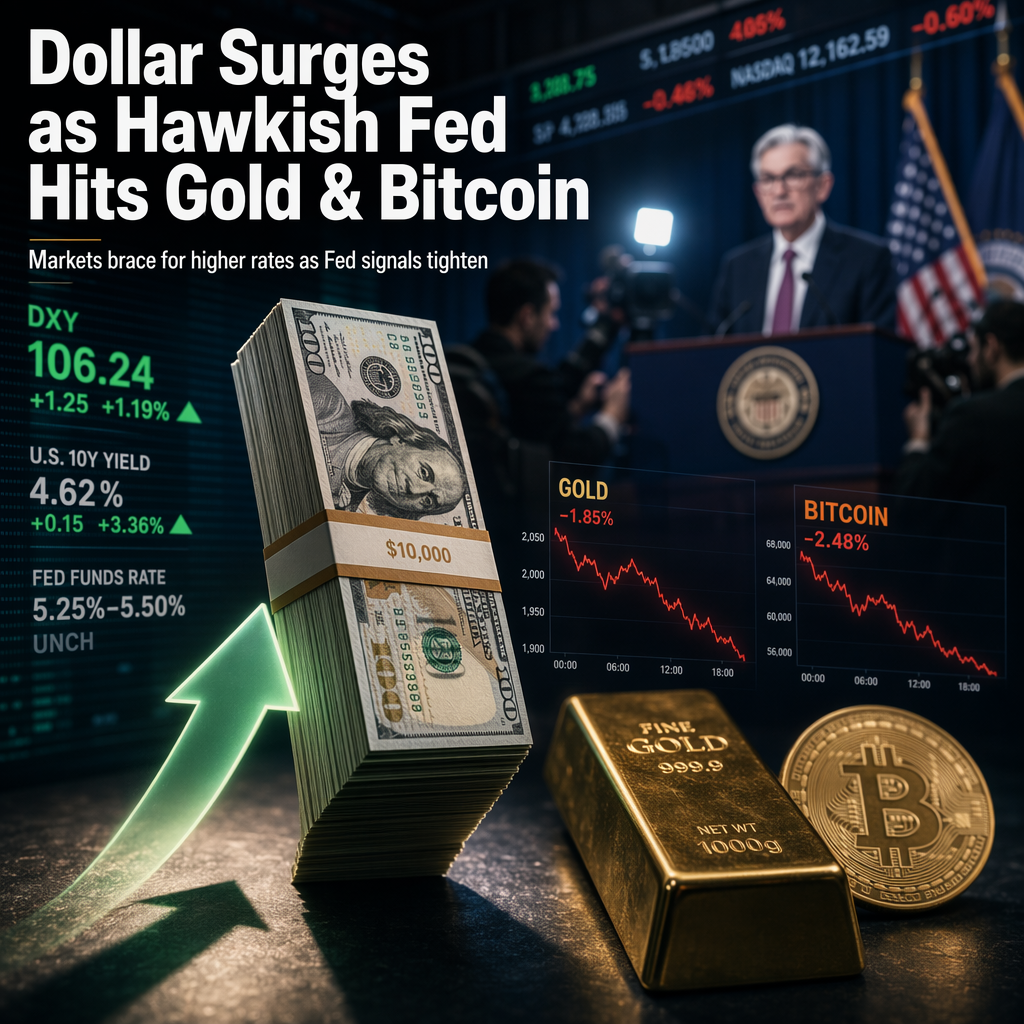
Deutsche Bank reports that a hawkish shift in Federal Reserve expectations, following Kevin Warsh’s debut as Fed Chair and a more aggressive dot plot, led markets to fully price in a Fed rate hike by October. The probability of a September hike surged from 36% to 80% by the close of the previous day, with 38 basis points of hikes priced in by year-end [1]. This repricing caused 2-year Treasury yields to jump 13.1 basis points, reaching a 15-month high of 4.19%. In contrast, the 10-year yield rose by a more moderate 4.9 basis points, while 30-year yields declined by 1.2 basis points [1].
The shift in Fed expectations had a significant impact on financial markets. The US Dollar Index advanced by 0.55% against all G10 currencies, reflecting broad-based dollar strength [1][2]. Risk assets responded negatively, with gold prices falling 1.71% and Bitcoin dropping 2.15% [1][2]. Deutsche Bank notes that gold remained modestly lower in the latest data, with a specific quote of Gold at 4323, down 0.34% [2]. The sell-off in risk assets occurred after the FOMC meeting, and although there was some relief from a US-Iran Memorandum of Understanding, it did not fully offset the earlier declines in gold [2].
According to Deutsche Bank, the hawkish Fed repricing and stronger dollar were the primary drivers behind the pressure on gold and Bitcoin prices [2]. The market reaction underscores the sensitivity of risk assets to shifts in US monetary policy expectations, with higher yields and a firmer dollar weighing on alternative assets [1][2].
CONCLUSION
A hawkish shift in Fed expectations has driven the US dollar and Treasury yields higher, while weighing on gold and Bitcoin prices. The market is now pricing in a higher probability of a Fed rate hike by October, reflecting increased sensitivity to US monetary policy signals.