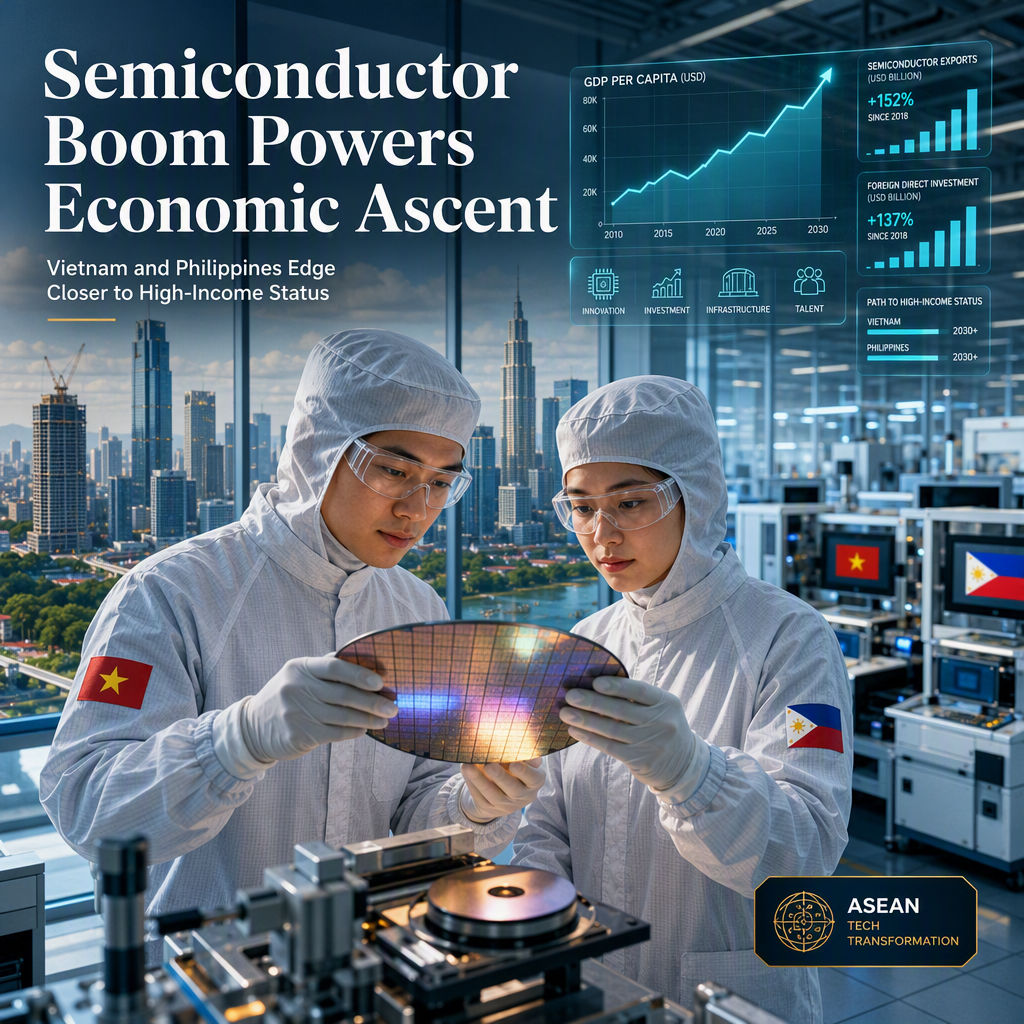
Vietnam and the Philippines are experiencing accelerated economic development due to the rapid growth of the semiconductor industry in Southeast Asia, positioning both countries closer to achieving 'high-income' status as defined by the World Bank. Currently, only Singapore and Brunei hold this designation among the 11 members of the Association of Southeast Asian Nations (ASEAN) [1].
The semiconductor sector is increasingly recognized as a pivotal factor in helping nations overcome the 'middle-income trap,' a situation where countries face stagnating growth after reaching middle-income levels. In response to surging global demand for chips, Southeast Asian countries are intensifying efforts to attract international chipmakers and build robust local supply chains [1].
Vietnam has notably advanced in the semiconductor value chain, highlighted by a recent $1 billion investment from LG, which signals the country's rising significance in the industry. Meanwhile, the Philippines is leveraging its skilled workforce and favorable investment climate to attract more participants in the chip sector [1].
These strategic moves are enhancing the prospects of both Vietnam and the Philippines to ascend to high-income status, representing a major shift in the region's economic dynamics. Policymakers and industry experts cited in the article view the semiconductor industry as a catalyst for sustained economic growth and technological progress in Southeast Asia [1].
CONCLUSION
The semiconductor industry's expansion is reshaping Southeast Asia's economic landscape, with Vietnam and the Philippines emerging as strong contenders for high-income status. Continued investment and development in the chip sector are expected to drive long-term growth and technological advancement in both countries.