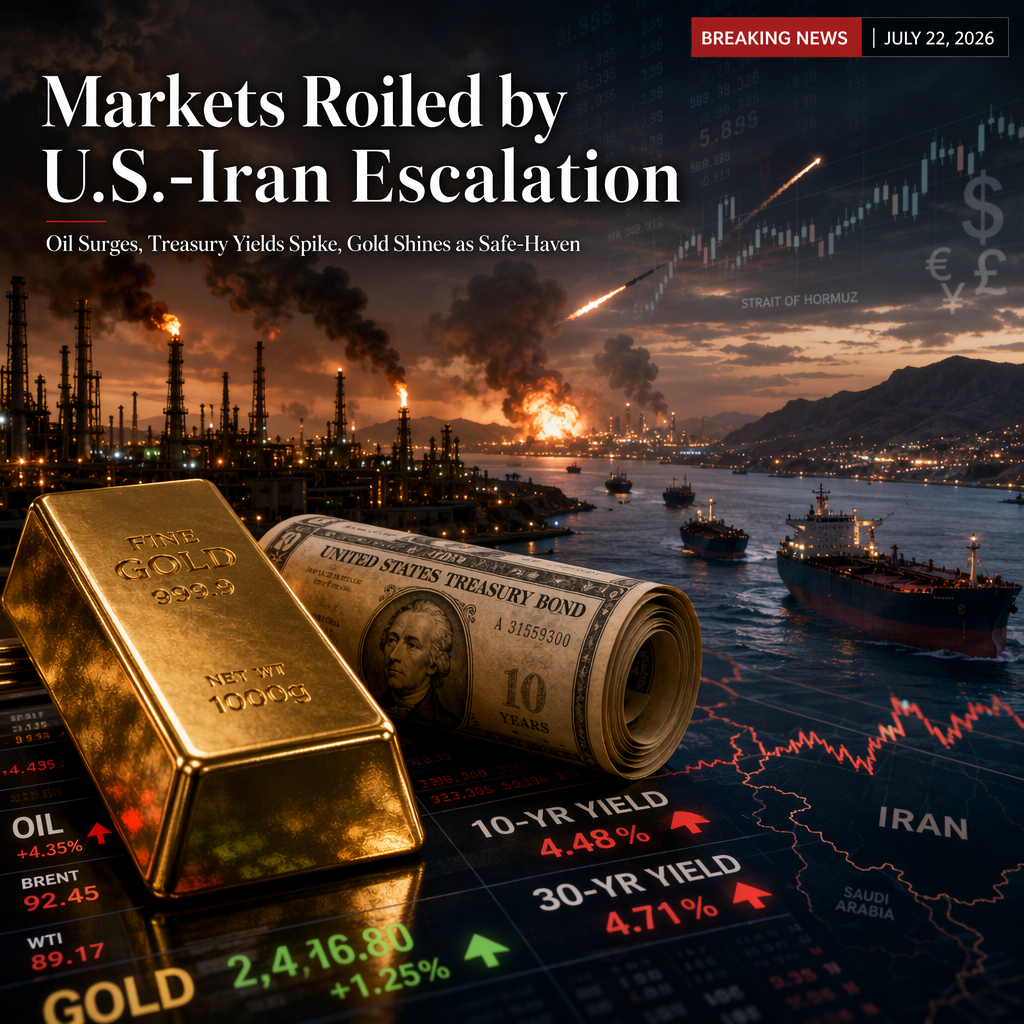
On July 22, 2026, global financial markets were dominated by the ongoing escalation between the U.S. and Iran, which entered its 11th consecutive night of strikes. Both nations signaled an unwillingness to return to talks after escalating attacks, resulting in a surge in oil prices and U.S. Treasury yields due to heightened inflation concerns [1]. WTI crude oil led the major commodities, closing up around 2.1% near $86 a barrel, after peaking close to $87.90 during Asian and early European trading hours. The rally was fueled by strikes targeting military, energy, and gas infrastructure across several Iranian cities, as well as renewed threats to shipping through the Strait of Hormuz and the Red Sea [1].
Gold prices also advanced, gaining roughly 1.3% to trade near $4,133, with a midday high around $4,166. The move was attributed to safe-haven demand amid the geopolitical tensions and ongoing central bank buying, despite the absence of a gold-specific catalyst [1]. U.S. 10-year Treasury yields rose about 0.7% to trade near 4.66%, marking their highest level in approximately two months, as yields tracked the climb in crude oil prices [1].
U.S. equities finished close to flat, with traders exercising caution ahead of after-hours earnings reports from Alphabet and Tesla. The dollar index experienced a choppy and mixed session against major currencies, reflecting the uncertain market environment [1]. Other key data releases included a U.S. MBA 30-Year Mortgage Rate of 6.69% and an increase in U.S. MBA Mortgage Applications by 1.9% for the week ending July 17, 2026. The EIA Crude Oil Stocks Change showed a build of 2.01 million barrels for the same period [1].
The market's reaction was characterized by a flight to safety, with gold and Treasury yields rising, while risk assets such as equities remained subdued. The focus remained on the potential for further escalation in the U.S.-Iran conflict and its implications for energy markets and global inflation [1].
CONCLUSION
The escalation of the U.S.-Iran conflict has injected significant risk premium into energy and rates, driving oil and Treasury yields higher while supporting gold as a safe-haven asset. Market participants remain cautious, with equities largely flat and traders awaiting further developments in both the geopolitical landscape and upcoming corporate earnings. The situation continues to pose upside risks to inflation and volatility in global markets.