
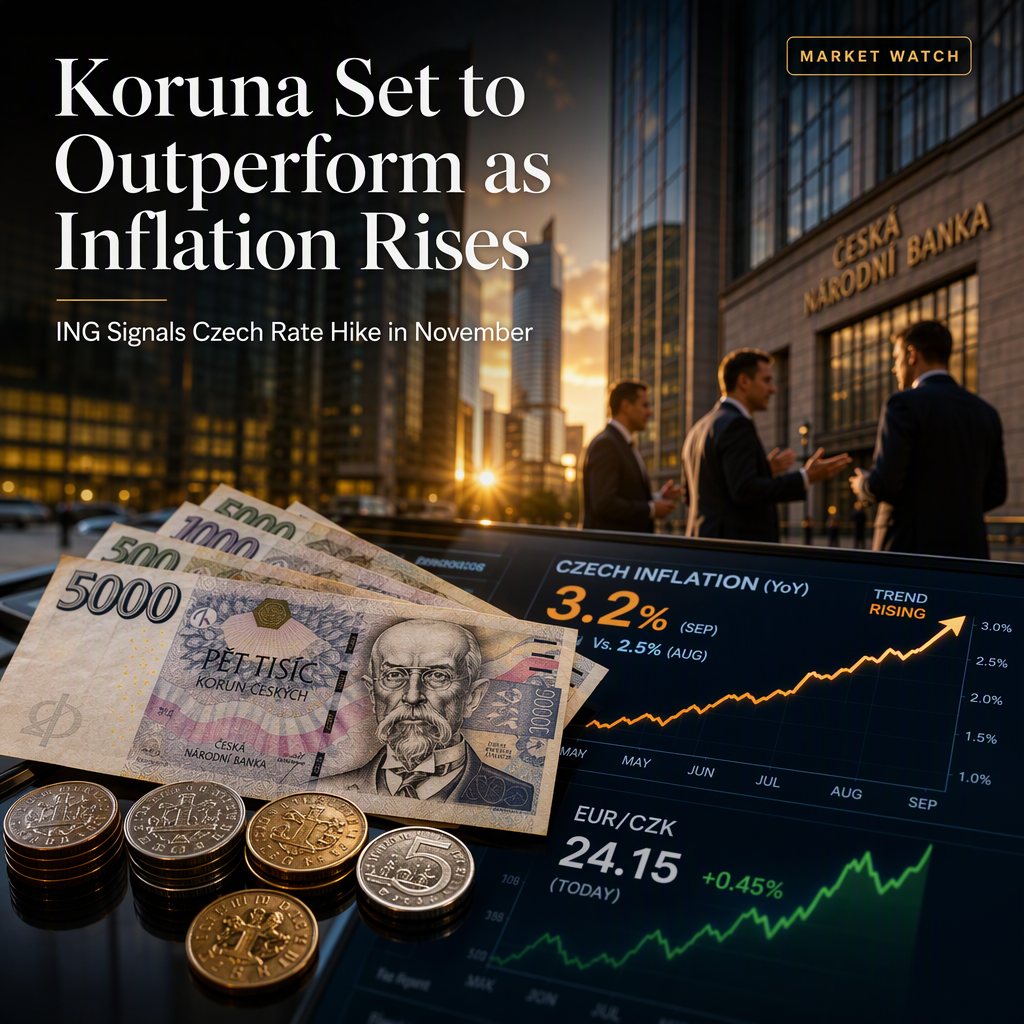
ING analyst Frantisek Taborsky anticipates higher inflation figures for September in both the Czech Republic and Hungary, with Czech inflation expected to rise from 1.9% to 2.5%, primarily due to increased fuel prices. This projected figure would surpass the Czech National Bank's August forecast of 2.2% for the first time in a while. Core inflation in the Czech Republic is also forecasted to edge up from 3.0% to 3.1%, reinforcing ING's expectation of a rate hike by the Czech National Bank in November [1].
In Hungary, inflation is expected to increase from 1.3% to 2.0%, also driven by fuel prices and exceeding the National Bank of Hungary’s September forecast of 1.7%. In contrast, the National Bank of Poland is anticipated to keep rates unchanged at 3.75%, with a cautious tone expected at Thursday’s press conference. ING notes that new government fuel measures in Poland are likely to delay any rate hike until the first quarter of 2027. Similarly, the National Bank of Romania is expected to maintain its rate at 6.50%, with market attention focused on commentary regarding recent EUR/RON movements [1].
Taborsky maintains a bearish outlook on regional currencies but expresses a preference for the Czech koruna, citing its relative insulation from global narratives and the likelihood of outperformance compared to more dovish Central and Eastern European currencies. Despite the koruna hitting new lows last week, ING expects that higher inflation data will prompt a more hawkish stance from the Czech National Bank, potentially shifting market pricing in favor of the koruna [1].
CONCLUSION
ING expects rising inflation in the Czech Republic and Hungary to influence monetary policy, with a November rate hike likely in the Czech Republic. The Czech koruna is seen as poised to outperform regional peers due to its favorable inflation dynamics and less dovish central bank outlook. Market participants are advised to monitor upcoming inflation data and central bank communications for further direction.