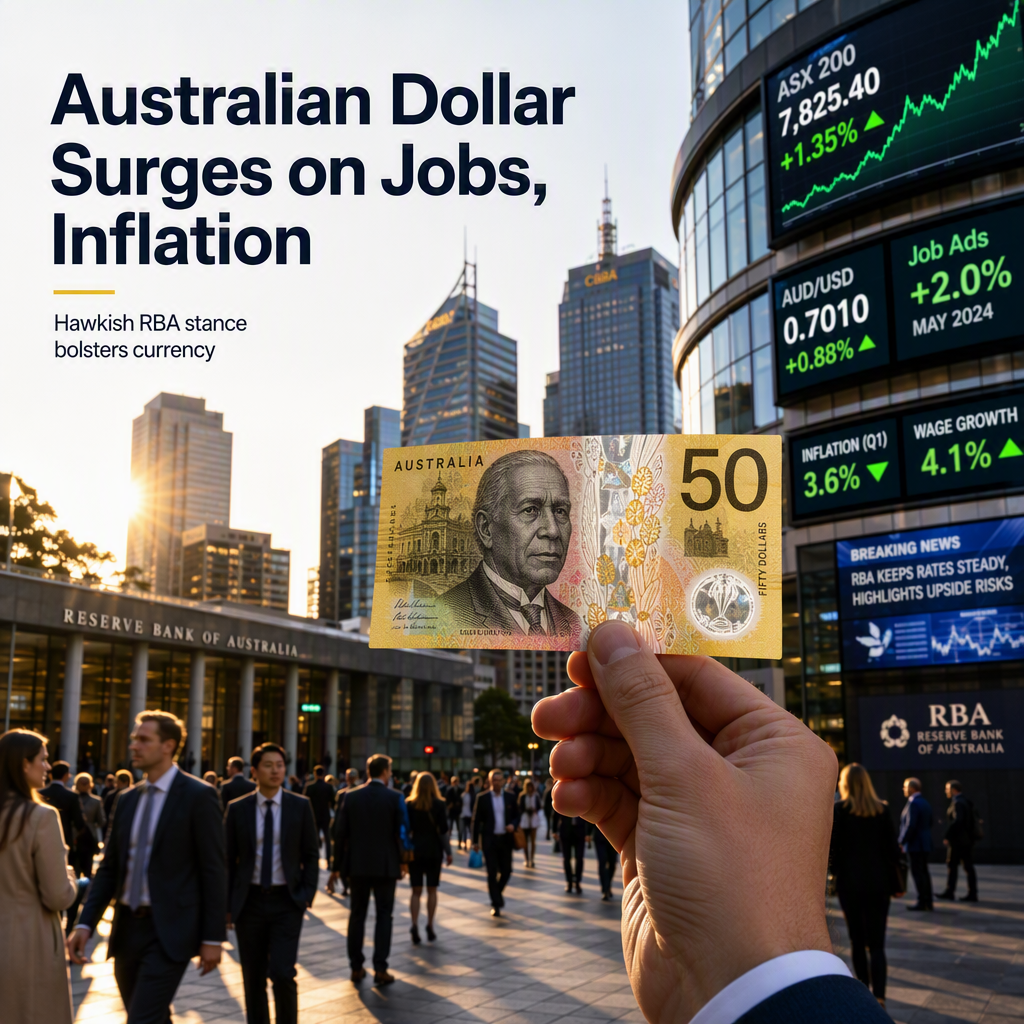
The Australian Dollar (AUD) strengthened against the US Dollar (USD), with the AUD/USD pair hovering around 0.7010 during Asian trading hours on Tuesday, following two days of losses. This rebound was driven by positive employment data, as the ANZ–Indeed Job Ads increased by 2.0% month-over-month in July, reversing a 0.2% decline from the previous month and marking the fourth monthly rise this year. ANZ Senior Economist Catherine Birch highlighted that the growth was broad-based across both states and industries, indicating robust labor demand despite a cooling overall economy [1].
Inflation data also contributed to the AUD's gains. The TD-MI Inflation Gauge rose by 1.0% month-on-month in July, recovering from a 0.4% drop in June and marking its first gain since April. This uptick is consistent with the Reserve Bank of Australia’s (RBA) June Meeting Minutes, which anticipated intensifying underlying price pressures mid-year. RBA Governor Michele Bullock emphasized that underlying inflation remains too high and warned of potential further increases due to higher oil prices linked to the conflict in Iran, reinforcing the case for the RBA to maintain a cautious policy stance [1].
BNY’s Geoff Yu cited RBA Assistant Governor Sarah Hunter, who acknowledged that inflation remains above the 2-3% target band and stressed the need to keep pressure on price growth to prevent higher inflation expectations from becoming entrenched. Hunter also noted that the labor market remains "somewhat tight," with job growth holding up "not too badly" in the first half of the year, underscoring ongoing resilience in employment despite softer headline price dynamics [1].
Market sentiment was further influenced by easing geopolitical tensions, as the US Dollar struggled amid hopes for a diplomatic breakthrough between the United States and Iran. US President Donald Trump described his latest offer of talks as a "last chance" for Iran, following his decision to call off a major attack, and expressed expectations that negotiations would soon begin to reopen the Strait of Hormuz and address US concerns regarding Iran's nuclear program [1].
CONCLUSION
The Australian Dollar's gains were supported by robust job ads and a rebound in inflation, reinforcing expectations for a hawkish stance from the RBA. Persistent inflation and a resilient labor market suggest the central bank is likely to maintain pressure on price growth. Easing geopolitical tensions also contributed to the AUD's strength against the USD.