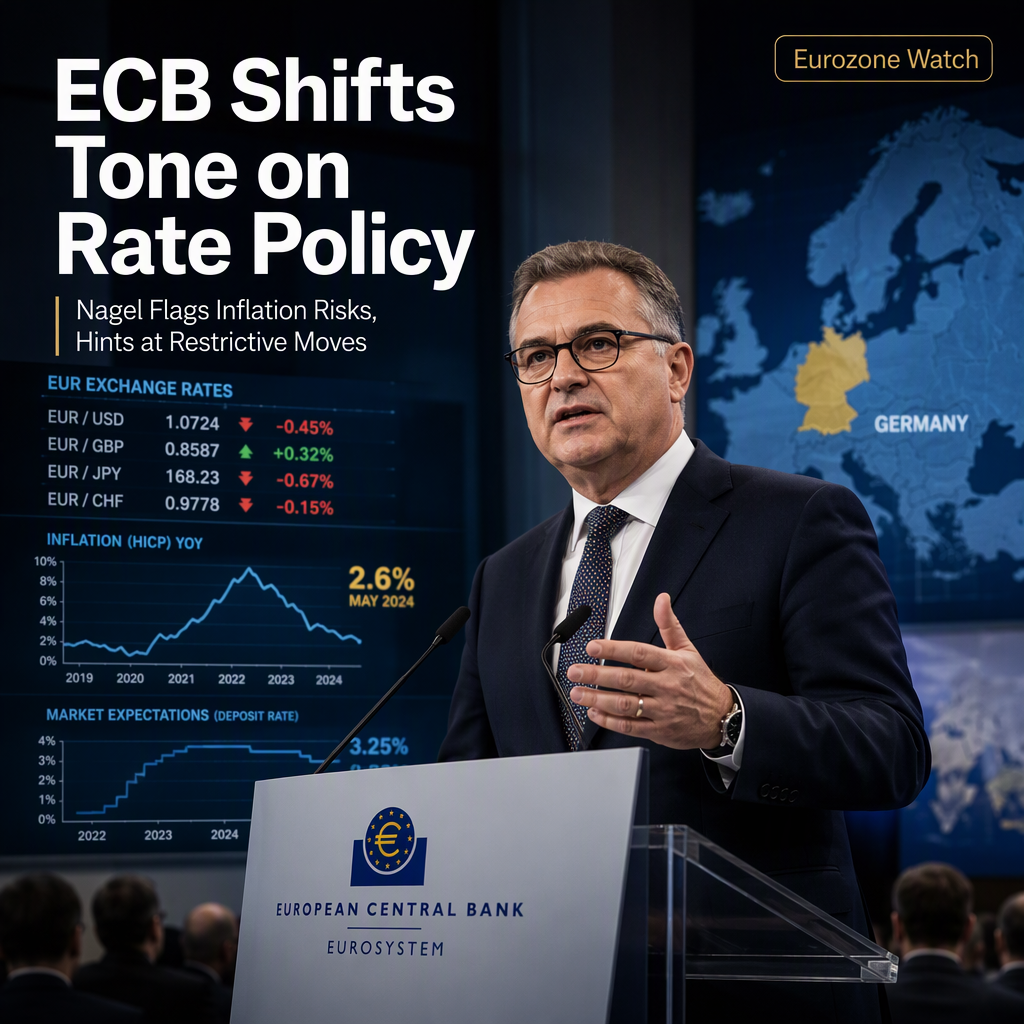
Joachim Nagel, President of the Bundesbank and European Central Bank (ECB) member, stated at a financial event in London that high energy prices have pushed inflation away from the ECB's 2026 target, raising concerns about price stability in the Eurozone [1]. Nagel emphasized that he is not particularly worried about labor market developments and noted that current ECB rates remain in neutral territory. However, he acknowledged that the possibility of the ECB moving into mildly restrictive policy cannot be excluded, suggesting a potential tightening of monetary policy if inflationary pressures persist [1].
Nagel described the ECB's approach as operating between 'constructive ambiguity and forward guidance,' and expressed confidence that there is not too much uncertainty in markets regarding the drivers of ECB decision-making [1]. He reiterated that the ECB's primary mandate is to maintain price stability, typically targeting inflation around 2%, and that interest rate adjustments are the main tool for achieving this goal [1].
On the currency front, the Euro showed mixed performance against major currencies, being strongest against the Canadian Dollar (+0.08%) and weakest against the New Zealand Dollar (-0.35%) on the day [1]. These movements reflect market reactions to ongoing monetary policy discussions and inflation concerns within the Eurozone.
No forward-looking statements or analyst opinions beyond Nagel's remarks were provided in the source article [1].
CONCLUSION
ECB’s Nagel’s comments highlight ongoing inflation concerns driven by high energy prices and signal that a shift toward mildly restrictive policy remains possible. The Euro exhibited mixed performance against major currencies, reflecting market sensitivity to ECB policy signals. Investors should monitor upcoming ECB decisions for further clarity on the central bank’s policy direction.