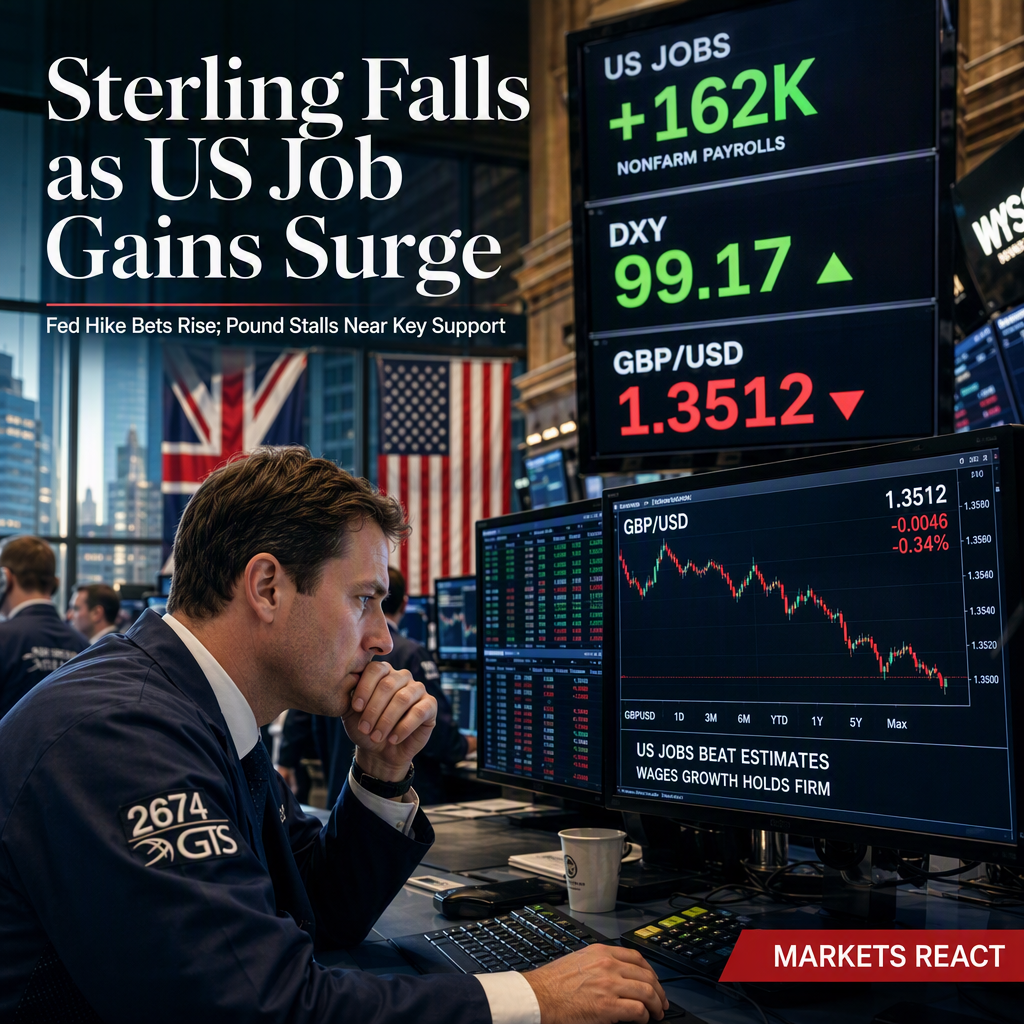
The Pound Sterling retreated by approximately 0.09% against the US Dollar following the release of strong US jobs data, which reignited debate over potential Federal Reserve rate hikes [1]. GBP/USD traded near Friday’s opening price of 1.3512, reflecting the market's reaction to the US Nonfarm Payrolls report for August, which significantly exceeded forecasts at 162K versus the expected 56K and July’s print of 21K. The US Unemployment Rate remained unchanged at 4.1% [1].
Fed Chairman Kevin Warsh, speaking at Jackson Hole, emphasized that the labor market is “consistent with full employment” and maintained a hawkish stance, prioritizing inflation concerns [1]. Cleveland Fed's Beth Hammack echoed this sentiment, stating that “policy is not restrictive and inflation is too high,” and suggested that now is the time for the Fed to hike rates to control inflation [1]. Money markets responded by increasing the probability of a Fed rate hike in September to 61%, up from 54% the previous day, according to Prime Terminal [1]. The US Dollar Index (DXY) rose 0.18% to 99.17, reflecting strengthened dollar sentiment [1].
Looking ahead, traders are focused on upcoming US economic releases, including the Producer Price Index (PPI), Consumer Price Index (CPI), jobless claims, the US Monthly Budget Statement, and the University of Michigan Consumer Sentiment for September [1].
In the UK, Bank of England Chief Economist Huw Pill commented that raising rates now would reduce the likelihood of more aggressive action in the future to tame inflation, which has increased due to the war in Iran [1]. Swap markets indicate expectations for the BoE to hike rates twice in the next six months, though economists anticipate unchanged rates at the September meeting [1]. The UK economic calendar will feature Retail Sales and Gross Domestic Product (GDP) figures for July [1].
Technically, GBP/USD maintains a constructive near-term tone, trading at 1.3521 and holding above former trend-line resistances turned support around 1.3476–1.3375. However, it remains capped by a cluster of simple moving averages near 1.3455, which acts as immediate resistance. The 14-period Relative Strength Index is close to 50, indicating neutral momentum. A daily close above the moving average cluster could open the way toward resistance at 1.3657, while initial support is seen at 1.3476 [1].
CONCLUSION
Strong US jobs data has bolstered expectations for a Fed rate hike, strengthening the US Dollar and stalling Sterling’s rally. Market participants are now closely watching upcoming US and UK economic releases for further direction. The probability of a Fed rate hike in September has increased, while the BoE is expected to maintain rates for now, with potential hikes anticipated in the coming months.