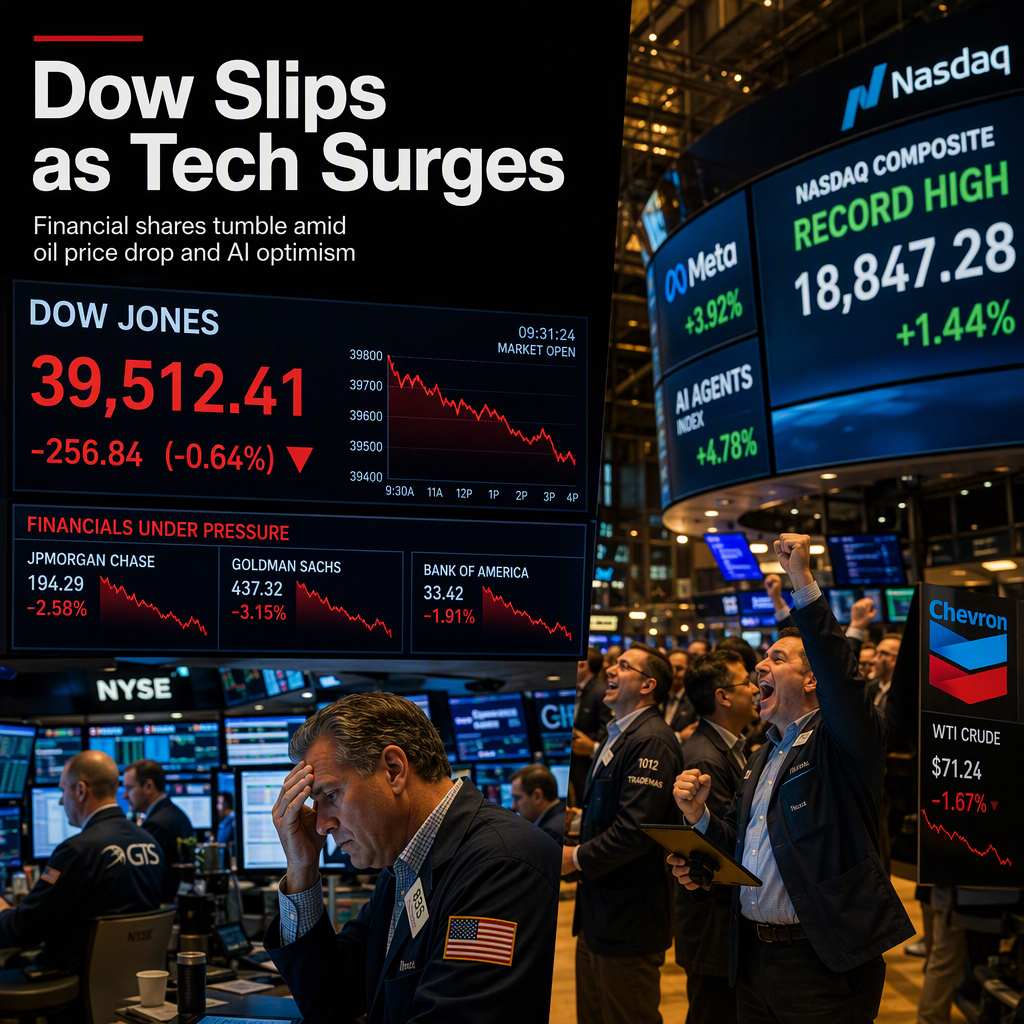
The Dow Jones Industrial Average (DJIA) reached its highest level since September 14 before the opening bell on Tuesday, but subsequently turned lower once trading began in New York, trading near 51,800 and below Monday's close [1]. Financial shares, including banks, brokers, and insurers, are falling across the market, with traders reallocating funds into technology stocks amid growing interest in artificial intelligence (AI) agents and applications [1]. JPMorgan Chase (JPM), the largest bank in the country, is declining alongside other financials, while Meta Platforms (META) is benefiting from increased investor attention, partly due to its new AI agent and a rating upgrade from JPMorgan's own analysts earlier in September [1].
The Dow's composition, which includes more financial companies and fewer technology firms compared to the S&P 500 and NASDAQ Composite, has contributed to its underperformance. The NASDAQ Composite tested record highs, and the S&P 500 remained nearly unchanged, highlighting the divergence in sector performance [1]. The Dow is price-weighted, meaning a $1 change in any of its 30 shares moves the index about 6 points, regardless of company size. For example, Goldman Sachs (GS) shares, priced over $900, have a larger impact on the index than JPMorgan's, which are priced under $400, despite JPMorgan's greater market capitalization [1]. Meta Platforms is not included in the Dow, which explains why a day of selling banks and buying technology leaves the Dow lower while the NASDAQ Composite reaches new highs [1].
Crude oil prices have declined for the fifth consecutive session, with Brent crude hitting its lowest level since September 8 amid reports that Iran has offered to reopen the Strait of Hormuz within seven days, contingent on the United States lifting its blockade of Iranian ports. This report has not been independently confirmed [1]. Lower oil prices negatively impact Chevron (CVX), the only energy producer in the Dow, but benefit the other 29 Dow constituents by reducing fuel costs [1]. Former President Trump stated at the United Nations General Assembly that he expects a deal with Iran after the November 3 midterms, which could push crude oil prices below prewar levels. Crude oil prices rebounded slightly after his speech, but the timeline for further declines is tied to the outcome of the American election [1].
The Federal Reserve is scheduled to make its next interest rate decision six days before the midterm elections, which could further influence market direction [1].
CONCLUSION
The Dow Jones Industrial Average is under pressure due to declining financial shares and a shift of investor interest toward technology stocks, while the NASDAQ Composite benefits from this rotation. Falling crude oil prices are impacting energy stocks like Chevron, with potential further declines dependent on geopolitical developments. The upcoming Federal Reserve rate decision and the midterm elections are expected to play a significant role in shaping market sentiment in the near term.