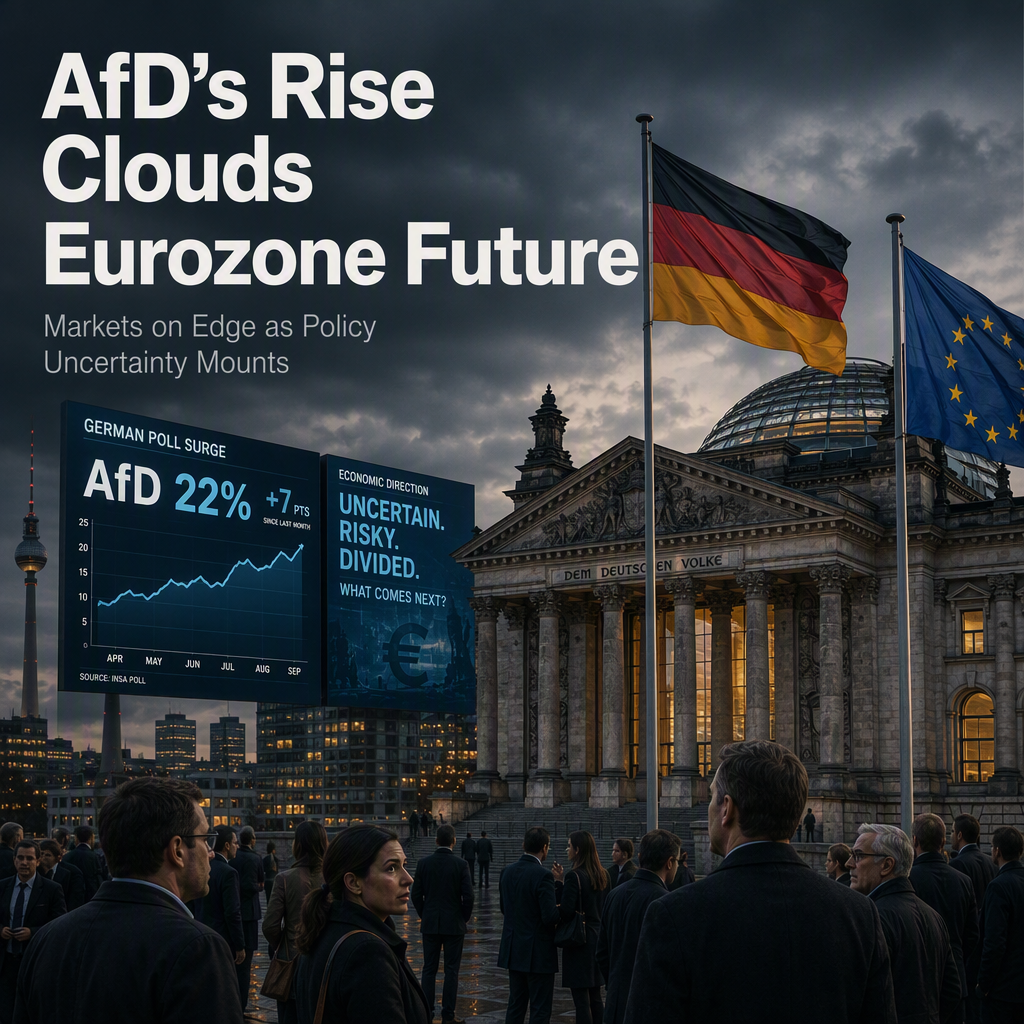
According to Carsten Brzeski of ING, the Alternative for Germany (AfD) party has risen to become Germany’s largest political party in recent polls, introducing significant uncertainty regarding Eurozone policy direction [1]. Brzeski highlights that the AfD’s economic policy platform is inconsistent and lacks clarity, with contradictions and few concrete commitments [1]. The party’s 2025 federal manifesto, which remains its binding program, includes explicit calls for Germany’s exit from the euro, a return to a national currency, gold repatriation, and Target-2 'monetarisation,' as well as higher pensions [1].
However, Brzeski notes that a more recent economic position paper from the AfD’s parliamentary group has notably deleted some of these demands, signaling a potential softening of their stance compared to the 2025 manifesto [1]. Despite these changes, there is still no clear indication of what economic policy would be implemented if the AfD were to lead at the state or federal level [1].
The rise of the AfD and the ambiguity surrounding its economic agenda have unsettled the outlook for the euro, with Brzeski emphasizing that markets and the business community should pay closer attention to these developments [1]. No specific market reactions or analyst forecasts are provided in the article, but the overall tone suggests heightened policy risk and uncertainty for the Eurozone [1].
CONCLUSION
The AfD's ascent in German polls has raised significant uncertainty about future Eurozone policy, particularly given the party's unclear and shifting economic positions. ING's analysis underscores the need for markets to closely monitor these political developments, as they could have meaningful implications for the euro and broader economic stability.