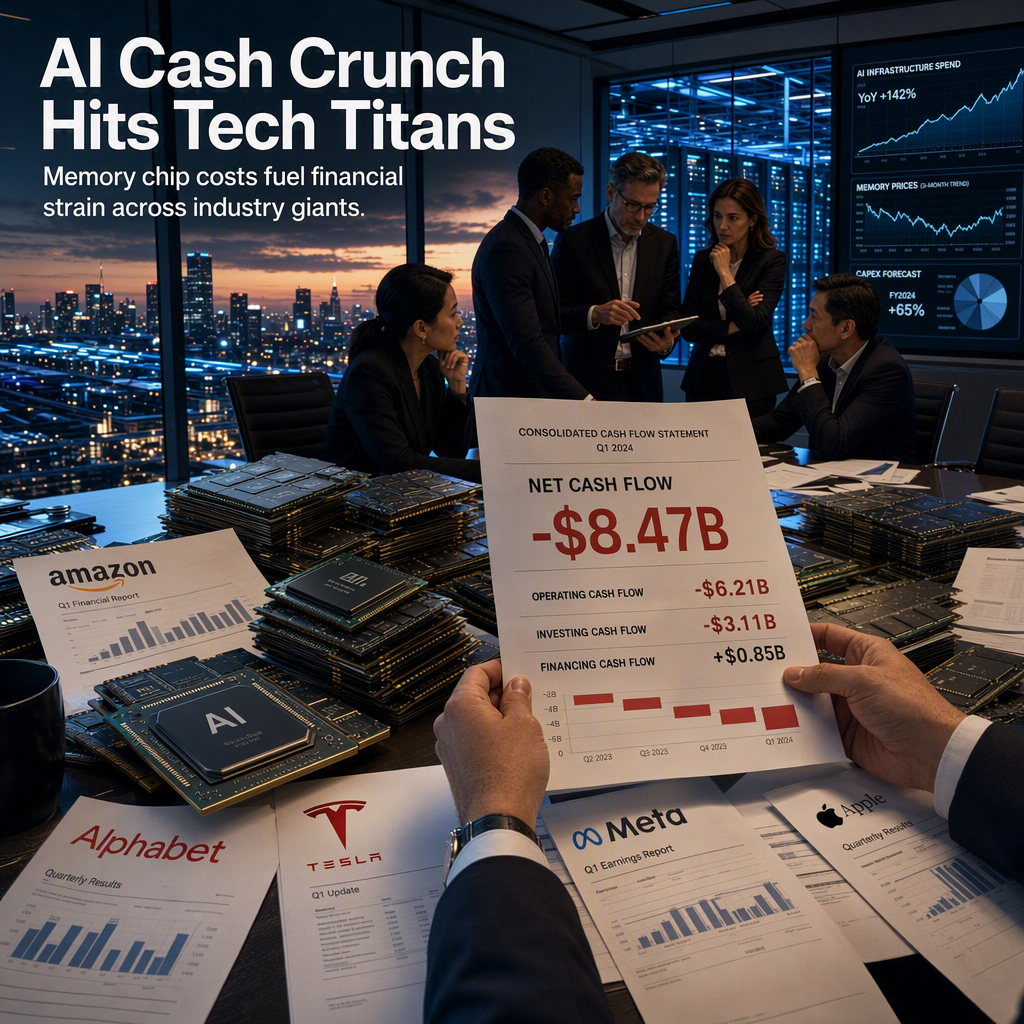
Major technology companies, including Amazon, Alphabet, Tesla, Meta, and Apple, are experiencing significant financial strain as the costs associated with artificial intelligence (AI) infrastructure continue to escalate. In the latest quarter, Amazon, Alphabet, and Tesla all reported negative cash flow, while Meta's cash generation plummeted by 91% compared to the previous year [1]. Alphabet's cash flow turned negative for the first time on record, with CFO Anat Ashkenazi stating that free cash flow will remain under pressure as the company pursues AI opportunities [1].
AI spending among the largest tech firms is projected to reach $765 billion in 2024, with forecasts from Goldman Sachs indicating a rise to nearly $1.2 trillion by 2027 [1]. Amazon raised its capital spending forecast for the year to $220 billion, the highest among the four hyperscalers, and reported negative free cash flow of $7.6 billion for the trailing 12 months [1]. The surge in costs is attributed in part to a 'memory crisis,' as demand for AI processors reliant on memory chips has outpaced supply, driving up prices. Tesla CEO Elon Musk described memory pricing as 'insane,' and Amazon CEO Andy Jassy cited 'inflated price' of memory chips as a key factor behind the company's increased capital expenditure guidance [1].
Apple, while spending less on AI infrastructure than its peers, is also affected by the memory crunch, as memory technology is integral to its consumer devices. The company has already raised prices on Macs and iPads and issued a weaker-than-expected revenue forecast for the current quarter due to supply constraints, which CEO Tim Cook does not expect to ease this year [1]. Many analysts anticipate further price hikes for iPhones later in the year [1].
Despite the financial pressures, tech leaders continue to emphasize the long-term benefits of their AI investments, particularly in new data centers and advanced chips and systems. However, the immediate market impact is clear, with distorted balance sheets and increased operational costs across the sector [1].
CONCLUSION
The rapid escalation in AI-related spending is placing unprecedented pressure on the cash flow and balance sheets of major technology companies. With memory chip shortages and rising costs expected to persist, the market is likely to see continued financial strain and potential price increases for consumer products in the near term.