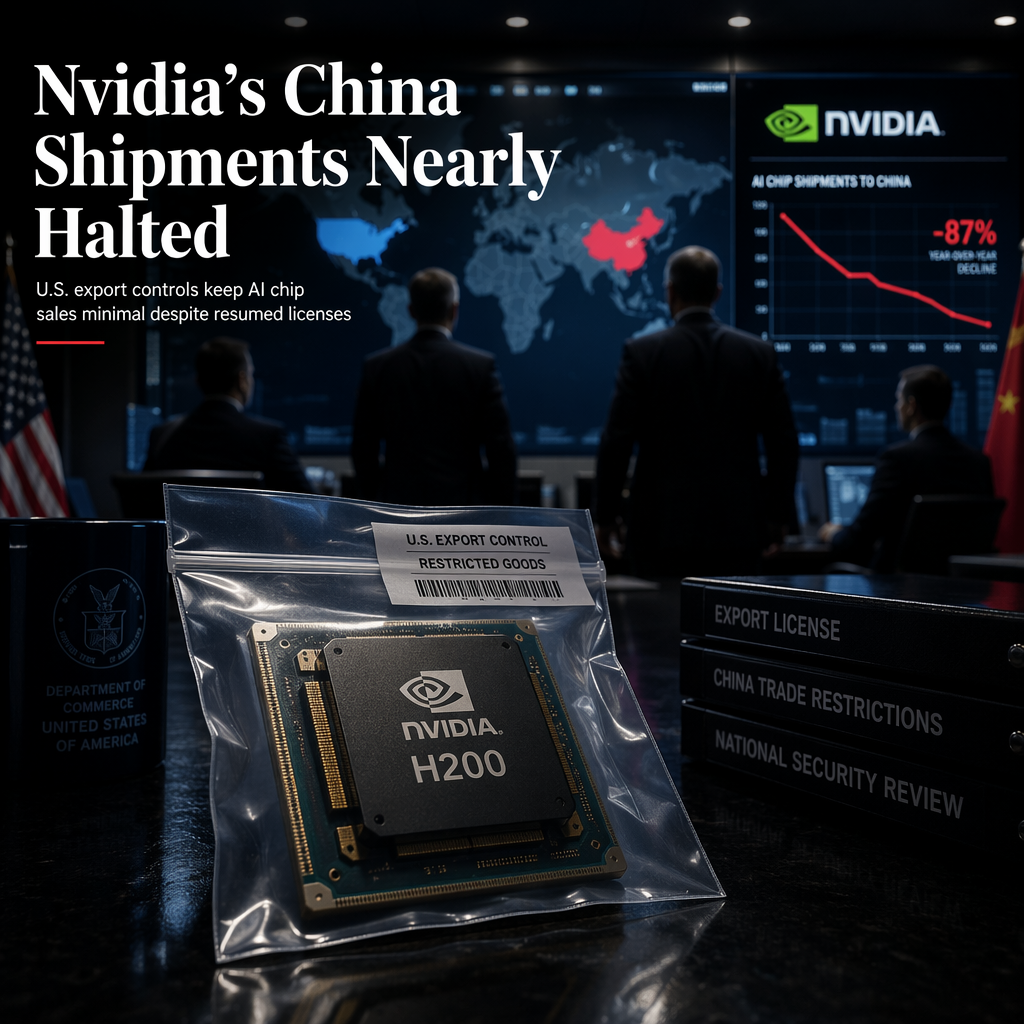
A top U.S. trade official stated that 'very few' of Nvidia's H200 AI chips have been shipped to China and Hong Kong, highlighting the limited restart of shipments to the region under strict U.S. export controls [1]. Under Secretary of Commerce for Industry and Security Jeffery Kessler described the quantity as 'a very small quantity of chips' during a congressional hearing, signaling that while some shipments have resumed, the volume remains minimal [1].
Nvidia has excluded potential Chinese AI chip revenue from its forecasts since last year, with CEO Jensen Huang previously telling investors to 'expect nothing' from Chinese sales [1]. The company has faced significant challenges in accessing the Chinese market due to ongoing trade and technology tensions between Washington and Beijing, with most Nvidia products under export restrictions [1].
In December, President Donald Trump announced that the U.S. government would approve China sales of the H200 AI chip in exchange for a 25% cut, and licenses for these chips were issued earlier this year [1]. However, Kessler emphasized that the U.S. government assesses license applications on a case-by-case basis, requiring applicants to meet national security requirements and submit to inspections, and noted that some applications are denied [1].
The H200 is an older chip in Nvidia's Hopper generation, while U.S. companies are currently using the more advanced Blackwell chips [1]. It remains uncertain whether China will ultimately approve the import of larger quantities of the H200 chips, and without access to Nvidia's technology, Chinese firms may have to rely on domestic alternatives, which are considered less effective for AI training [1].
CONCLUSION
The confirmation of minimal Nvidia H200 shipments to China underscores the ongoing impact of U.S. export controls on Nvidia's access to a major AI market. While some shipments have resumed, the volume is limited and future approvals remain uncertain, maintaining pressure on Chinese firms to seek domestic alternatives.