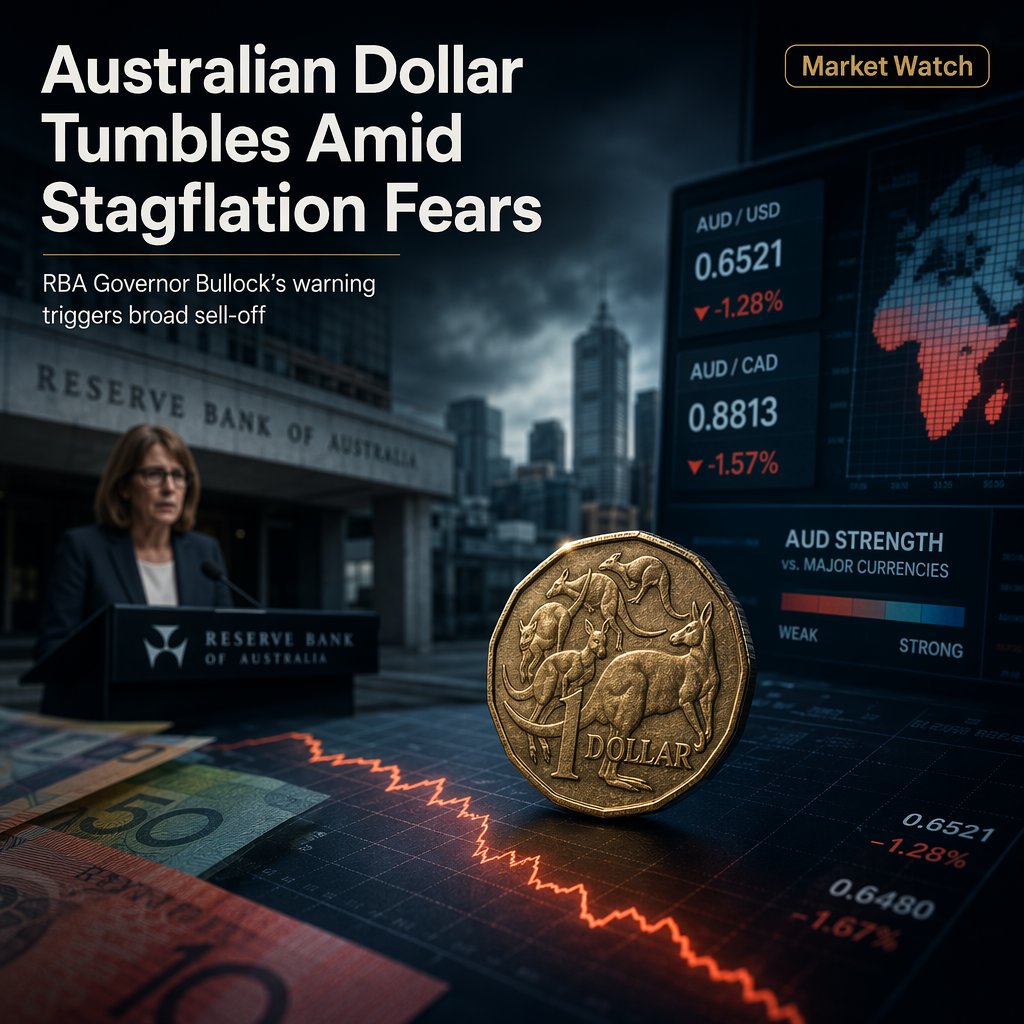
The Australian Dollar (AUD) experienced significant underperformance against its major currency peers, trading 0.35% lower at approximately 0.6965 against the US Dollar (USD) during the European trading session on Tuesday [1]. This decline followed remarks from Reserve Bank of Australia (RBA) Governor Michele Bullock, which heightened market concerns about potential stagflation in the Australian economy [1]. Bullock stated that the 'economy is slowing, housing market cooling more than anticipated,' and emphasized that the RBA board would face difficult decisions if inflation does not decrease as expected. She also kept the option of further cash rate hikes open to address inflation, but did not provide explicit guidance for the upcoming policy meeting [1].
The AUD was the weakest performer among major currencies, particularly against the Canadian Dollar, as shown in the provided heat map. The AUD fell 0.35% against the USD and 0.48% against the CAD, reflecting broad-based selling pressure [1]. The technical outlook, according to the article, suggests that upside inflation risks combined with a subdued economic outlook are prompting fears of stagflation [1].
Looking ahead, investors are awaiting the release of the Australian Q2 and June Consumer Price Index (CPI) data on Wednesday for further insight into inflation trends. The annualized Q2 and June CPI are expected to have grown steadily by 4.1% and 4%, respectively [1]. On the US side, markets are also anticipating the Federal Reserve’s monetary policy announcement, with expectations that rates will remain unchanged at 3.50%-3.75%. Fed Chair Kevin Warsh is not expected to provide forward guidance, as he indicated in the June meeting that such guidance is not suitable at this policy juncture [1].
CONCLUSION
The Australian Dollar came under heavy selling pressure after RBA Governor Bullock highlighted economic slowdown and left the door open for further rate hikes if inflation persists. With stagflation risks in focus, markets are closely watching upcoming Australian CPI data and the Federal Reserve’s policy decision for further direction. The immediate market reaction has been negative for the AUD, reflecting heightened uncertainty about Australia’s economic outlook.