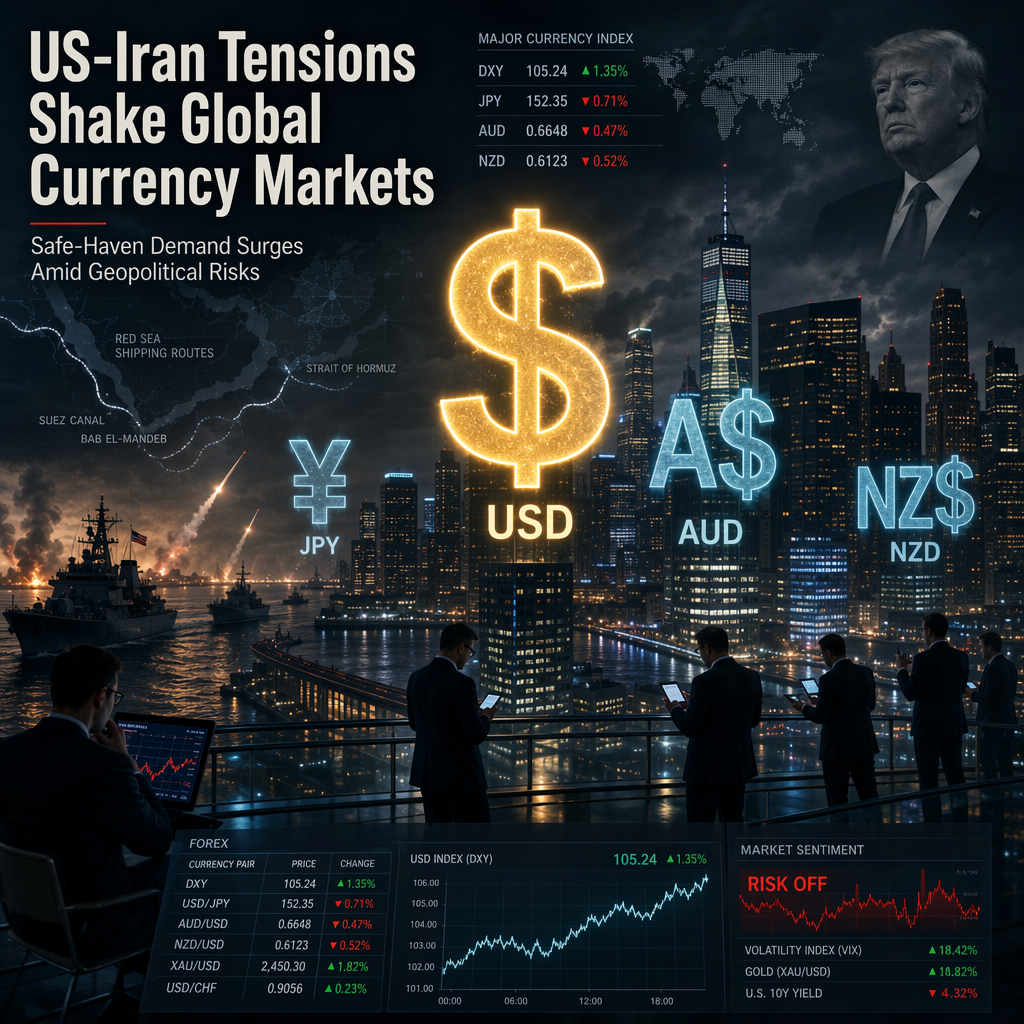
Escalating geopolitical tensions between the United States and Iran have triggered significant movements across major currency pairs, as investors seek safe-haven assets amid heightened risk aversion. The New Zealand Dollar (NZD/USD) depreciated after opening at a bullish gap, trading around 0.5830 during Asian hours on Wednesday, as the US Dollar (USD) pared its daily losses due to increased safe-haven demand. This risk aversion was fueled by mutual military strikes and threats from Iran-backed Houthi militants to disrupt Red Sea shipping routes. US President Donald Trump pledged to respond if the group interfered with the waterway, though he did not specify the actions to be taken [1]. Iran's top military command warned via Xinhua news agency that Tehran would expand its strikes to target US and allied assets if the US attacks Iranian nuclear facilities [1][2][3].
Despite the NZD's decline, New Zealand's annual inflation accelerated to 4.1% in Q2, up from 3.1% in the previous quarter, surpassing market expectations of 4.0% and the central bank's projection of 3.9%. This marks the highest inflation rate since Q4 2023 and remains above the Reserve Bank of New Zealand's (RBNZ) 1–3% target range. The hot inflation data has reinforced market expectations for another RBNZ rate hike in September, following the July 8 rate increase, the first in three years [1].
The Australian Dollar (AUD/USD) strengthened to near 0.7010 during early Asian trading hours, supported by speculation of further tightening by the Reserve Bank of Australia (RBA). Traders have raised bets on an RBA rate hike, pricing in a 23% chance in August and over 50% probability by December, as energy-driven inflation fears rise amid the US-Iran conflict. The Australian June employment report, expected to show a 15,000 job increase and an unemployment rate holding at 4.4%, is anticipated to further influence the AUD's performance [2].
The Japanese Yen (USD/JPY) entered a bullish consolidation phase above 163.00, near its highest level since 1986, as traders remain cautious about potential intervention by Japanese authorities. The wide rate differential between Japan and the US continues to drive carry trades, contributing to the Yen's underperformance. The Bank of Japan raised its short-term policy rate to 1.00% in June, the highest since 1995, while the US Federal Reserve is expected to hold its benchmark rate at 3.50%-3.75% at its July meeting, maintaining a gap of 250-275 basis points. The closure of the Strait of Hormuz, critical for Japan's crude oil imports, and ongoing US-Iran strikes have raised concerns about Japan's economy and supported USD/JPY upside. Energy-driven inflation risks have also bolstered Fed rate-hike bets, supporting the USD [3].
No relevant US economic data is due for release on Wednesday, leaving the USD influenced by FOMC member comments and further developments in the US-Iran saga, which may continue to infuse volatility in financial markets [3].
CONCLUSION
Heightened US-Iran tensions have driven safe-haven flows, strengthening the US Dollar and impacting major currencies, with the NZD and JPY under pressure and the AUD supported by rate hike speculation. Market volatility is expected to persist as geopolitical risks and central bank policy expectations continue to shape currency movements. Investors remain focused on upcoming economic data and policy signals for further direction.