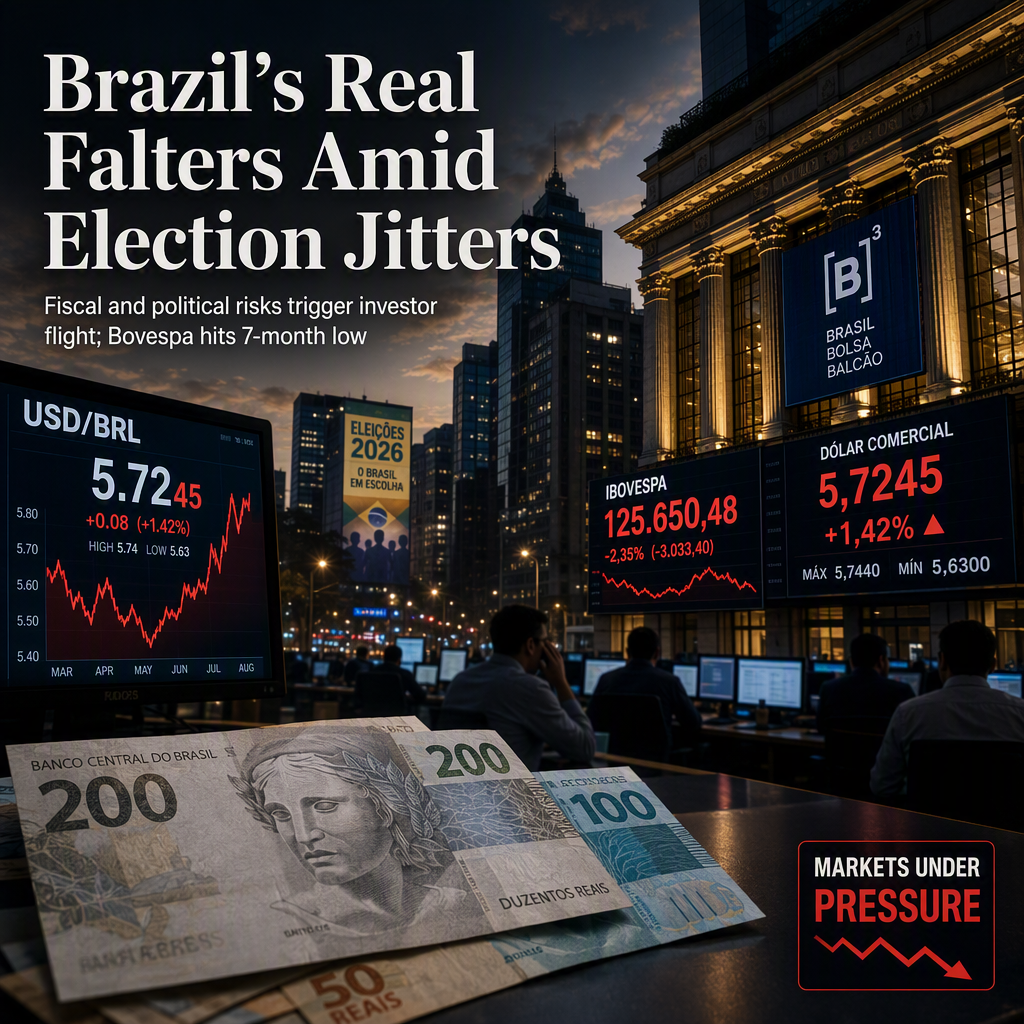
Societe Generale’s Dev Ashish highlights mounting election and fiscal risks that are negatively impacting Brazilian assets, particularly the Brazilian Real (BRL) [1]. The BRL has been the main laggard in Latin America this month, posting a negative total return of 1.7%, in stark contrast to the Chilean Peso (CLP) and Mexican Peso (MXN), which have seen profits of around 2% [1]. The USD/BRL exchange rate is nearing its 200-day moving average at 5.2042, and technical analysis suggests that a sustained move above this level could target the 5.34–5.38 range [1]. Meanwhile, the Bovespa index has broken below its long-term average, retreating to a seven-month low of 167,000 points [1].
Dev Ashish assigns a 65% probability to a base-case scenario where President Lula secures a fourth term with a divided Congress, a combination that could further weigh on the real [1]. This scenario is contributing to investor concerns, leading to a repricing of election and fiscal risks ahead of the presidential vote [1]. Some fund allocations are reportedly rotating toward the MXN, which is seen as a relatively more attractive carry and politically neutral destination [1].
The technical and fundamental pressures on the BRL and Bovespa reflect broader market apprehension about Brazil’s political landscape and fiscal outlook. The underperformance of Brazilian assets compared to regional peers underscores the heightened uncertainty and risk aversion among investors [1].
CONCLUSION
Brazilian assets, especially the Real and Bovespa, are underperforming due to elevated election and fiscal risks, with a 65% probability assigned to a Lula fourth term and divided Congress scenario. Investors are increasingly seeking safer alternatives in Latin America, notably the Mexican Peso, as Brazil’s political uncertainty weighs on market sentiment.