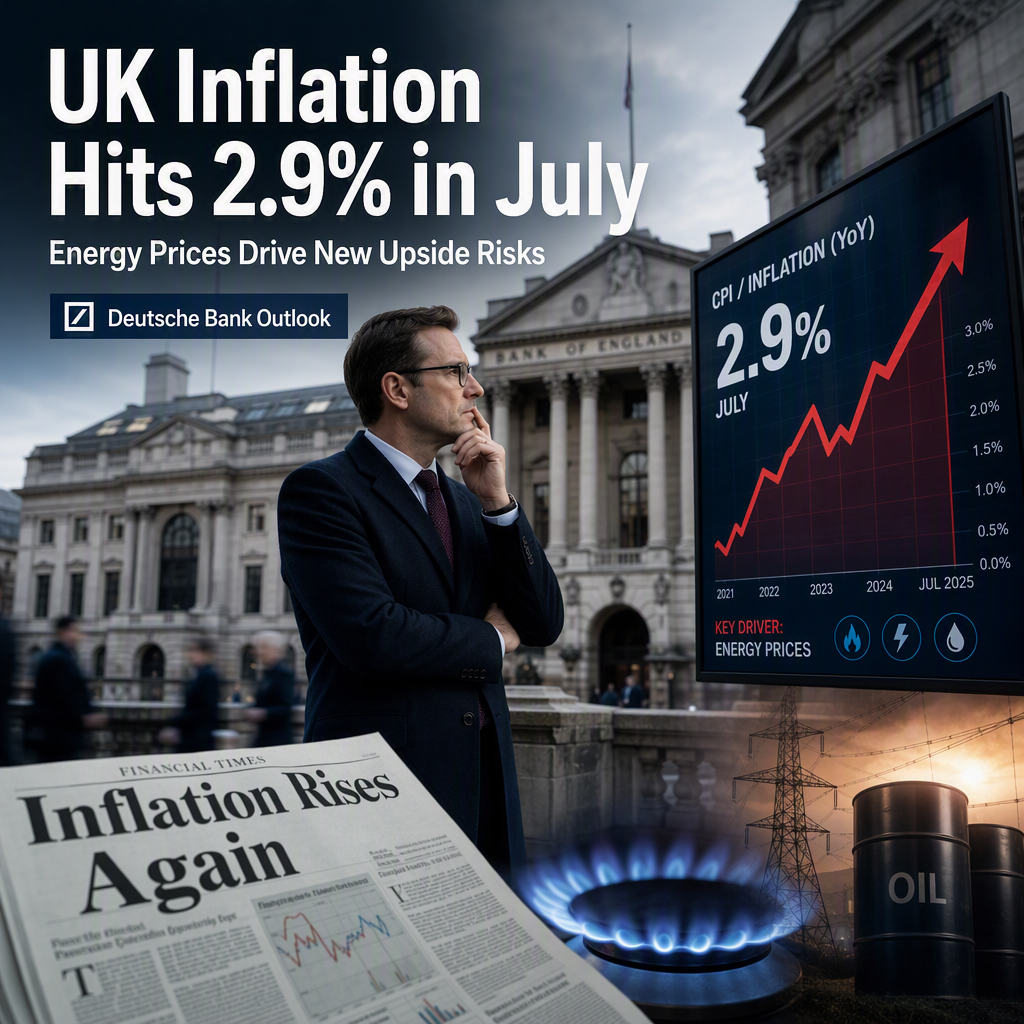
UK inflation data for July showed headline Consumer Price Index (CPI) rising to 2.9% year-over-year, up from 2.6% in June, broadly matching market expectations according to Deutsche Bank’s Chief UK Economist Sanjay Raja [1]. Core CPI remained steady at 2.6% year-over-year, while services CPI slowed to 3.4% from 3.6% in June [1]. The increase in headline inflation was primarily driven by higher energy prices following a significant rise in the Ofgem Price Cap, as well as base effects [1].
There were some positive developments, with food price inflation dropping to its lowest rate since late 2021 and services CPI falling to its lowest rate in three months [1]. Core goods pricing remained constrained due to ongoing summer discounting and promotional activity, which helped keep prices competitive [1].
Looking forward, Deutsche Bank anticipates further upside in inflation, with energy prices expected to rise further and services inflation likely to edge up. The bank forecasts CPI peaking near 3% year-over-year later this year, with risks skewed to the upside [1]. The suite of core services measures from the Bank of England all ticked up, indicating some uneasiness in price momentum, and energy inflation remains volatile due to ongoing tensions in the Middle East [1].
For the Monetary Policy Committee (MPC), the latest inflation and labour market data suggest that policymakers can remain on the sidelines for now. However, uncertainty around the inflation outlook persists, and Deutsche Bank expects the MPC to remain cautious in the near term [1].
CONCLUSION
UK inflation data for July met expectations but highlighted persistent upside risks, particularly from energy prices and services inflation. While some price pressures have eased, Deutsche Bank expects the MPC to remain cautious amid ongoing uncertainty and potential further increases in inflation.