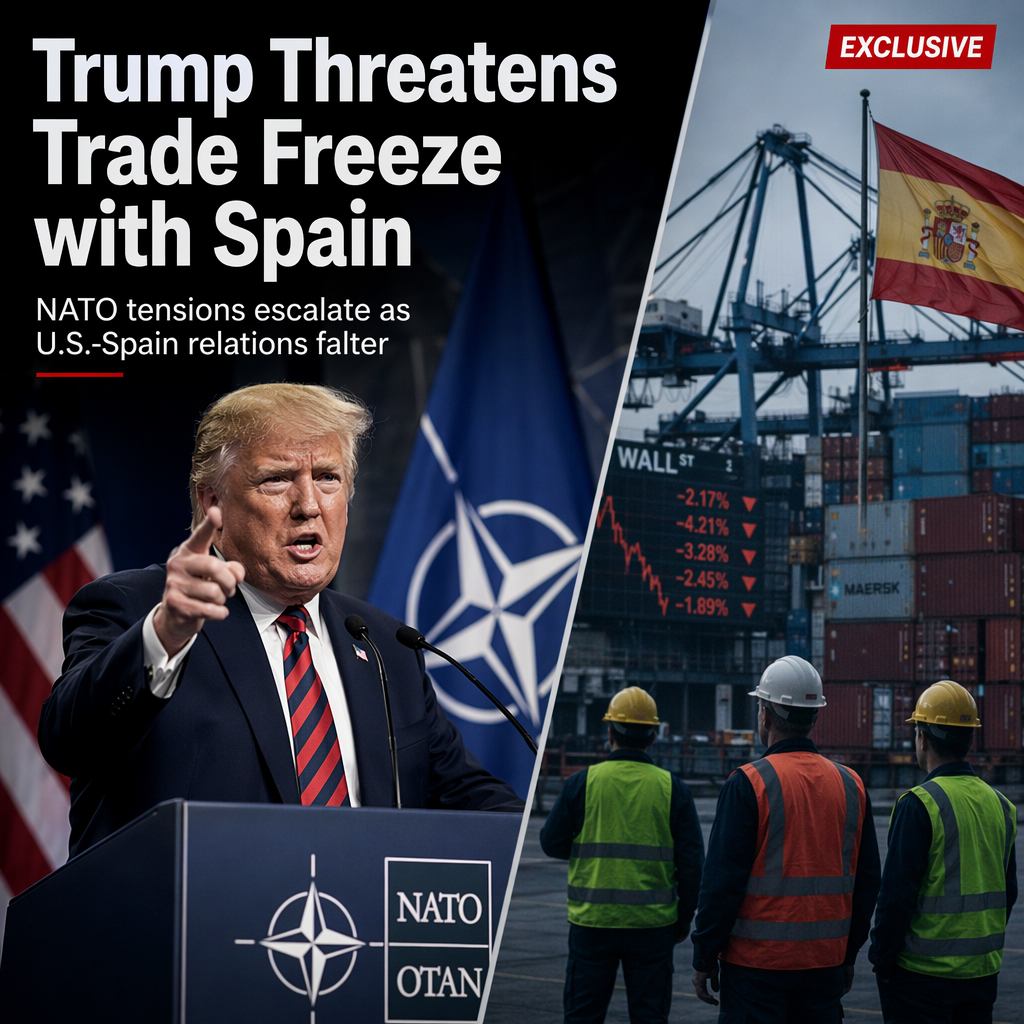
President Donald Trump threatened to end U.S. trade with Spain, a key NATO ally, after criticizing Spain for refusing to commit to the alliance's new defense spending target during the NATO summit. Trump repeatedly referred to Spain as a 'wasted cause' and called for an immediate halt to all trade and visits between the two countries, stating, 'We don't want to do any trade business with Spain anymore, by the way' and 'Cut off all trade with Spain, please, including visits' [1].
Trump's remarks followed NATO leaders' endorsement of a new defense spending benchmark, which calls on allies to invest 5% of their gross domestic product in defense and related expenditures. Spain was the only member to publicly reject the full target, opting instead to negotiate flexibility in meeting NATO capability goals. Trump argued that Spain has benefited from the alliance while failing to contribute its fair share, saying, 'They don't participate, they don't pay. I don't want anything to do with Spain' [1].
The U.S. and Spain have a significant trading relationship, with approximately $47 billion in goods traded in 2025. The United States exported about $26 billion worth of goods to Spain and imported around $21 billion from Spain, according to U.S. Census Bureau data. Key Spanish exports to the U.S. include pharmaceuticals, machinery, chemicals, food products, and vehicles, while U.S. exports to Spain consist of energy products, machinery, aerospace equipment, and chemicals [1].
While Trump's comments represent an escalation of his criticism of NATO allies that spend less on defense, it was not immediately clear whether he was announcing a formal policy or expressing frustration. The White House had not provided details on whether the administration is considering trade restrictions targeting Spain. Any significant effort to restrict trade could face legal and diplomatic challenges, as Spain is a member of the European Union, which negotiates trade policy as a customs union [1].
CONCLUSION
President Trump's threat to end trade with Spain marks a significant escalation in tensions over NATO defense spending. The lack of clarity on whether this represents a formal policy move leaves markets and diplomatic relations in a state of uncertainty, with potentially high economic and geopolitical implications.