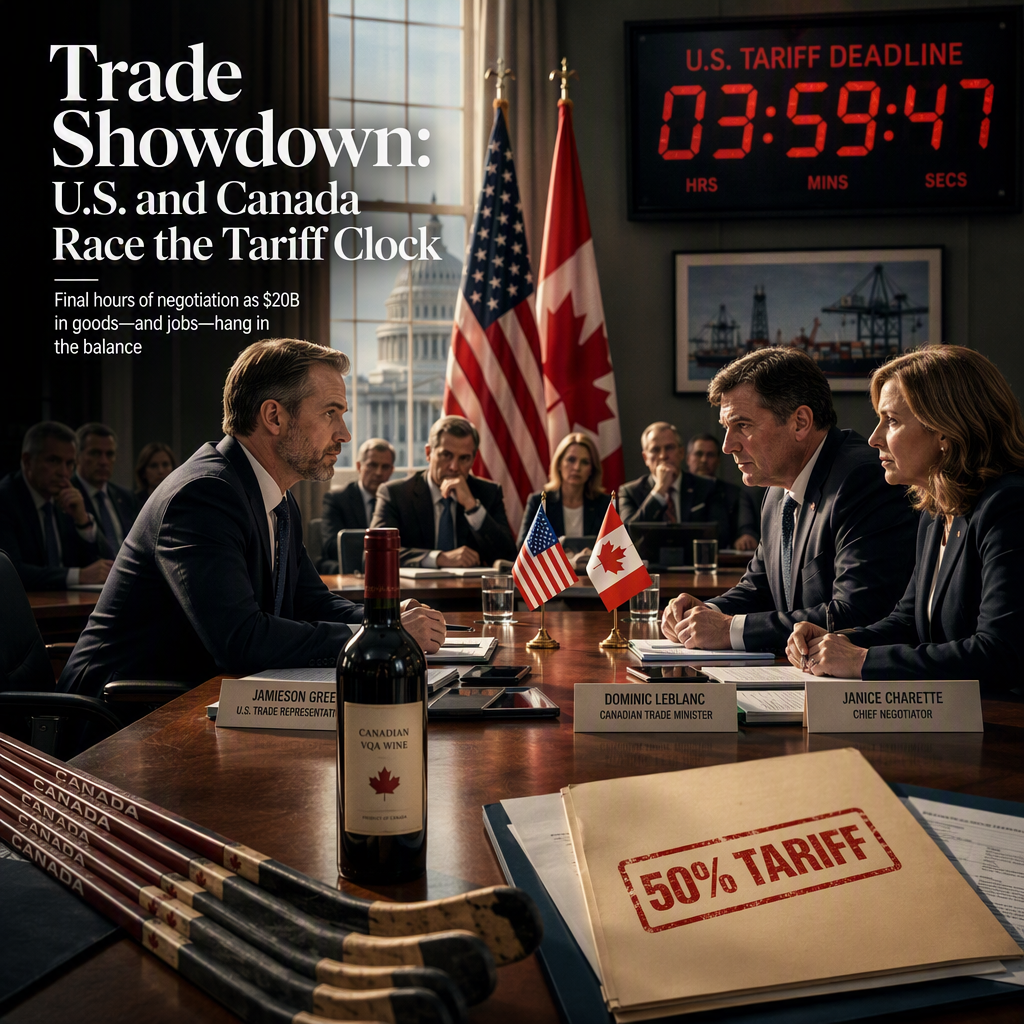
The United States and Canada are in the final stages of negotiating a trade agreement, with only hours remaining before President Donald Trump's proposed 50% tariffs on Canadian goods such as hockey sticks and wine are set to take effect [1]. Trade Minister Dominic LeBlanc and chief Canadian negotiator Janice Charette are scheduled to meet with U.S. Trade Representative Jamieson Greer at 10:30 a.m. ET in Washington to continue discussions [1].
The 50% tariffs, which would impact approximately $20 billion worth of imports, were originally scheduled to begin on Wednesday but were postponed by President Trump for three days to allow more time for negotiations [1]. Trump indicated on Truth Social that the deal was nearly complete, pending final documentation, but as of Thursday, no agreement had been finalized [1]. LeBlanc stated, "We're very close. We continue to make progress, and we're going to stay here and do the work that's necessary until we get to that point" [1].
Businesses have expressed concern that the tariffs could severely damage their sales, and the threat alone has already had negative effects [1]. Key issues in the negotiations include existing U.S. tariffs on Canadian steel, aluminum, and lumber, though Canadian officials have not commented on how these are being addressed [1]. Trump has suggested that the U.S. might lower these duties and that reduced tariffs on Canadian autos could also be considered [1]. Additionally, Trump mentioned the possibility of reviving the Keystone XL pipeline project as part of the deal [1].
The Trump administration claims that Canada has agreed to lower trade barriers for the U.S., particularly in the agricultural sector, but Canada has not confirmed these assertions [1]. Prime Minister Mark Carney stated that the agreement aims to secure the best terms for Canada's strategic sectors and provide greater certainty for Canadian workers [1].
CONCLUSION
With the deadline for new U.S. tariffs looming, both countries are under pressure to finalize a trade deal that could have significant economic implications. While negotiators report progress and optimism, key details remain unresolved, and the threat of substantial tariffs continues to weigh on businesses and markets.