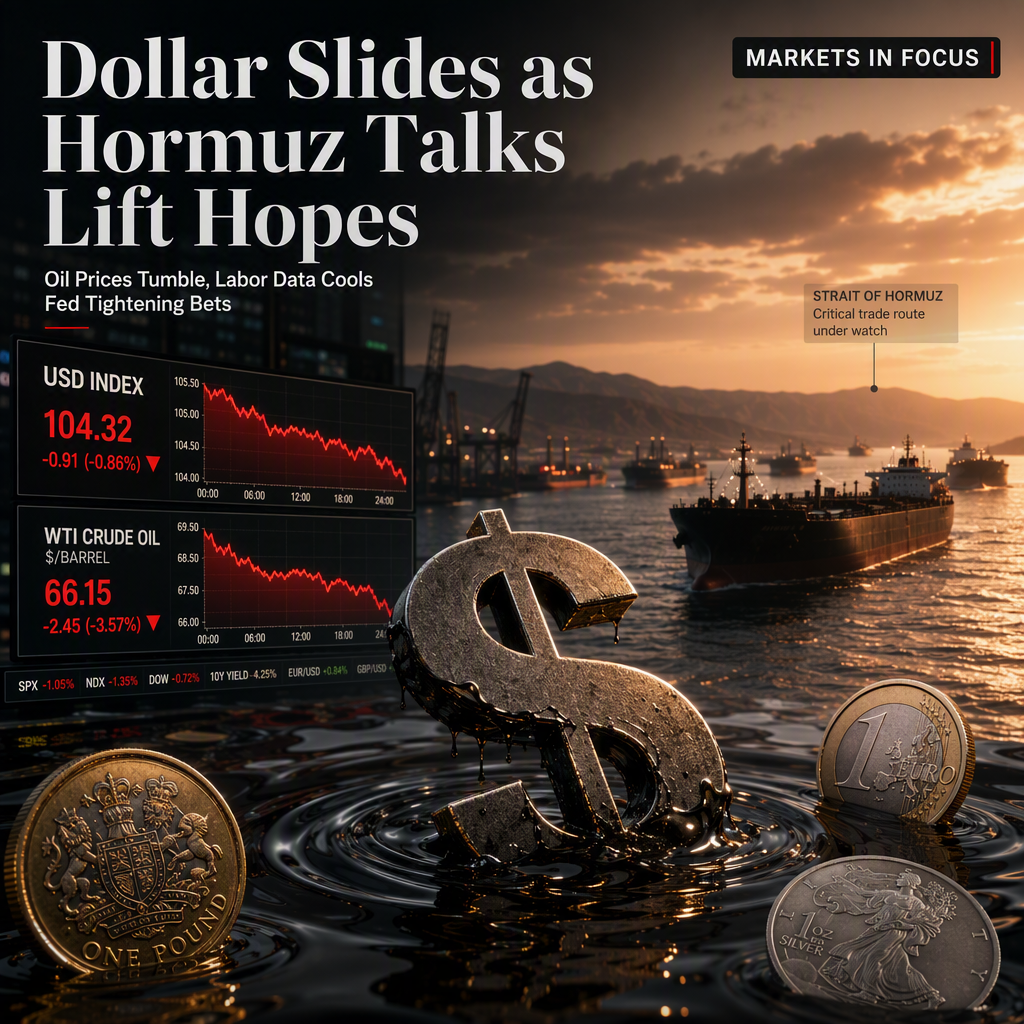
On Tuesday, the US Dollar weakened against major currencies as markets responded to two key developments: ongoing diplomatic efforts to reopen the Strait of Hormuz and softer-than-expected US labor market data. The US Job Openings and Labour Turnover Survey (JOLTS) for June showed vacancies falling to 7.359 million from 7.537 million, below the 7.4 million forecast, indicating a cooling in labor demand but still reflecting a balanced labor market with layoffs little changed [1][2][3]. The US trade deficit also narrowed in June to $-73.3 billion from $-77.6 billion, slightly above estimates [1].
Hopes for a diplomatic breakthrough between the US and Iran to reopen the Strait of Hormuz drove oil prices sharply lower, with West Texas Intermediate (WTI) crude falling 4% to $76.73 per barrel according to one source [1], and towards $75.50, its lowest in three weeks, according to another [2]. Reports from Al Arabiya and Al Hadath suggested an announcement on reopening the key shipping route could be imminent, though these have not been officially verified [2][3]. US Treasury Secretary Scott Bessent and Secretary of State Marco Rubio both confirmed ongoing talks with Iran, with Rubio noting progress but no final agreement yet [2].
The US Dollar Index (DXY) traded around 99.90–99.94, down about 0.04% on the day and approximately 2% lower from late July, making the USD the weakest G10 currency over the past week [1][2][4]. Rabobank’s Jane Foley highlighted that the recent slide in the USD has revived concerns about its safe-haven status and reserve-currency privilege, especially after last year’s volatility and recent geopolitical developments [4]. The decline in oil prices and softer labor data have led traders to trim expectations for further Federal Reserve tightening, with market pricing now reflecting about 20 basis points of additional tightening for the rest of the year, four fewer than the previous day [1].
Currency markets reflected these shifts: GBP/USD rebounded 0.14% to 1.3451, supported by improved risk appetite and reduced Fed hawkishness [1]. EUR/USD held above 1.1500, with ING analysts noting the pair is modestly overvalued and likely to edge back below 1.150 unless US jobs data surprises to the upside [2]. Silver (XAG/USD) rose 2% to near $59.50 per troy ounce, benefiting from both fading safe-haven demand and the prospect of improved industrial demand if global trade conditions improve following a Hormuz reopening [3].
Looking ahead, markets await further US labor data, including ADP Employment Change and Nonfarm Payrolls later in the week, which could further influence Fed policy expectations and currency moves [1][2][3]. ING analysts and Rabobank both suggest that unless US jobs data is particularly strong, the USD may remain under pressure in the near term [2][4].
CONCLUSION
The US Dollar has come under significant pressure due to softer labor market data and optimism over a potential reopening of the Strait of Hormuz, which has also driven oil prices lower. These developments have led to reduced expectations for further Fed tightening and have supported gains in other major currencies and commodities. Market participants are now closely watching upcoming US jobs data for further direction.