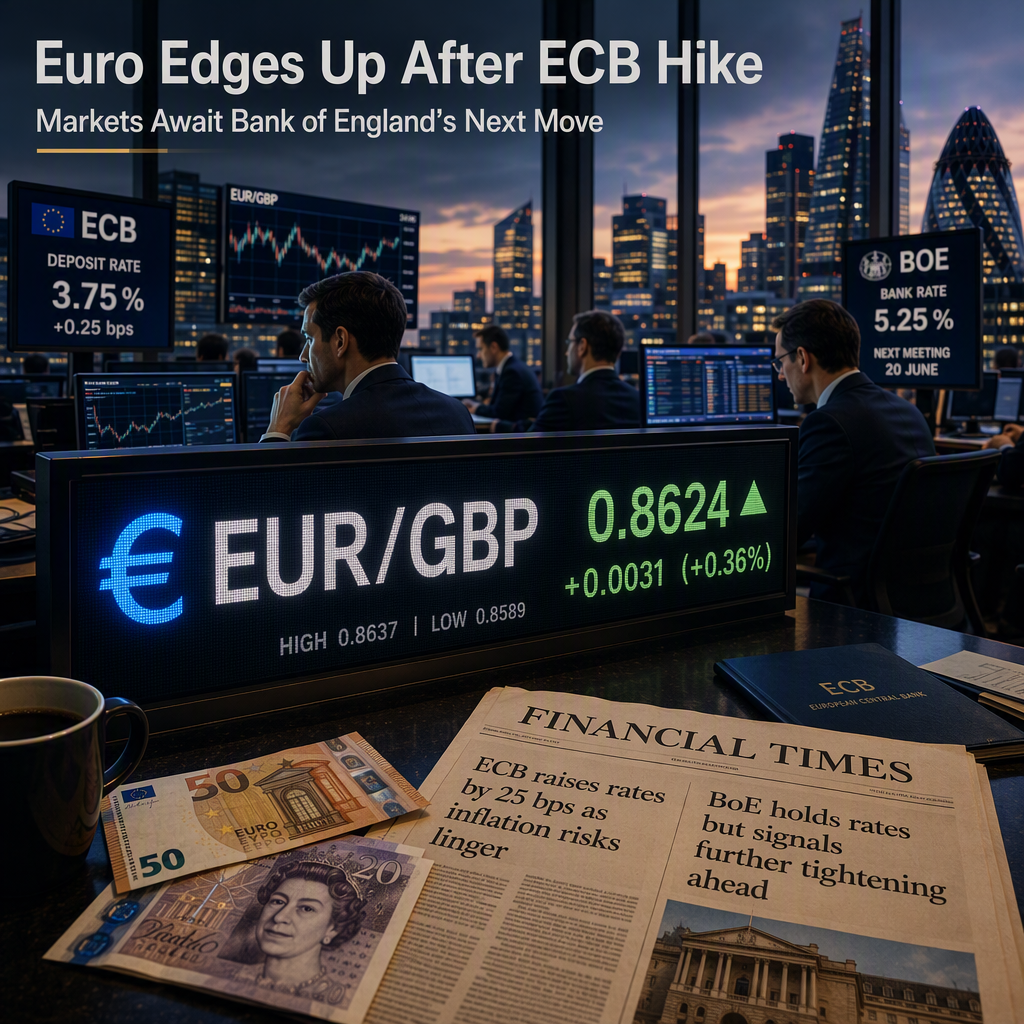
The Euro (EUR) gained modestly against the British Pound (GBP) following the European Central Bank's (ECB) widely anticipated interest rate hike on Thursday, with EUR/GBP trading around 0.8595 and remaining within a narrow range that has persisted for over a week [1]. The ECB raised its three key interest rates by 25 basis points, marking its second increase this year and bringing the deposit facility rate to 2.50% [1]. Despite the hike, the move was already priced in by markets and did not trigger a breakout in the currency pair [1].
The ECB cited ongoing inflation pressures stemming from the war in the Middle East, projecting headline inflation to average 3.0% in 2026, 2.5% in 2027, and 2.1% in 2028 [1]. ECB President Christine Lagarde stated that the Eurozone economy remains resilient, with most measures of underlying inflation broadly stable, though shorter-term inflation expectations are still elevated and higher energy costs are expected to gradually feed into core and food prices [1]. Lagarde expects headline inflation to return to the ECB’s 2% target toward the end of 2027, and clarified that the ECB did not debate the future rate path or take a view on the direction for the next meeting [1].
On the UK side, the Bank of England (BoE) is widely expected to keep its policy rate unchanged at 3.75% at its September 17 meeting, according to a Reuters survey of 65 economists, with 57 expecting no change through the end of the year [1]. However, rising oil prices are keeping inflation risks tilted to the upside, and traders are pricing in a possible rate hike in November [1]. Strategists at Scotiabank note that the short-term rates market is pricing about 17 basis points of tightening for November 5th and a cumulative 32 basis points by December 17th, indicating expectations for gradual BoE tightening into year-end [1]. Fiscal risk remains elevated ahead of the UK budget release in late October, and there is an absence of material data releases before Friday’s trade and industrial production figures [1].
The British Pound was the strongest against the Australian Dollar today, according to a table showing percentage changes against major currencies [1].
CONCLUSION
The ECB's rate hike provided limited support to the Euro, as markets had already anticipated the move. Attention now shifts to the Bank of England, with expectations for a steady policy rate but possible tightening later in the year. Inflation risks and fiscal concerns remain key factors for both currencies, keeping market sentiment cautious.