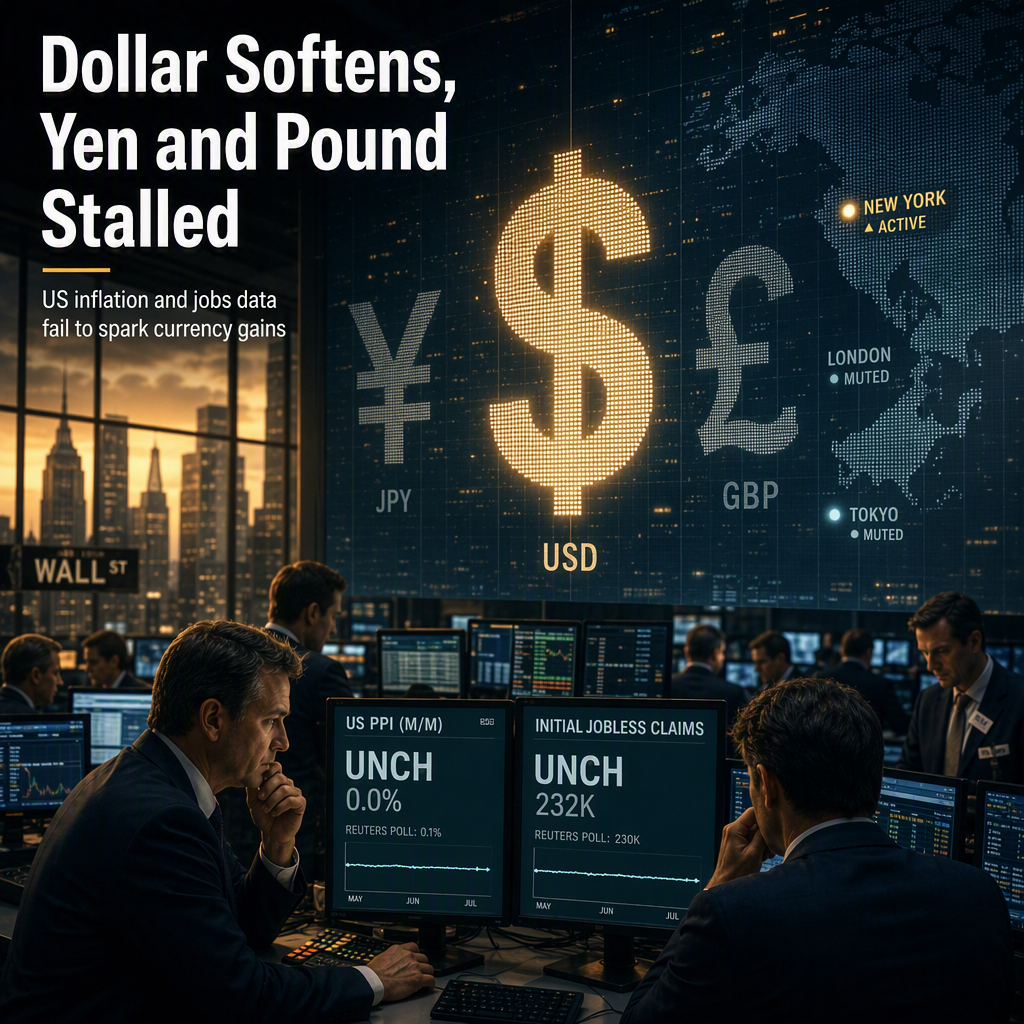
The US Dollar experienced a softer session on Thursday following the release of July Producer Price Index (PPI) data, which came in flat month-over-month against expectations of a 0.2% increase. The year-over-year rate dropped to 4.7% from 5.5%, and the core measure rose 0.2% versus the 0.3% expected. Initial jobless claims were reported at 209,000, slightly above the 202,000 expected and 200,000 previously. These readings collectively pointed to a weaker Dollar and led rate futures to price a 65.2% probability of the Federal Reserve holding rates at its September 16 meeting, with a 34.8% chance of a hike. The likelihood of maintaining the current range through December 9 stands at 34.1%, with no rate cuts priced in for any 2026 meeting, indicating a downgrade of the hike case rather than the start of an easing cycle [1][2].
Despite the Dollar's softer tone, the Japanese Yen failed to capitalize. The USD/JPY pair traded at 159.50, which is halfway between the pre-intervention peak just below 164.00 and the post-intervention low just above 155.00. Seven sessions after the largest Yen-buying operation ever—estimated at 8.45 trillion Yen solo and an additional 5.3 trillion Yen in a joint operation with the US Treasury—the market has retraced half of the intervention's impact without further official action. The Ministry of Finance will publish the final intervention tally at the end of August. Notably, Tokyo indicated future interventions would be funded via the Federal Reserve's repo facility, removing previous spending constraints. However, the Yen's inability to hold gains despite a Dollar-negative session highlights ongoing market skepticism about the sustainability of such interventions [1].
In the UK, the British Pound traded just under 1.3500 in a narrow range, despite a positive surprise in June GDP, which rose 0.3% against expectations of no growth. The second-quarter year-over-year rate was 1.2% versus 1.1% expected, while the quarterly rate matched consensus at 0.4% but slowed from 0.6%. The upside surprise was attributed to a temporary Gulf ceasefire, the start of the World Cup, and favorable weather—factors unlikely to be repeated. Industrial production and manufacturing output both disappointed, falling 0.2% and 0.5% respectively. The Pound's muted reaction suggests that the growth beat was seen as unsustainable, especially as the main driver—a Gulf truce—had already ended by July [2].
Both articles emphasize that the Dollar remains the dominant force in currency pairs, with recent US data and rate expectations shaping market moves. Despite softer US data, neither the Yen nor the Pound managed to sustain significant gains, reflecting underlying structural and event-driven weaknesses in both currencies [1][2].
CONCLUSION
US inflation and labor data provided a softer backdrop for the Dollar, but neither the Japanese Yen nor the British Pound were able to capitalize meaningfully. The Yen has already surrendered half of its intervention-driven gains, and the Pound's growth surprise was rooted in one-off factors. Market sentiment remains cautious, with the Dollar still steering major currency pairs.