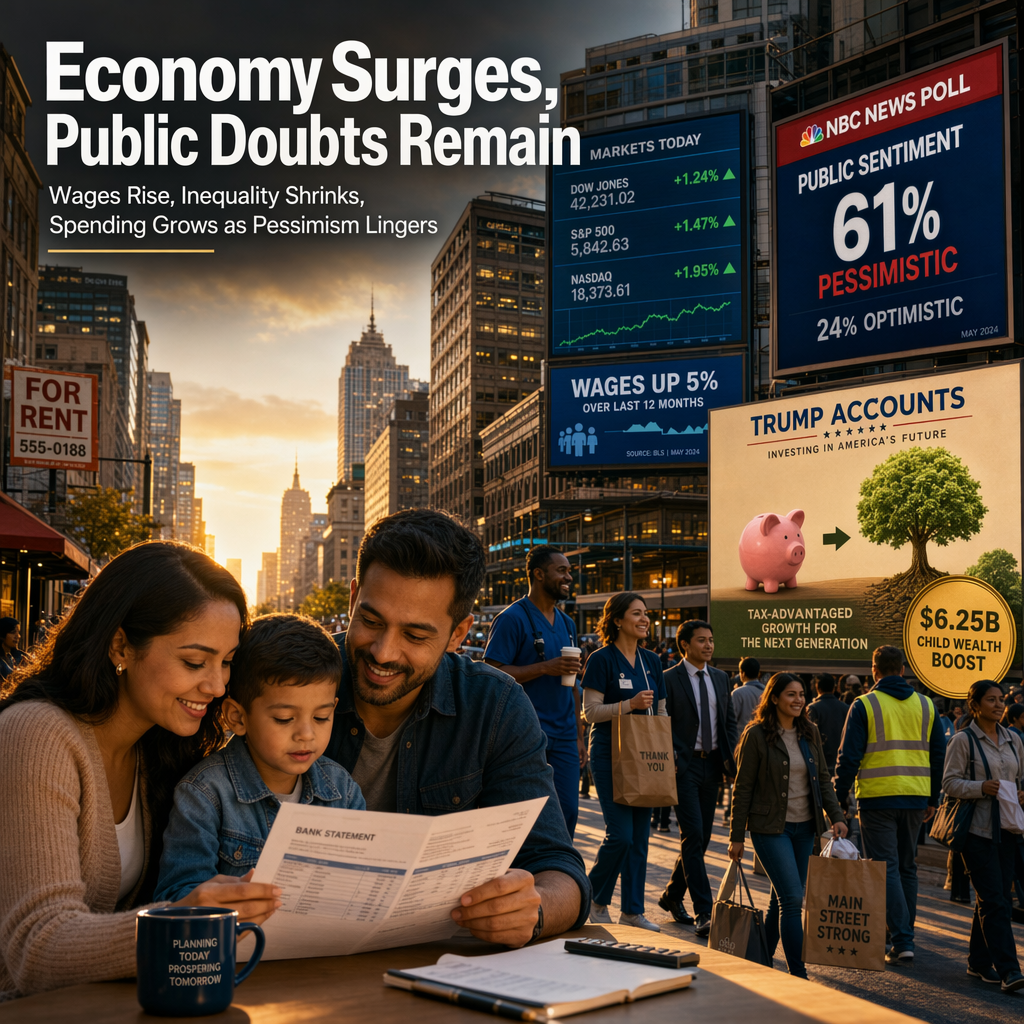
The article highlights several positive economic indicators under President Donald Trump's current term. Unemployment remains low, real wages are rising, the stock market is high, and investment is booming. Inflation, while still above the Federal Reserve’s target, recently decreased to 3.5%, or 2.6% when excluding food and energy, which is notably lower than the 4.95% average recorded under President Joe Biden [1]. The conservative Committee to Unleash Prosperity reports that real incomes for the lowest 25% of earners increased by almost $2,100 during the first 16 months of Trump’s term, whereas these incomes shrank under Biden [1].
Consumer spending is also robust, with the Bank of America Institute noting that total credit and debit card spending rose 6.3% year-over-year in June, marking the strongest growth in over four years. The Institute further observes that wage and spending growth gaps across income groups have narrowed, indicating a reduction in income inequality [1]. Despite these positive trends, public sentiment remains largely negative. A CNBC survey found that 61% of the public is pessimistic about the current state and future outlook of the economy, and a Washington Post-Ipsos poll places the president’s approval rating on the economy at just 33% [1].
The article attributes this disconnect between economic data and public perception to persistent negative media coverage and a lack of effective communication from Republican leaders about the benefits of lower taxes and lighter regulations, which are central to Trump’s agenda [1]. Additionally, the article highlights the Trump accounts program, which has seen over 6 million children sign up for deferred investment accounts, with 1.4 million qualifying for a $1,000 Treasury contribution. Michael Dell and his wife Susan donated $6.25 billion to the program, emphasizing its potential to transform financial outcomes and mindsets for American children [1].
While challenges such as high living costs and expensive housing persist, the overall economic picture presented is one of strength and improvement, particularly for lower-income Americans [1].
CONCLUSION
Despite strong economic indicators such as rising wages, shrinking inequality, and robust consumer spending, public sentiment remains pessimistic, likely due to negative media coverage and communication gaps. The Trump accounts program and significant philanthropic contributions aim to further boost long-term financial outcomes for American children. Overall, the article suggests the economy is in good shape, though challenges remain.