
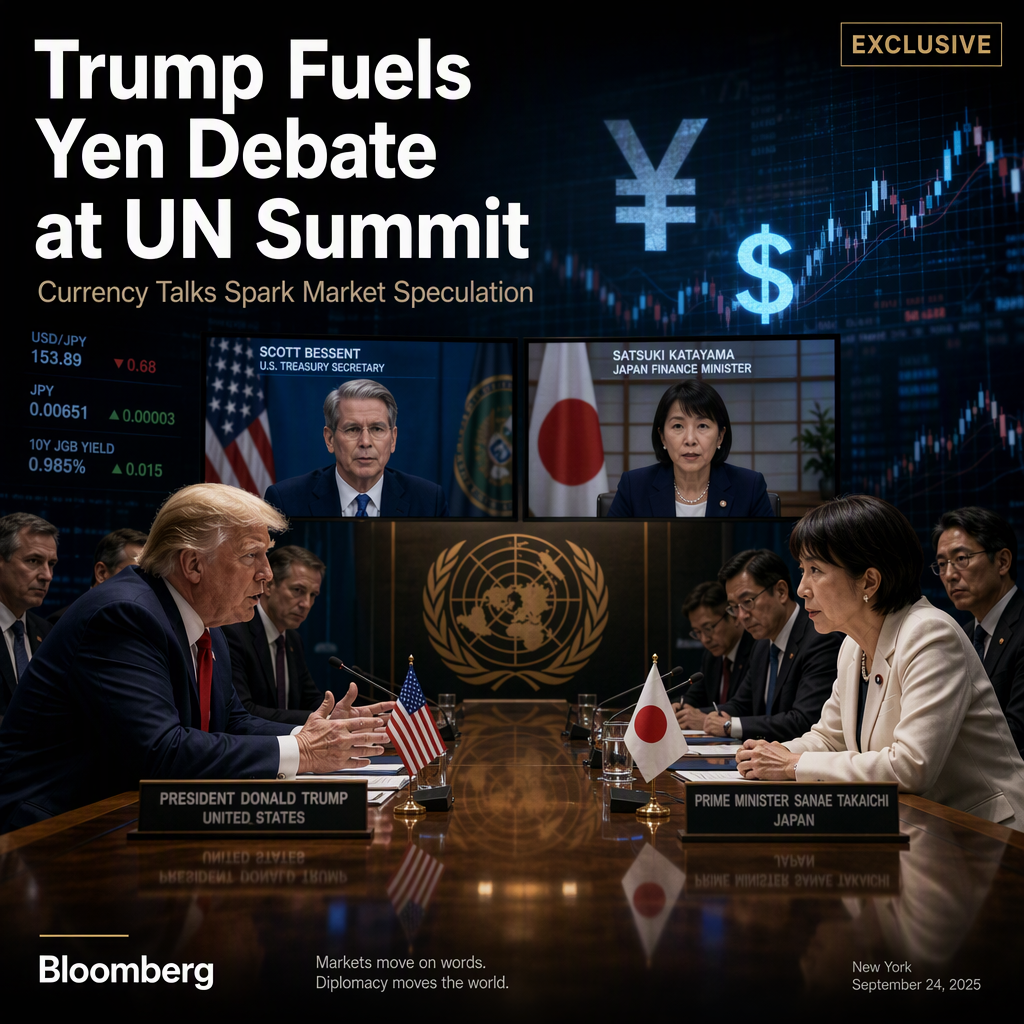
U.S. President Donald Trump expressed concerns about the weak yen to Japanese Prime Minister Sanae Takaichi during their summit at the United Nations headquarters, elevating currency issues to the highest diplomatic level and fueling speculation about potential U.S. pressure on Japan's economic and fiscal policies [1][2]. This public disclosure of leaders discussing foreign exchange matters is rare and has heightened market sensitivity to possible policy shifts or interventions [1].
Following the summit, Japanese Finance Minister Satsuki Katayama and U.S. Treasury Secretary Scott Bessent held a virtual meeting to address the yen's recent movements and broader market trends, directly responding to Trump's concerns [2]. Bessent stated that the currency should reflect Japan's 'strong fundamentals,' while both officials reaffirmed the importance of close communication and agreed to continue monitoring market trends and cooperate as needed to ensure stability [2]. No specific interventions or policy changes were announced, but the dialogue has intensified speculation about potential government or central bank action to support the yen [2].
The yen has been under pressure in recent months due to interest rate differentials between Japan and the U.S. and ongoing monetary policy divergence [1]. After recent Bank of Japan rate checks, the yen was trading in the upper-156 range against the dollar [2]. Traders and market participants are closely watching for further signals from authorities, with technical indicators and support/resistance levels for the yen under scrutiny [1][2].
While the articles focus on the U.S.-Japan currency discussions, a separate analysis of the recent U.S.-China summit notes that financial markets have reacted with caution to the lack of substantive progress, with the Shanghai Composite Index closing marginally higher and the renminbi holding steady against the dollar [3]. However, this is a distinct event from the U.S.-Japan yen discussions and does not directly impact the yen market [3].
CONCLUSION
President Trump's public concerns over the weak yen have brought currency issues to the forefront of U.S.-Japan relations, prompting immediate follow-up discussions between finance chiefs. While no concrete policy actions have been announced, the heightened scrutiny and ongoing dialogue are keeping currency markets on alert for potential intervention or shifts in policy. Market participants remain cautious, closely monitoring official statements and technical signals for any indication of future moves.