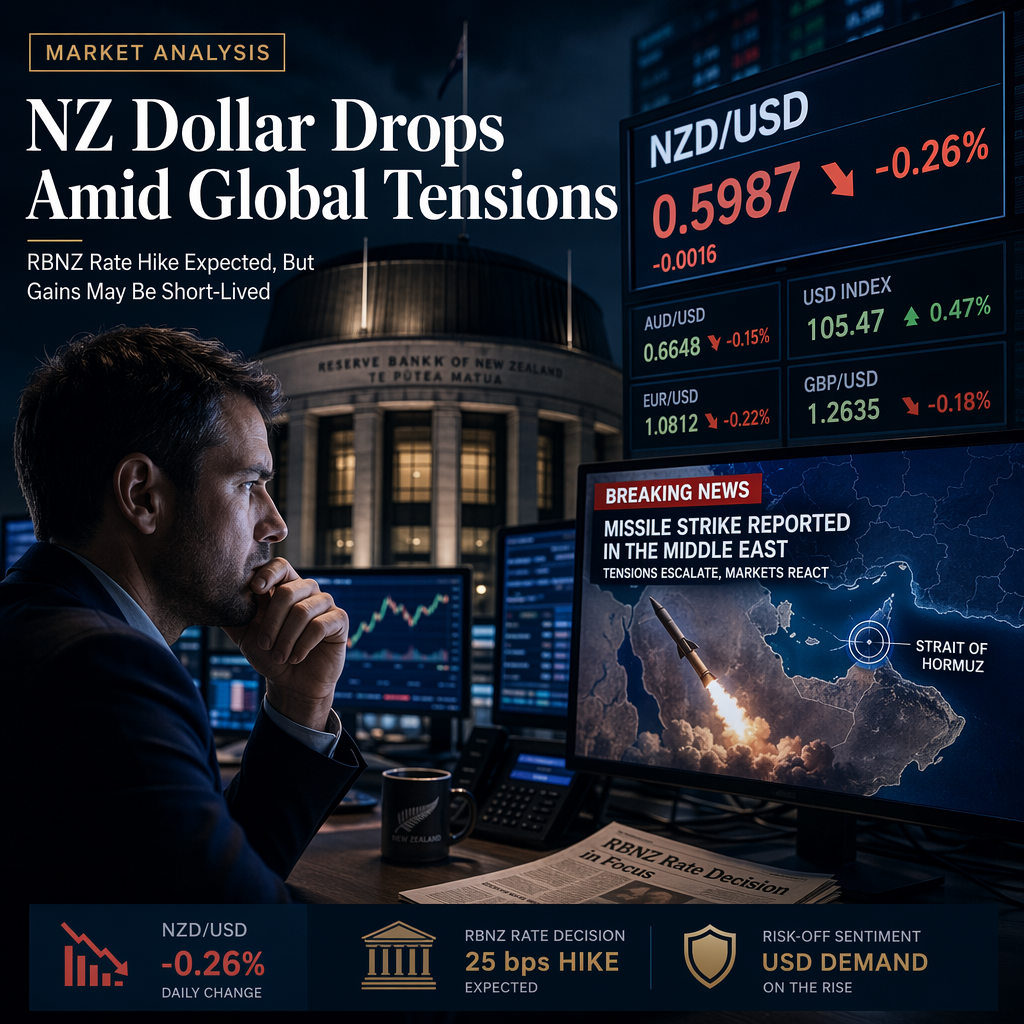
The New Zealand Dollar (NZD) weakened against the US Dollar (USD) on Tuesday, with NZD/USD trading around 0.5685, down 0.26% on the day [1]. This decline was attributed to renewed demand for the US Dollar amid escalating geopolitical tensions in the Middle East. According to Bloomberg, citing a US official, Iran fired at least two missiles at commercial vessels in the Strait of Hormuz late Monday, resulting in significant damage to two ships but no reported casualties. The UK Maritime Trade Operations also confirmed that a tanker was struck by an unidentified projectile. These developments have fueled safe-haven flows, strengthening the US Dollar [1].
Market participants are also closely watching the upcoming Reserve Bank of New Zealand (RBNZ) monetary policy decision, scheduled for Wednesday. ING expects the RBNZ to deliver a 25-basis-point rate hike, raising the Official Cash Rate to 2.5%, describing it as an 'insurance' hike. However, ING suggests this could be a one-off move, potentially limiting any positive impact on the NZD [1]. Commerzbank shares this cautious outlook, noting that while a rate hike could initially support the Kiwi, markets have already priced in around 3.5 rate hikes over the next 12 months—a scenario the bank considers overly optimistic. Rabobank also warns that tightening expectations are too aggressive and that a repricing could weigh on the NZD in the coming months. BBH similarly expects a 25-basis-point hike but believes any NZD strength will be short-lived as attention shifts to the RBNZ's forward guidance [1].
In terms of broader market context, expectations for Federal Reserve policy have shifted following a slowdown in the US labor market, with investors now anticipating the Fed will keep rates unchanged at its July and September meetings. Additionally, lower oil prices—driven by increased output from OPEC+ and a US-Iran peace agreement—are helping to ease inflationary pressures [1].
On the day, the New Zealand Dollar was the strongest against the Australian Dollar, according to a table of percentage changes against major currencies [1].
CONCLUSION
The New Zealand Dollar is under pressure due to heightened Middle East tensions and a stronger US Dollar, despite expectations for a rate hike from the RBNZ. Analysts caution that any NZD gains from the anticipated hike may be limited or short-lived, given already aggressive market pricing and the focus on future central bank guidance.