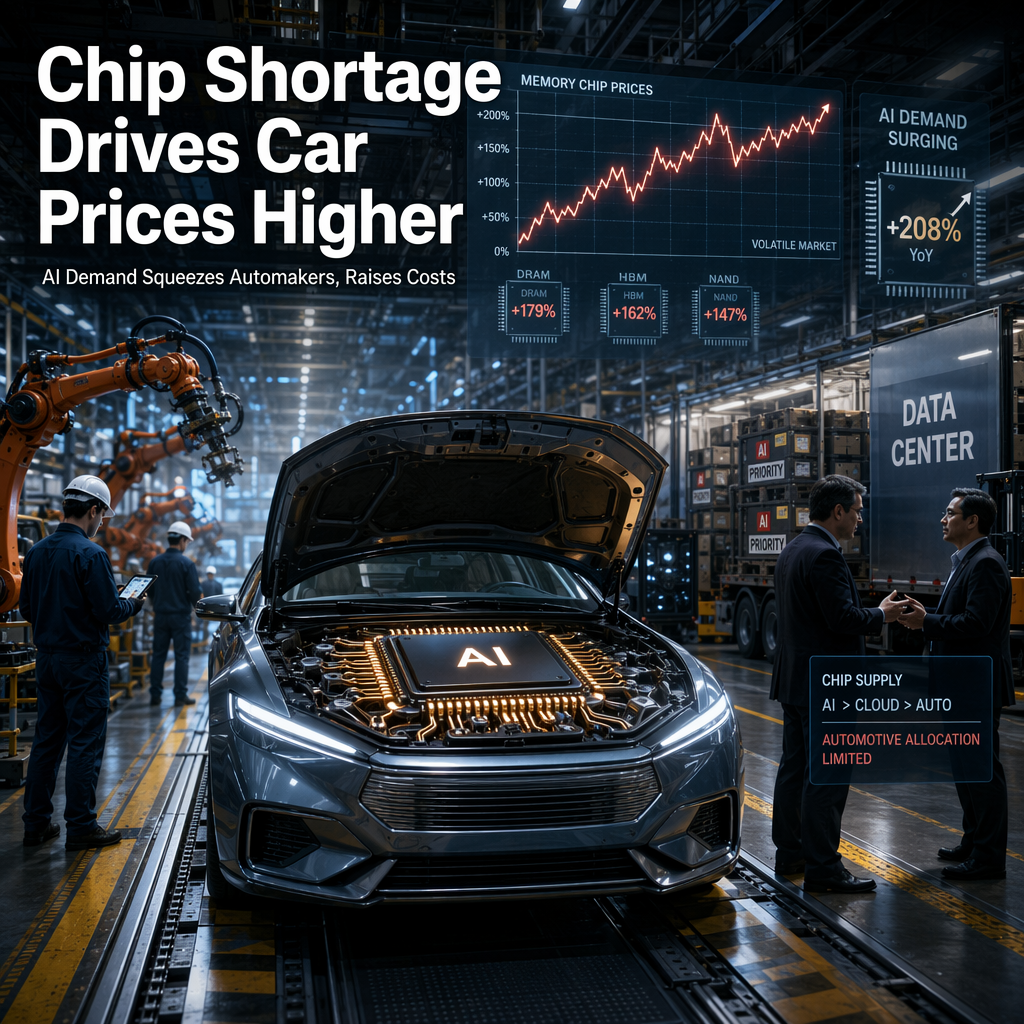
Automakers worldwide are facing sharply increased costs due to soaring memory chip prices, a trend driven by surging investments in artificial intelligence applications [1]. US and Japanese car manufacturers are now scrambling to secure memory chip supplies as chipmakers prioritize AI data center demand over automotive needs [1]. General Motors and Ford, among others, have recently signed agreements with US memory maker Micron Technology to ensure continued supply [1].
The automotive sector, which relies heavily on memory chips for advanced onboard systems, is experiencing significant cost pressures as memory prices have soared in recent months [1]. Industry sources highlight that securing supply agreements with major memory manufacturers has become essential for carmakers aiming to avoid production disruptions and protect profit margins [1].
The competition for memory chips is expected to intensify further, as AI-related demand continues to outpace the expansion of manufacturing capacity [1]. As a result, automakers are considering passing these increased costs onto consumers through higher vehicle prices [1]. The broader phenomenon of AI-driven 'chipflation' is impacting both the electronics and automotive sectors, prompting companies to reevaluate their supply chain strategies and pricing models [1].
CONCLUSION
The surge in memory chip prices, fueled by AI demand, is creating significant cost challenges for automakers and may lead to higher vehicle prices. Companies like General Motors and Ford are taking proactive steps to secure supply, but the ongoing competition for chips signals continued market volatility and potential margin pressures for the automotive industry.