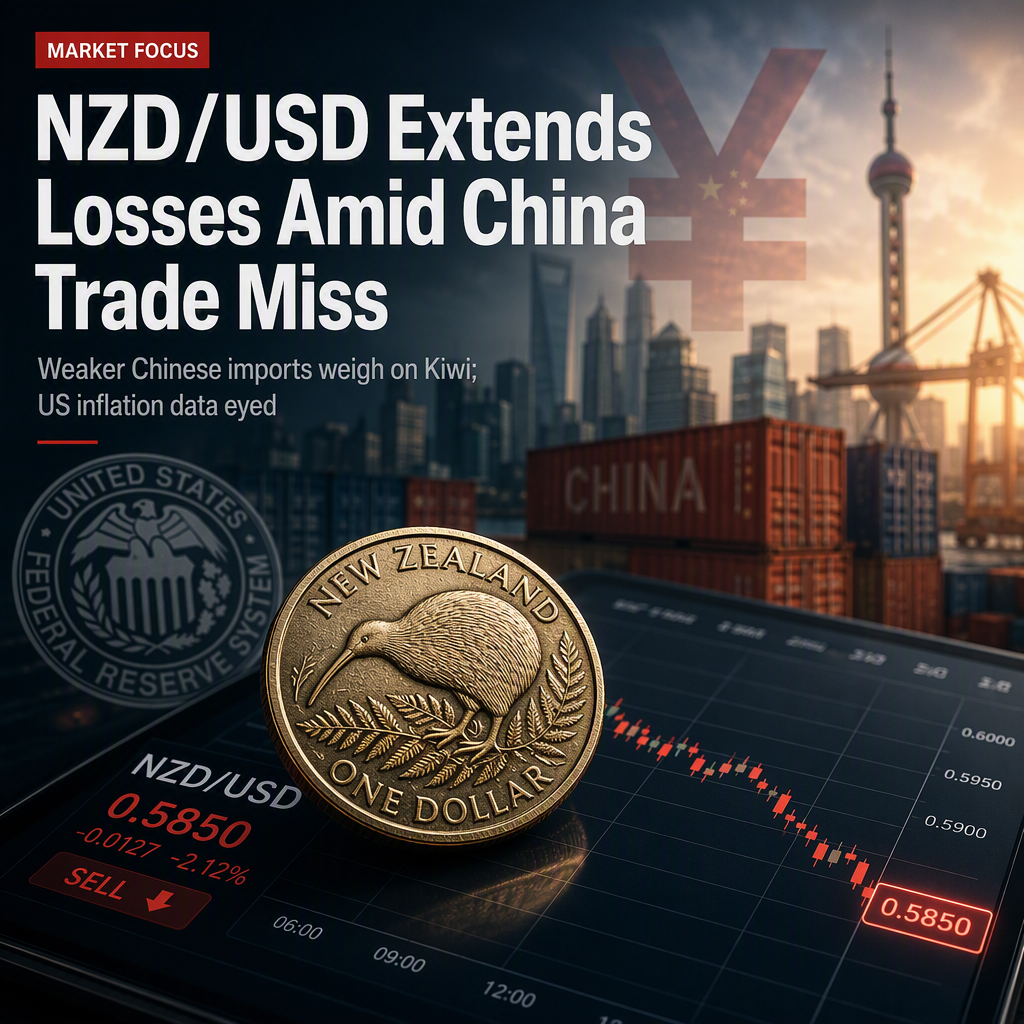
The New Zealand Dollar (NZD) continued its decline against the US Dollar (USD) for the third consecutive day, with NZD/USD trading around 0.5850 during Asian hours on Tuesday. This weakness in the Kiwi was attributed to the latest trade data from China, New Zealand’s major trading partner, which showed mixed results for August. China's trade balance reached $119.09 billion, an improvement from July's $112.5 billion and in line with forecasts. Exports grew by 25% year-over-year, accelerating from July's 23.9% increase. However, imports rose by 28.2% year-over-year, a slight improvement from July's 27.5% but below the market's expectation of a 30% increase, highlighting some softness in demand [1].
Despite the NZD's softness, further downside for NZD/USD may be limited by ongoing weakness in the US Dollar. The Greenback could strengthen, however, as traders are pricing in a greater than 60% probability of a Federal Reserve rate hike in September, following a stronger-than-expected August US labor report. Specifically, US Nonfarm Payrolls expanded by 162,000 and the Unemployment Rate remained steady. Investors are now focused on the upcoming US Producer Price Index and Consumer Price Index reports later in the week to assess the Fed's next policy move [1].
From a technical perspective, NZD/USD remains bearish in the near term, trading below both the 50- and nine-day Exponential Moving Averages (EMAs). The 14-day Relative Strength Index (RSI) has retreated toward the low-40s, indicating fading bullish momentum. Immediate resistance is seen at the 50-day EMA around 0.5867 and the 9-day EMA near 0.5887, with a daily close above these levels needed to ease the downside bias. On the downside, the lack of nearby structural price levels leaves the pair vulnerable to further declines, especially if buyers fail to reclaim the overhead EMA cluster [1].
CONCLUSION
The NZD/USD pair remains under pressure following China's trade data, particularly due to weaker-than-expected import growth. While ongoing US Dollar weakness may cushion further declines, the technical outlook suggests the pair is vulnerable unless key resistance levels are reclaimed. Market participants are closely watching upcoming US inflation data for further direction.