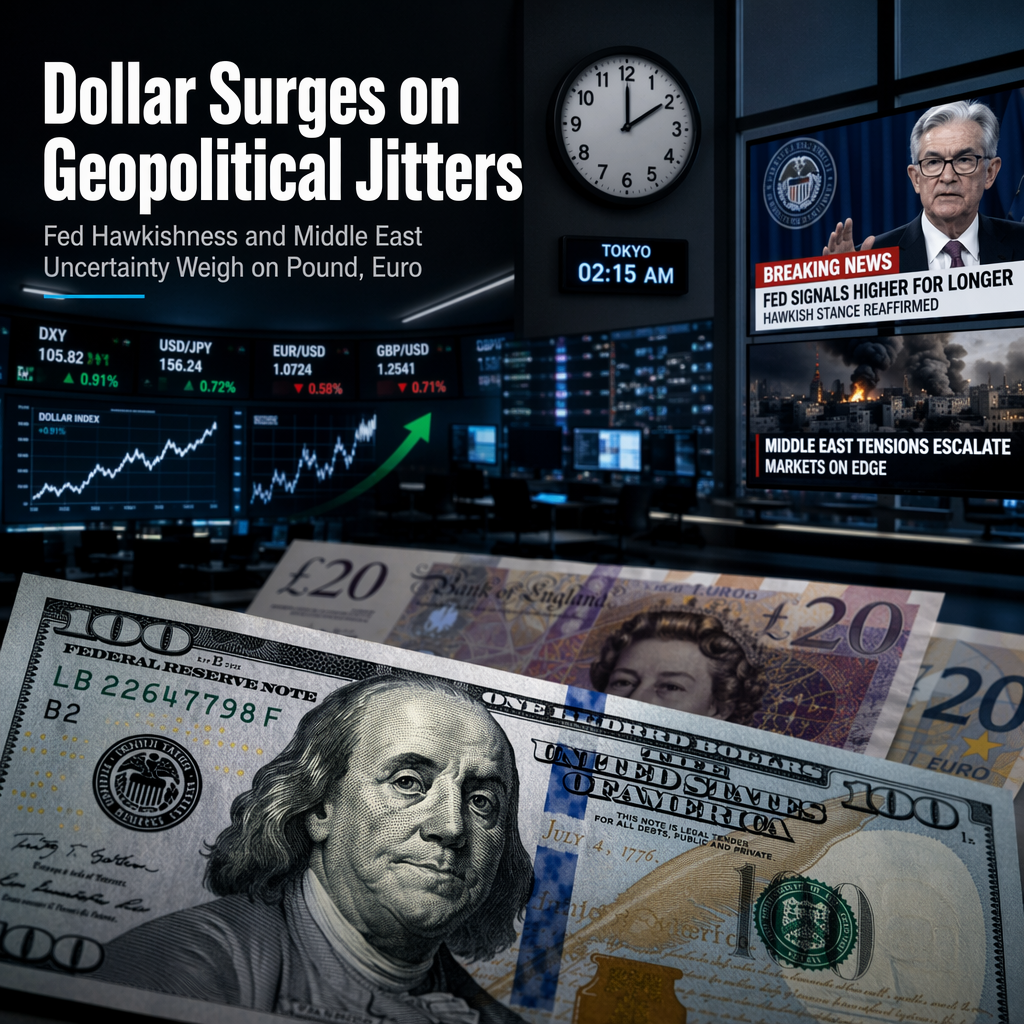
The US Dollar (USD) gained momentum against both the British Pound (GBP) and the Euro (EUR) during early Asian trading hours on Wednesday, driven by robust US economic data and heightened geopolitical uncertainty surrounding the US-Iran peace deal [1][2]. GBP/USD extended its gains for the second consecutive day, trading around 1.3200, while EUR/USD weakened below 1.1400, trading near 1.1380 [1][2].
US President Donald Trump stated that Iran had 'fully and completely' agreed to open its facilities to nuclear inspections, but Iranian Foreign Minister Abbas Araghchi clarified that substantive negotiations on the nuclear issue have not actually begun [1][2]. Iran’s chief negotiator warned that the strategic Strait of Hormuz will 'never return to its pre-war status' and will remain under Iranian oversight, adding to market caution [1][2]. Meanwhile, a new round of talks between Israel and Lebanon began in Washington, DC, aiming to halt the conflict involving Iran-backed Hezbollah [1][2].
The Greenback's strength was further supported by strong US macroeconomic indicators. June’s flash estimate for the US S&P Global Composite PMI rose to 52.2 from May’s 51.5, signaling healthy business expansion. Manufacturing output increased to 55.7 from 55.1, beating forecasts of 54.8, while Services PMI printed at 51.3, up from May's 50.7 and above the consensus estimate of 51.0 [1]. Additionally, an unexpectedly hawkish Federal Reserve meeting chaired by Kevin Warsh last week boosted expectations for a year-end interest rate hike. Traders are now pricing in a 37.4% chance of at least a 25 basis point hike at the July meeting, up from 8.5% a week ago, according to the CME FedWatch tool [2].
Political developments in the UK provided some stability for the Pound. Investors reacted positively to signs that a prolonged Labour leadership contest would likely be avoided following Keir Starmer's resignation, with Andy Burnham emerging as the frontrunner and key backing from Wes Streeting, reducing the risk of a drawn-out battle for control [1].
Both articles highlight that ongoing geopolitical tensions and the lack of progress in the US-Iran peace agreement could weigh on riskier assets such as the Euro and Pound against the US Dollar in the near term [2].
CONCLUSION
The US Dollar has strengthened significantly against both the Pound and Euro, supported by strong US economic data and increased expectations for a Fed rate hike. Geopolitical uncertainty, particularly regarding the US-Iran peace deal and tensions in the Middle East, continues to drive market caution and favor the Greenback. Political stability in the UK has provided some support for the Pound, but overall, risk assets remain pressured by global developments.