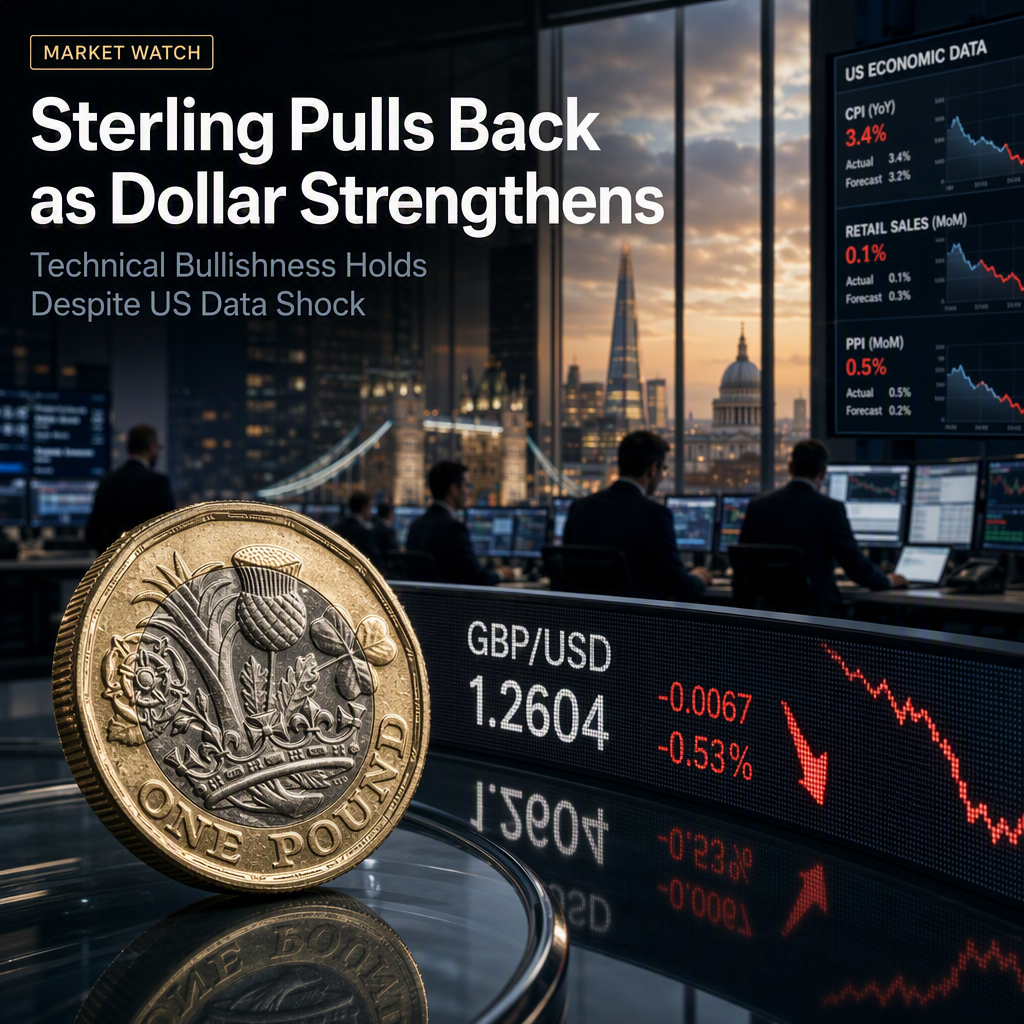
The British Pound (Sterling) experienced a notable pullback late on Wednesday, trading just below 1.3600, which is approximately 0.4% lower and about 55 pips under the session high of 1.3650. The currency pair drifted during the European morning session and then lost nearly 50 pips in the two hours following the 12:30 GMT release of American economic data. Since then, the price has remained flat at the lows, indicating a pause in the recent bullish momentum [1].
The August rally for Sterling has been the strongest leg of the year, with the currency rising from around 1.3300 in early August to a peak just below 1.3700. Technical indicators remain bullish, as Sterling trades well above its 50-day EMA (just above 1.3450) and 200-day EMA (just above 1.3400), both of which are rising. The daily Stochastic RSI is near 93, suggesting the move is overbought. However, the article notes that the recent advance was driven more by US Dollar weakness—specifically, the US Treasury's decision to at least double its purchases of longer-dated government debt—rather than domestic UK factors [1].
Key US data released included the July Personal Consumption Expenditures (PCE) price index, which came in at 0.2% month-over-month versus a 0.1% consensus, while the core measure matched expectations at 0.2%. Annual rates were 3.7% for headline PCE and 3.3% for core PCE. Markets responded by easing the odds of a September rate hike into the high 30% range, with a year-end increase priced near 73%. Additionally, quarterly revisions showed second-quarter core PCE prices revised up to 3.7% quarter-over-quarter from 3.4%, headline PCE prices to 5.3% from 5.1%, and the GDP price index to 6.4% from 6.3%. Real growth remained at 1.5% annualized. Durable goods orders exceeded expectations at 1.1% (consensus 0.7%), and personal income rose 0.4% (consensus 0.3%) [1].
Looking ahead, the next significant UK event is the September 17 Bank of England rate decision, which is three weeks away and will not include a Monetary Policy Report. Market pricing suggests a rate increase is more likely than a cut, with curves indicating a rate near 4.00% by November. The dissent bloc within the Bank of England has also grown, but no major British data releases are expected in the near term [1].
CONCLUSION
Sterling's recent gains have been largely attributed to US Dollar weakness rather than domestic UK developments. While the technical outlook remains bullish, the Pound's ability to sustain its advance may depend on future US data and central bank actions. The market is now focused on the upcoming Bank of England rate decision in September, with expectations leaning toward a rate hike.