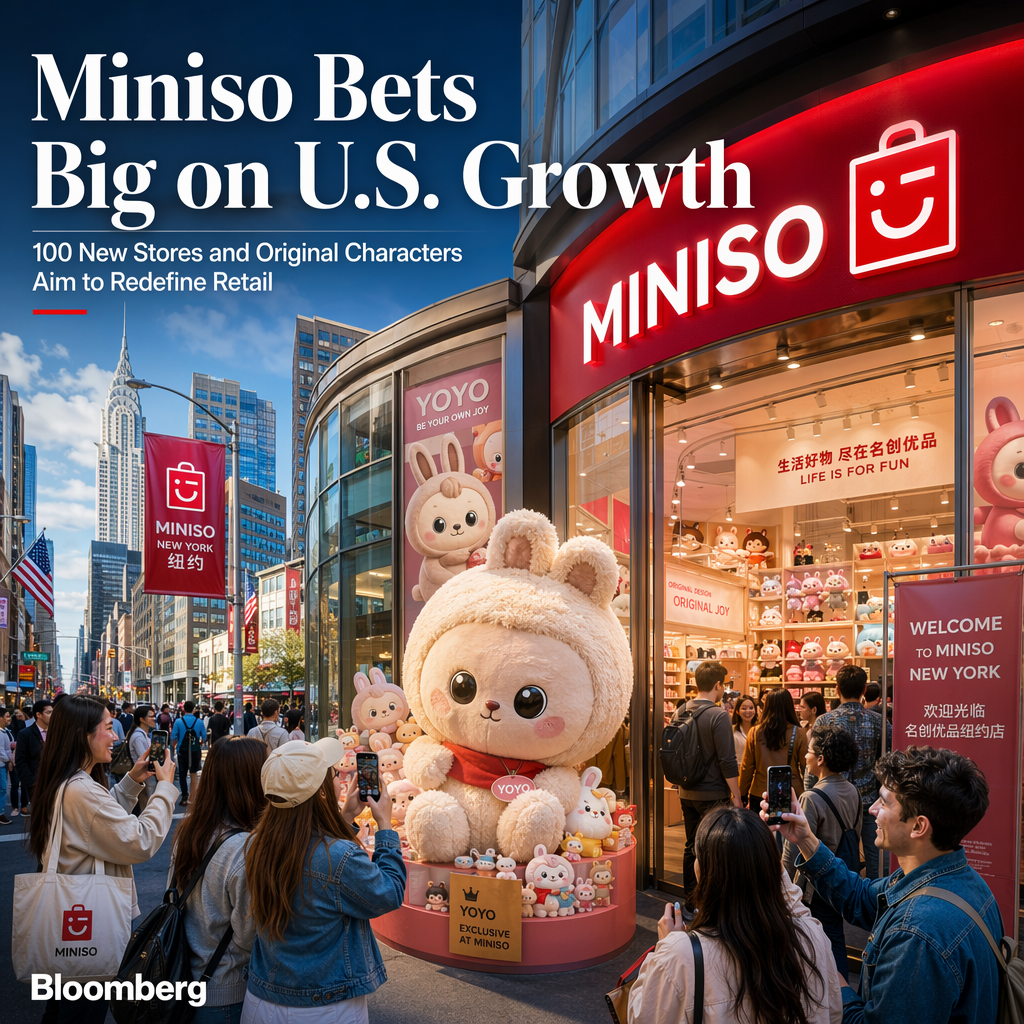
Chinese retailer Miniso has announced plans to open 100 stores in the United States this year, marking an aggressive expansion into the American market amid a challenging retail environment and heightened tariff risks for Chinese brands [1]. The company is shifting its growth strategy to focus on developing proprietary intellectual property (IP), aiming to replicate the success of Labubu, a popular character from Pop Mart, by creating its own unique characters and leveraging them across new product lines and stores [1].
Miniso's Chief Marketing Officer Robin Liu and Miniso USA CEO Tom Bartlebaugh emphasized the importance of building a strong brand identity through original characters such as YOYO plush toys, which are intended to differentiate the company from competitors and boost sales in international markets [1]. The strategy is designed to reduce reliance on third-party licenses and adapt to local consumer preferences, particularly targeting young shoppers and collectors in key metropolitan areas [1].
Financial analysts cited in the article note that Miniso's focus on proprietary IP could help mitigate risks associated with U.S.-China trade tensions by providing greater flexibility and control over product offerings [1]. The company's investment in design and marketing is seen as crucial for capturing market share in the competitive U.S. retail sector [1].
Market sentiment is described as cautiously optimistic, with analysts highlighting that while Miniso's IP-centric approach could provide long-term resilience, the ultimate success will depend on effective execution and consumer acceptance [1]. No specific trading advice or technical analysis was provided, but the shift from volume-driven retail to brand-centric growth is noted as a potential influence on future financial results and investor sentiment [1].
CONCLUSION
Miniso's U.S. expansion and proprietary IP strategy represent a significant shift toward brand-centric growth. While analysts see potential for long-term resilience, the market remains watchful of execution risks and consumer response. The company's performance in the coming months will be critical in determining the success of this approach.