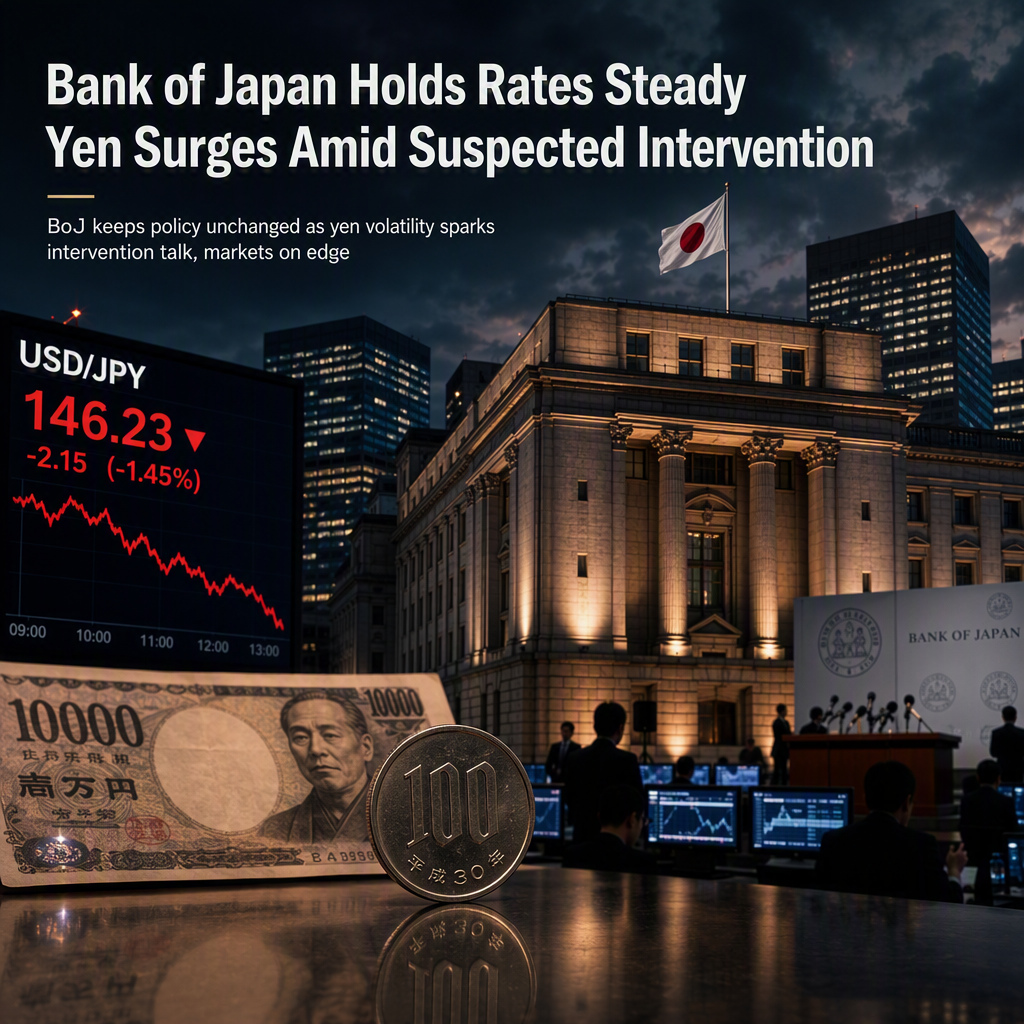
The Bank of Japan (BoJ) is set to announce its monetary policy decision on Friday, with investors widely expecting the central bank to keep its policy rate unchanged at 1% following its two-day meeting [1]. This decision comes after the Japanese Yen (JPY) experienced a sharp rebound during Thursday's American session, with the USD/JPY exchange rate plunging from above 163.00 to below 158.00 within minutes, fueling speculation of intervention by Japanese authorities in the foreign exchange market [1].
The BoJ's upcoming announcement will be closely watched for updated economic projections and insights from Governor Kazuo Ueda's press conference, as market participants assess whether the central bank's policy outlook could further support the Yen's recovery [1]. The June rate hike by the BoJ has provided policymakers with an opportunity to evaluate the effects of tighter financial conditions, and while another immediate rate move is considered unlikely, markets anticipate the possibility of additional tightening before the end of the year, with October and December highlighted as potential dates [1].
Alongside the rate decision, the BoJ will release its quarterly Outlook Report, which may include upward revisions to growth forecasts due to resilient domestic activity and strong demand related to artificial intelligence investment [1]. Conversely, headline inflation estimates could be adjusted slightly lower, reflecting the impact of government subsidies and softer energy prices [1]. However, the BoJ is expected to caution that underlying price pressures may remain robust, particularly as higher import and producer costs are gradually passed on to consumers [1].
The central bank's latest Tankan survey indicates that Japanese companies continue to expect inflation to stay above the BoJ's 2% target in the coming years, supported by rising wages and persistent services inflation [1]. The ongoing weakness of the Yen remains a key concern, as a softer currency increases the cost of imported goods and energy, potentially intensifying inflationary pressures [1]. Although the suspected intervention has temporarily strengthened the Yen, the trend of depreciation could resume, as observed after a previous intervention in April [1]. The BoJ, however, does not directly target exchange rates [1].
CONCLUSION
The Bank of Japan is expected to maintain its policy rate at 1%, with markets watching for signals on future tightening and updated economic projections. While the suspected intervention has temporarily boosted the Yen, underlying inflationary pressures and currency weakness remain key concerns for policymakers. The central bank's stance and outlook will be pivotal for market direction in the coming months.