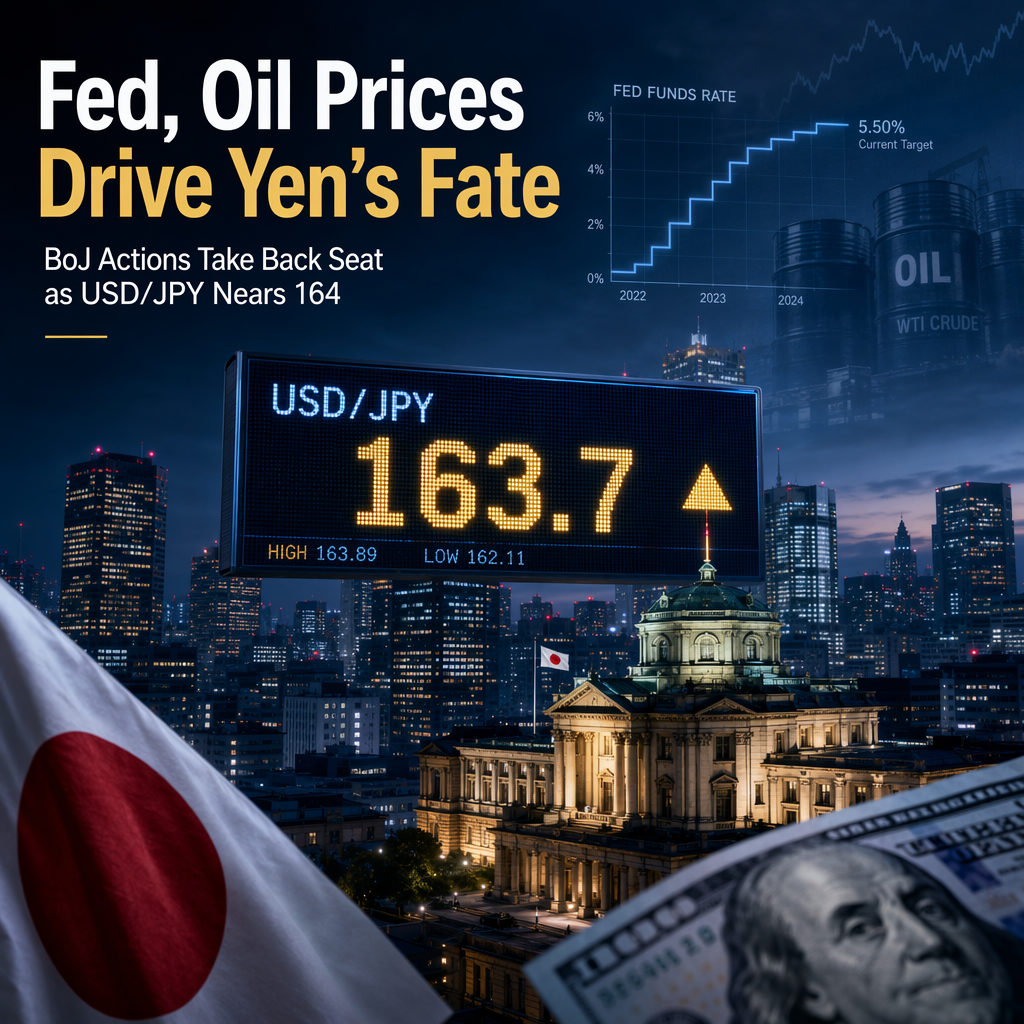
According to ING analysts Chris Turner and Padhraic Garvey, the Bank of Japan (BoJ) is expected to maintain its policy rate at 1.00% during the upcoming meeting on July 31, following last month's 25 basis point hike. While some market participants anticipate a potentially faster tightening cycle or an additional rate hike in October, ING believes that any modestly hawkish shift by the BoJ is unlikely to significantly strengthen the yen or alter the USD/JPY trajectory [1].
The analysts emphasize that energy prices and the Federal Reserve's policy decisions will be the primary factors influencing USD/JPY in the coming months. They note that unless the Federal Reserve delivers a surprisingly dovish outcome at its next FOMC meeting, or Brent crude oil prices fall sharply to $70 per barrel, USD/JPY is expected to remain near the 163/164 level heading into the BoJ meeting [1].
There is an outside risk that USD/JPY could approach 165 if BoJ Governor Ueda is not sufficiently hawkish in his post-meeting press conference. Should this occur, the risk of foreign exchange intervention by Japanese authorities increases. The BoJ previously spent $70 billion on intervention in late April and early May and currently holds $1.09 trillion in FX reserves. Japanese authorities are believed to prefer intervening in a falling market for greater effectiveness, but would likely act if the 165 level is tested [1].
Looking ahead, ING maintains a year-end forecast for USD/JPY at 158, based on the assumption that the Federal Reserve does not implement further rate hikes. Additionally, there is speculation that the Japanese government may introduce measures to support the yen by encouraging domestic investors to retain more capital within Japan [1].
CONCLUSION
ING analysts expect the Bank of Japan to keep rates unchanged, with energy prices and Federal Reserve policy remaining the dominant drivers for USD/JPY. The risk of FX intervention persists if the yen weakens further, but the year-end forecast remains at 158, assuming no additional Fed hikes. Market participants are advised to monitor upcoming Fed and BoJ communications for further direction.