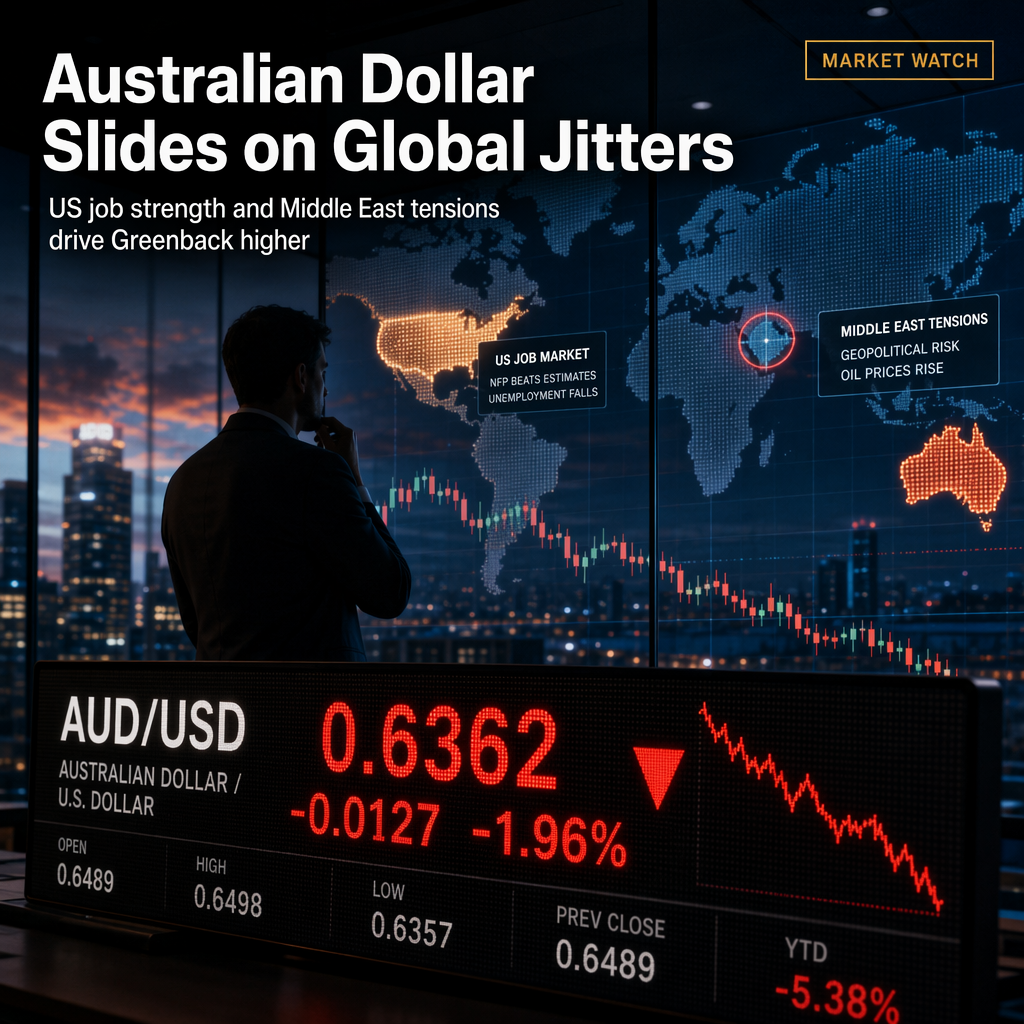
The Australian Dollar (AUD) traded under pressure on Thursday, with the AUD/USD pair declining to the 0.6970 area and giving back earlier gains as the US Dollar (USD) strengthened on the back of robust US labor market data and heightened geopolitical tensions in the Middle East [1][2]. Specifically, US Initial Jobless Claims fell to 187,000 for the week ending July 18, significantly below the market forecast of 212,000 and the previous revised figure of 209,000, reinforcing the perception of a resilient US labor market and supporting both US Treasury yields and the Greenback [1].
Geopolitical uncertainty increased after US President Donald Trump stated he was 'considering a massive attack greater than anything before' and suggested Israel would join 'within two minutes' if asked, which further lifted safe-haven demand for the USD [1]. The ongoing Middle East conflict also drove Oil prices higher, adding to inflation concerns and strengthening expectations that the Federal Reserve may raise interest rates. According to the CME FedWatch Tool, markets now see an 83% probability of a rate hike in September [2]. The US Dollar Index (DXY) traded around 101.45, its highest level in three weeks [2].
On the domestic front, Australia's June employment report was stronger than expected, with Employment Change rising by 76,300 (versus 15,000 expected and 44,000 previously), Full-Time Employment up by 29,300, and Part-Time Employment increasing by 47,000. The Participation Rate edged up to 67.0% from 66.7%, while the Unemployment Rate held steady at 4.4%, matching expectations [1]. Despite this positive data, the AUD remained under pressure due to external factors [1][2].
Technically, AUD/USD trades below key moving averages, with the 4-hour chart showing the pair at 0.6974, below the 20-period SMA at 0.7000, and the 100-period SMA at 0.6959 offering support [1]. The daily chart indicates the pair is above the 21-day and 200-day SMAs at 0.6948 and 0.6896, respectively, but remains capped by the 50-day SMA at 0.7028 [2]. The Relative Strength Index (RSI) readings near 40 and 47 on different timeframes suggest fading or subdued momentum, while the MACD histogram points to weakening bullish momentum [1][2].
Looking ahead, traders are watching Australia's preliminary July S&P Global PMIs, with the Composite PMI expected at 50.4, Manufacturing at 51.5, and Services at 50.5. Stronger PMI readings could help stabilize the AUD, while weaker data may leave AUD/USD vulnerable if USD strength persists [1].
CONCLUSION
Despite robust Australian employment data, the AUD/USD pair declined as strong US labor market figures and rising geopolitical tensions boosted the US Dollar. Market sentiment remains cautious, with expectations of a US rate hike in September and technical indicators pointing to subdued momentum for the AUD. The upcoming Australian PMI data will be closely watched for further direction.