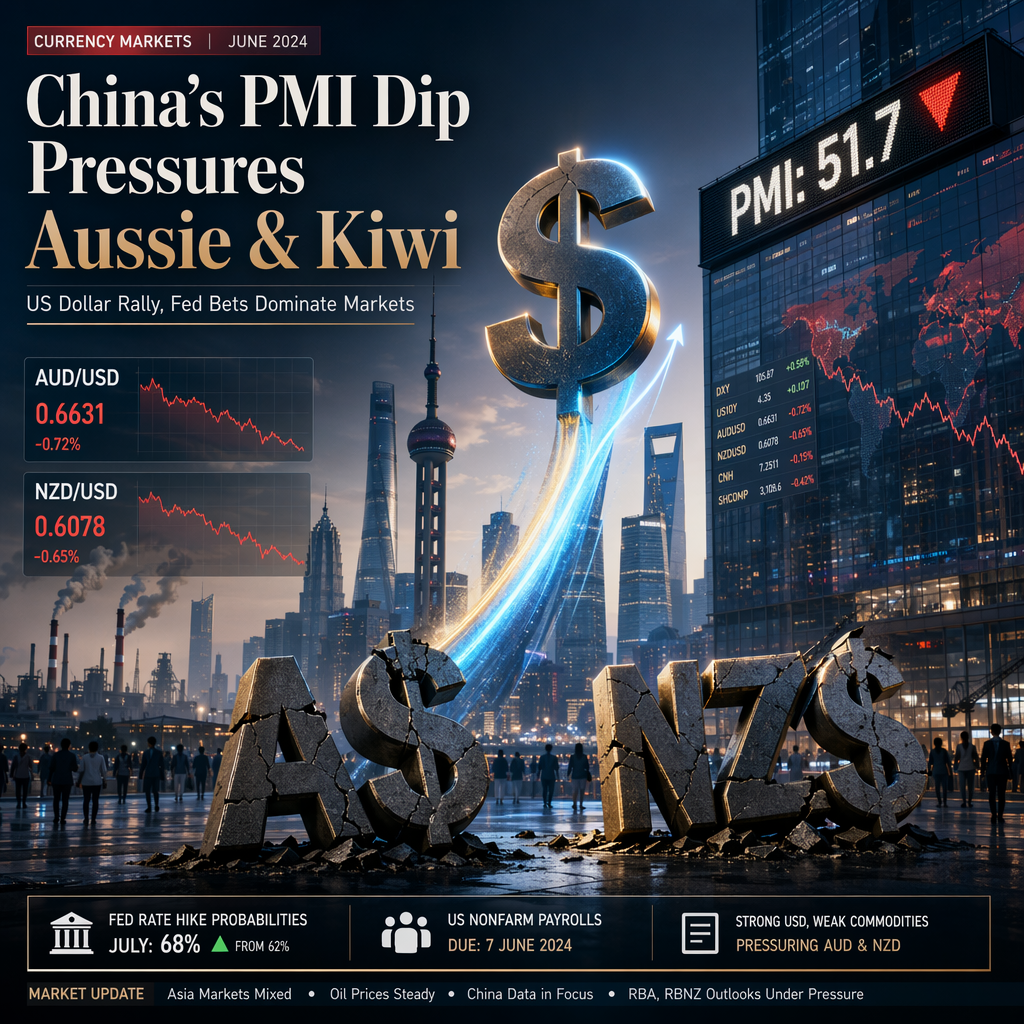
China's RatingDog Manufacturing Purchasing Managers Index (PMI) declined to 51.7 in June, down from 51.8 in May according to RatingDog data, matching market expectations [1][2][3]. This slight easing in Chinese manufacturing activity failed to boost the China-proxy currencies, with both the Australian Dollar (AUD) and New Zealand Dollar (NZD) remaining under pressure against the US Dollar (USD) during Asian trading hours on Wednesday [1][2][3].
The AUD/USD pair slipped back below the 0.6900 mark, trading at 0.6893 and down 0.37% on the day, making the AUD the weakest major currency against the USD according to a daily heat map [2][3]. Similarly, the NZD/USD pair held negative ground near 0.5665, with traders scaling back expectations for aggressive Reserve Bank of New Zealand (RBNZ) rate hikes. ASB Bank dropped its call for a July hike and now expects the RBNZ to keep the Official Cash Rate (OCR) on hold at the July meeting, followed by 25-basis-point increases starting in September, with the OCR peaking at 3.25% by early 2027 [1].
The modest uptick in the US Dollar was supported by resilient US labor market data, with the Job Openings and Labor Turnover Survey (JOLTS) showing job openings at a two-year high of 7.594 million at the end of May [2][4]. Renewed US-Iran hostilities and revived inflation fears have also boosted bets for an imminent US Federal Reserve (Fed) rate hike, with the CME Group's FedWatch Tool indicating traders assign around an 83% probability of a move this year [2][4]. This has contributed to downward pressure on both the AUD and NZD, as well as a continued rally in the USD/JPY pair, which reached 162.70, its highest level since 1986 [4].
Looking ahead, market participants are focused on upcoming US economic releases, including the ISM Manufacturing PMI and the ADP private-sector employment report on Wednesday, followed by the key Nonfarm Payrolls (NFP) report on Thursday [1][2][4]. Markets expect a rise of 110,000 jobs in June, with the unemployment rate projected to hold steady at 4.3% [1]. Analyst commentary suggests that the China PMI data, while not a major surprise, underscores ongoing concerns about sluggish Chinese demand and its spillover effects on commodity-linked currencies like the AUD and NZD [2][3].
CONCLUSION
The latest Chinese PMI data, while in line with expectations, reinforced weakness in the Australian and New Zealand Dollars amid persistent US Dollar strength and rising Fed rate hike expectations. Market focus now shifts to key US economic data, which could further influence currency moves and central bank policy outlooks.