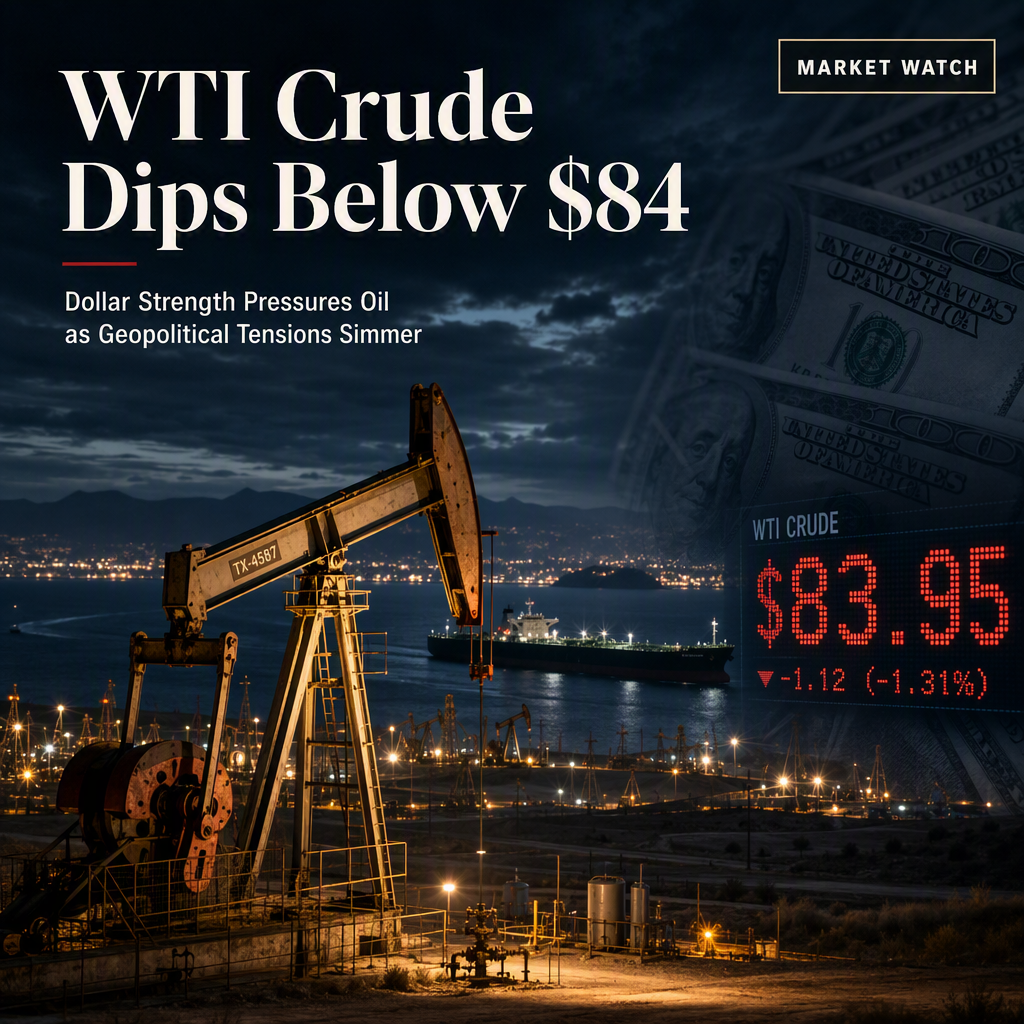
West Texas Intermediate (WTI), the benchmark US crude oil price, declined below $84.00 during the early European session after reaching an intraday high of $85.35, marking its second consecutive day of losses [1]. The primary driver behind this decline is the strengthening US Dollar, which has been recovering from its lowest level since May 14. This recovery is attributed to ongoing inflation risks linked to volatile energy prices, which have kept market expectations for at least one Federal Reserve rate hike in 2026 alive [1]. The firmer dollar has undermined demand for USD-denominated commodities, including crude oil [1].
Despite the downward pressure, the potential for deeper losses in WTI appears limited due to escalating US-Iran tensions. US Treasury Secretary Scott Bessent warned countries to sever financial ties with Iran or risk exclusion from the dollar-based financial system, while Iran threatened to halt all oil exports from the Gulf if economic pressures persist and issued a warning to ships regarding passage through the Strait of Hormuz [1]. Additionally, US Defense Secretary Pete Hegseth stated that the US would not rule out military action against Iran, maintaining a geopolitical risk premium that could support crude oil prices [1].
Another factor contributing to market caution is the decline in US Strategic Petroleum Reserve (SPR) stocks, which have fallen to their lowest level since November 1982 [1]. This development suggests that traders should be cautious before expecting a further extension of the recent pullback from last Friday's three-week high [1].
From a technical perspective, WTI retains a near-term bullish bias as long as it remains above the 100-period Exponential Moving Average (EMA) pivotal support at $82.61 on the 4-hour chart. A sustained hold above $82.00 could prompt a recovery toward recent cycle highs, while a break below the EMA may signal a deeper correction [1].
CONCLUSION
WTI crude oil prices are currently under pressure from a stronger US Dollar, but geopolitical risks related to US-Iran tensions and low US SPR stocks are providing support. The market remains cautious, with technical indicators suggesting potential for both recovery and further correction depending on price movements relative to key support levels.