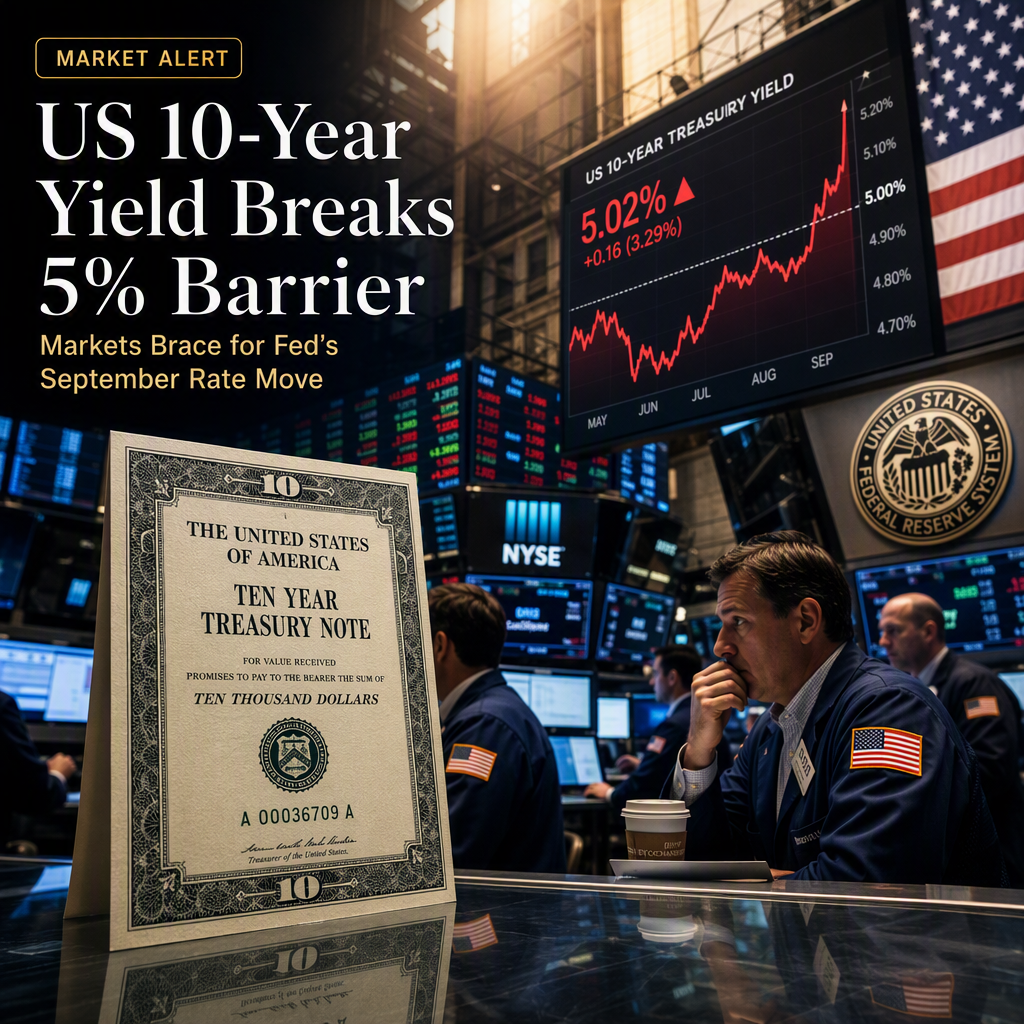
The US 10-year Treasury yield has breached the 5% mark for the first time since 2023, reaching 5.006% after rising by over 4 basis points, as investors nearly fully price in a 25-basis-point rate hike by the Federal Reserve at its September 16 meeting [1]. Money markets are assigning a 93% probability to a rate hike, according to Prime Terminal [1], while the CME FedWatch Tool shows an 86% probability, up from 59.4% a week earlier [2]. This surge in yields has strengthened the US Dollar, with the US Dollar Index (DXY) climbing nearly 0.60% to 99.66, its highest level since September 3 [1][2].
The anticipation of tighter Fed policy has weighed on the Euro, which dropped around 0.55% against the US Dollar, with EUR/USD trading near 1.1525, its lowest since August 13 [2]. Strategists at Scotiabank note that swaps pricing indicating a 70% or higher risk of a Fed rate move has historically been a strong indicator of policy action, explaining the dollar's gains [2]. However, they caution that the market reaction will depend on the Fed's communication, warning that an unchanged decision or a dovish hike could negatively impact the USD [2].
Recent US inflation data has contributed to the hawkish expectations, with headline CPI rising 0.4% month-on-month in August, up from 0.1% in July, and core CPI increasing 0.3%, the fastest pace in four months [2]. Rising oil prices, with West Texas Intermediate (WTI) trading near $100 and up more than 15% this month, are adding to inflation concerns and pressuring the Fed to act [2]. The escalation of the US-Iran conflict and attacks on Saudi infrastructure have further fueled oil price gains [1].
ING economists now expect a 25bp Fed rate hike in September, viewing it as a one-off adjustment rather than the start of a tightening cycle [3]. They cite weak wage growth, a stagnant housing market, and tariff refunds as factors likely to help inflation converge to the 2% target next year, with the Fed funds rate ultimately returning to 3.1% [3]. ING projects that the Fed will forecast slightly lower inflation than in June, with GDP and labor metrics largely unchanged [3]. Despite markets pricing in additional hikes, ING believes the September move may be the only one, and expects the dollar to decline through next year as inflation falls and the focus shifts to potential easing [3].
CONCLUSION
Markets are overwhelmingly expecting a 25bp Fed rate hike in September, driving US Treasury yields and the dollar higher while pressuring the Euro. However, some analysts, such as those at ING, see this as a one-off move rather than the start of a new tightening cycle, with expectations for inflation to moderate in 2024. The market's next focus will be on the Fed's forward guidance and economic projections, which could shape currency and rate expectations going forward.