
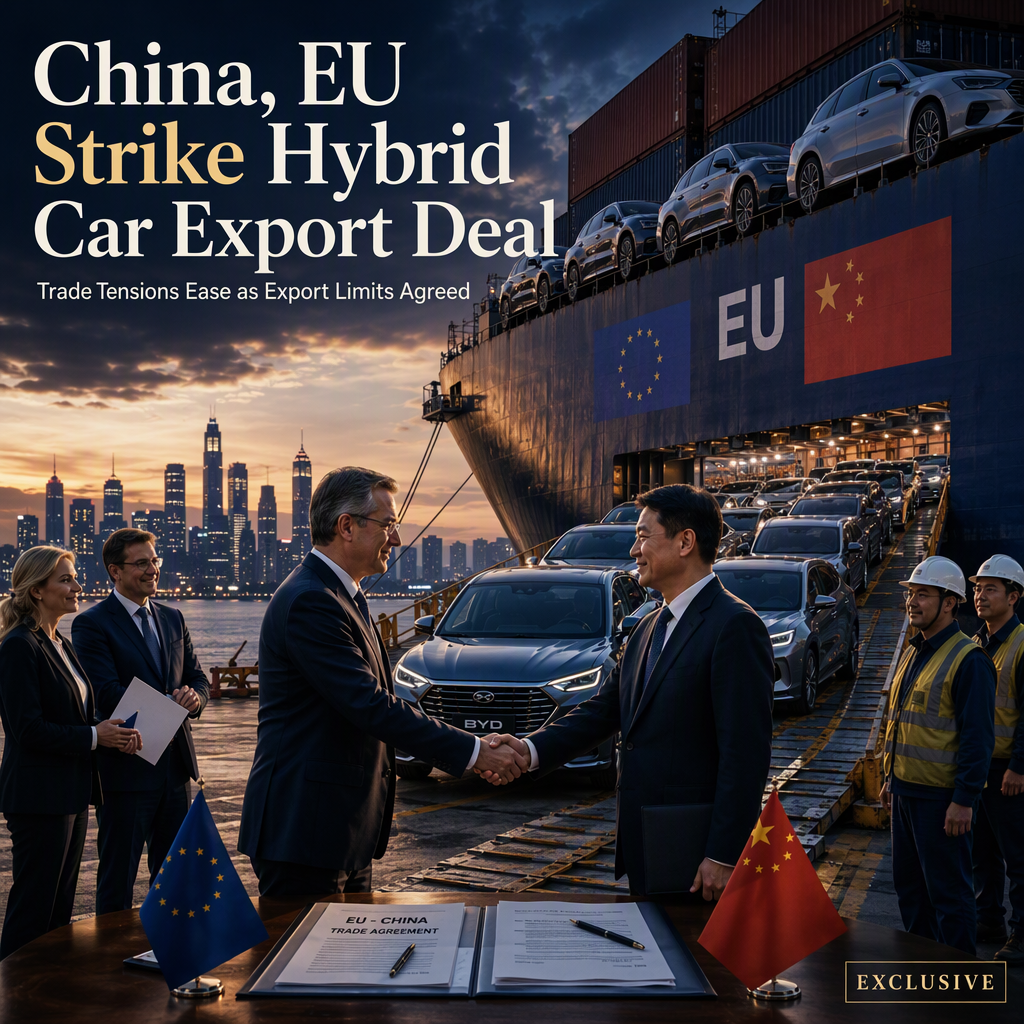
China and the European Union have reached an 'understanding' to halve Chinese exports of hybrid vehicles to the EU following two days of trade talks in Beijing between European Commissioner for Trade Maros Sefcovic and Chinese Commerce Minister Wang Wentao [1]. This agreement comes amid escalating tensions, as the EU had been preparing to impose tariffs on Chinese-made hybrid vehicles due to concerns over market distortions and subsidies [1].
The EU claims the deal will provide $4.5 billion in improved market access, although Beijing's official statement was more reserved and did not specify financial figures or commitments, instead highlighting ongoing dialogue and cooperation [1]. The reduction in hybrid vehicle exports will be phased in over time, with implementation details yet to be finalized [1].
EU officials view the agreement as a significant concession from Beijing, potentially easing pressure on European automakers and reducing the risk of a full-blown trade war [1]. An EU source familiar with the negotiations stated, 'This understanding paves the way for a more balanced automotive trade relationship and protects our industries' [1].
Analysts are closely monitoring the outcome, as it is expected to influence broader China-EU trade relations and could have implications for the global automotive market [1].
CONCLUSION
The agreement to halve Chinese hybrid vehicle exports to the EU marks a major step in de-escalating trade tensions between the two economies. While the EU touts improved market access, the phased reduction is expected to benefit European automakers and stabilize trade relations. Market participants are watching for further details and potential ripple effects in the global automotive sector.