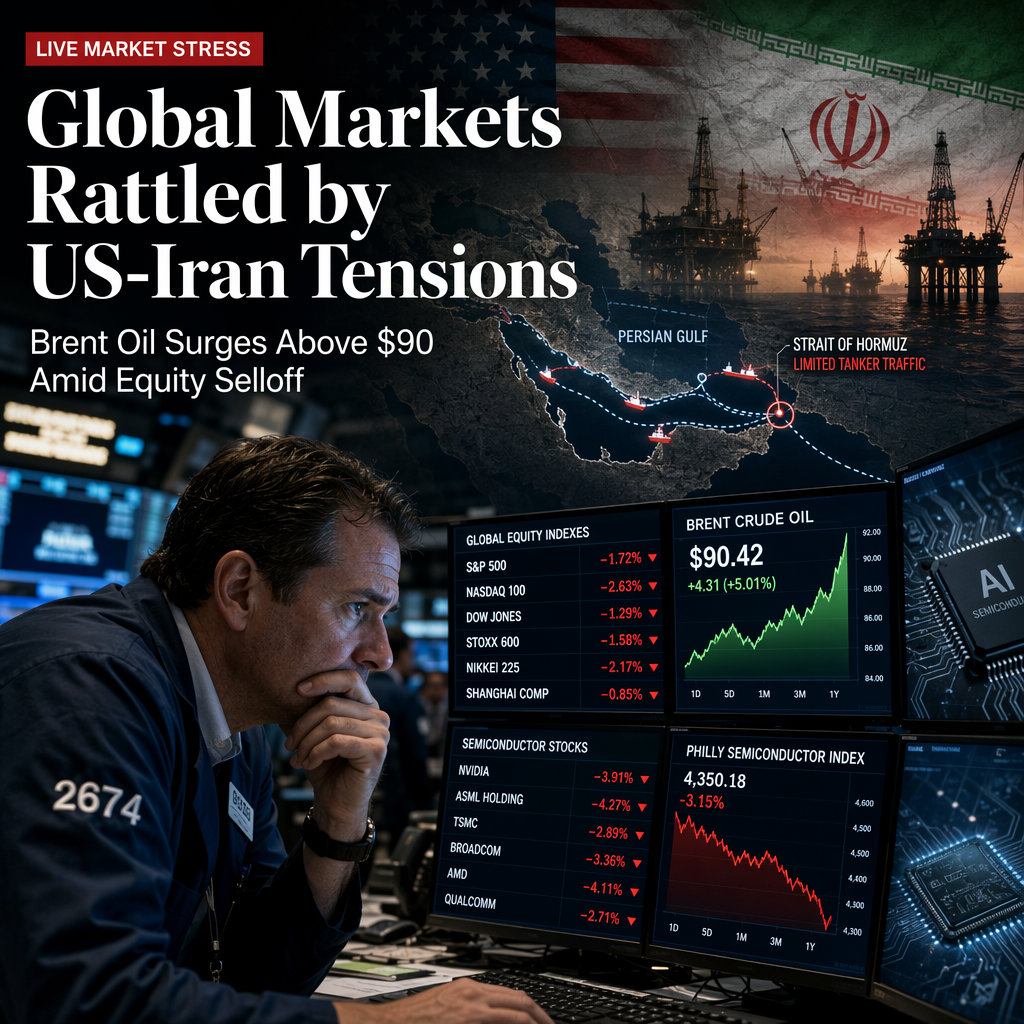
Global equities faced significant pressure as rising oil and gas prices, escalating US–Iran tensions, and renewed doubts over the AI trade weighed on investor sentiment, according to Deutsche Bank strategists [1]. Chipmakers led the declines, with the Philly semiconductor index dropping -9.97% last week and -1.63% on Friday, marking its largest weekly fall since the week of the Liberation Day tariff announcements last year. The index has now entered a bear market, having fallen -20.23% since its June 22 peak [1]. The S&P 500 declined -1.55% for the week (-1.01% Friday), while Japan’s Nikkei suffered its biggest weekly drop since the Liberation Day week, down -6.44% [1]. In contrast, European equities showed resilience, with the STOXX 600 up +0.07% over the week despite a -0.34% dip on Friday [1].
The energy market responded sharply to geopolitical developments. Brent crude oil surged +2.45% to $90.26 per barrel following a ninth consecutive night of US strikes against Iran [1]. ING analysts noted that Brent broke above $90 as conflict in the Persian Gulf intensified, disrupting vessel flows and raising the risk of chokepoint closures [2]. LSEG data indicated that only two outbound visible oil tankers transited the Strait of Hormuz, with no inbound traffic, returning flows to levels seen before the Memorandum of Understanding [2].
The oil market's vulnerability is heightened by the imminent end of US Strategic Petroleum Reserve (SPR) releases, which have provided relief during the conflict; these releases are set to cease around the end of the month, though further SPR use remains possible [2]. Speculators responded to the heightened supply risk by increasing their net long positions in ICE Brent by 114,752 lots over the last reporting week, bringing the total to 169,839 lots as of last Tuesday [2]. Net long positions in ICE gasoil also rose by 2,389 lots to 71,875, though ING analysts found the increase less aggressive than expected given recent market moves [2].
Despite ongoing geopolitical risks, US equity futures showed modest gains with S&P (+0.15%) and Nasdaq (+0.47%) contracts higher, while Chinese equities were strong, with the Hang Seng (+2.04%), CSI 300 (+1.55%), and Shanghai Composite (+1.18%) all advancing [1]. The S&P/ASX 200 edged up +0.17%, and Japanese markets were closed for the Marine Day holiday [1].
CONCLUSION
Escalating US–Iran tensions and renewed AI trade doubts have triggered a sharp selloff in global equities, particularly among chipmakers, while Brent oil prices surged above $90 on supply disruption fears. The market remains highly sensitive to further geopolitical developments and the cessation of US SPR releases, with speculative positioning in oil rising sharply. Investors are closely watching for further escalation and its impact on both equity and energy markets.