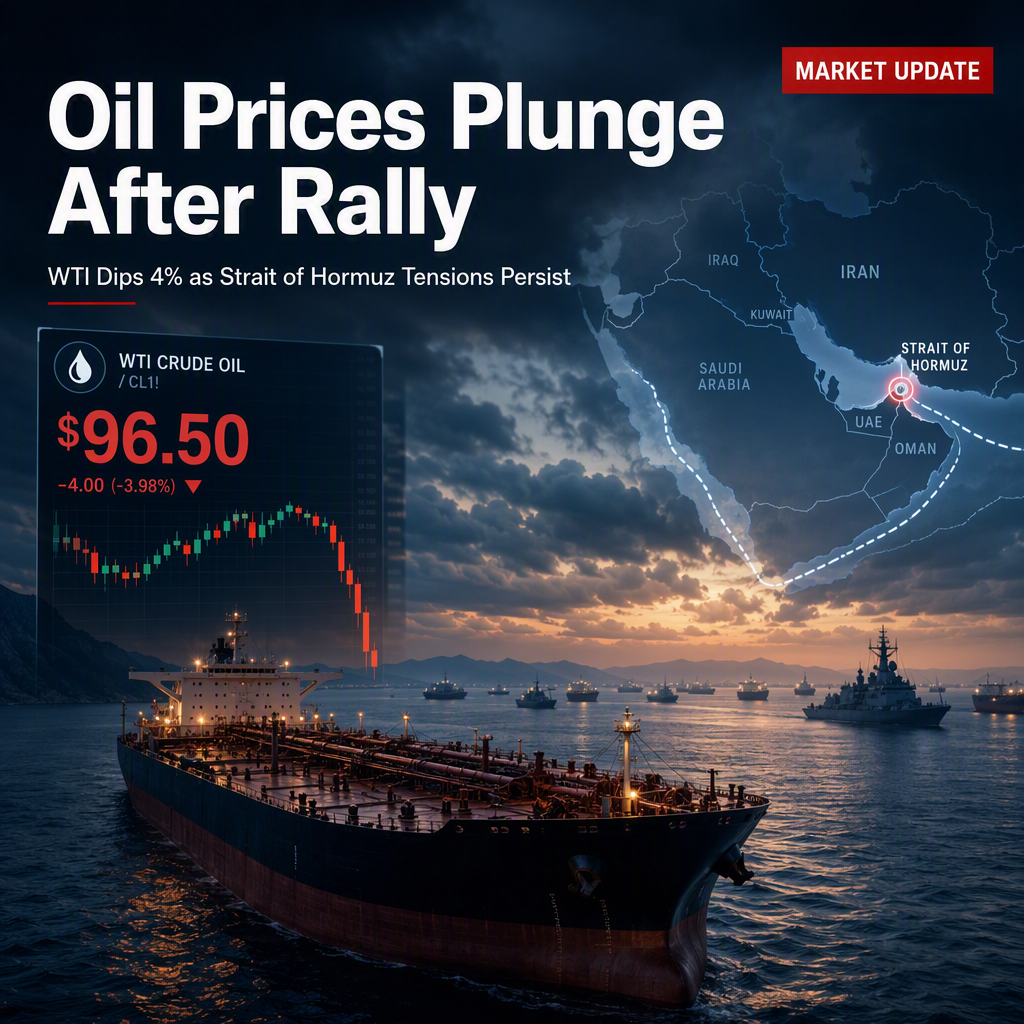
West Texas Intermediate (WTI) Oil experienced significant selling pressure on Friday, declining roughly 4% to trade around $96.50 after reaching its highest level since May 21. The sharp pullback was attributed to traders locking in profits following a strong rally earlier in the week. Despite this intraday correction, WTI remains on track for a second consecutive weekly gain, supported by ongoing supply concerns stemming from the war in the Middle East and a substantial geopolitical risk premium in energy markets [1].
Shipping disruptions through the Strait of Hormuz continue to impact the market, with only seven vessels crossing the waterway on Thursday, compared to 11 on Wednesday and a recent 10-day average of 15, according to shipping data cited by Reuters. However, the Financial Times reported that foreign ministers from Iran and Gulf countries are preparing to meet in Oman to discuss a temporary arrangement for managing shipping through the Strait, which could influence future supply dynamics [1].
From a technical perspective, WTI maintains a bullish bias, trading well above its 50-day, 100-day, and 200-day Simple Moving Averages (SMAs), indicating an underlying uptrend. The Relative Strength Index (RSI) has eased slightly from overbought territory but remains elevated near 66, while the Moving Average Convergence Divergence (MACD) remains positive, suggesting continued upside pressure. The Average Directional Index (ADX) at around 25 points to a moderately strong trend. Key resistance levels are identified at $100.00 and $105.00, with a sustained break above these levels potentially exposing the March high near $113.28. On the downside, immediate support is seen in the $90.00-$92.00 region, followed by the 100-day SMA at $85, the 50-day SMA at $82, and the 200-day SMA at $78 [1].
CONCLUSION
WTI Oil's recent rally has been tempered by profit-taking, but the market remains supported by geopolitical risks and supply disruptions in the Middle East. Technical indicators suggest the uptrend is intact, with key resistance and support levels in focus. The outcome of diplomatic efforts regarding the Strait of Hormuz could play a pivotal role in future price movements.