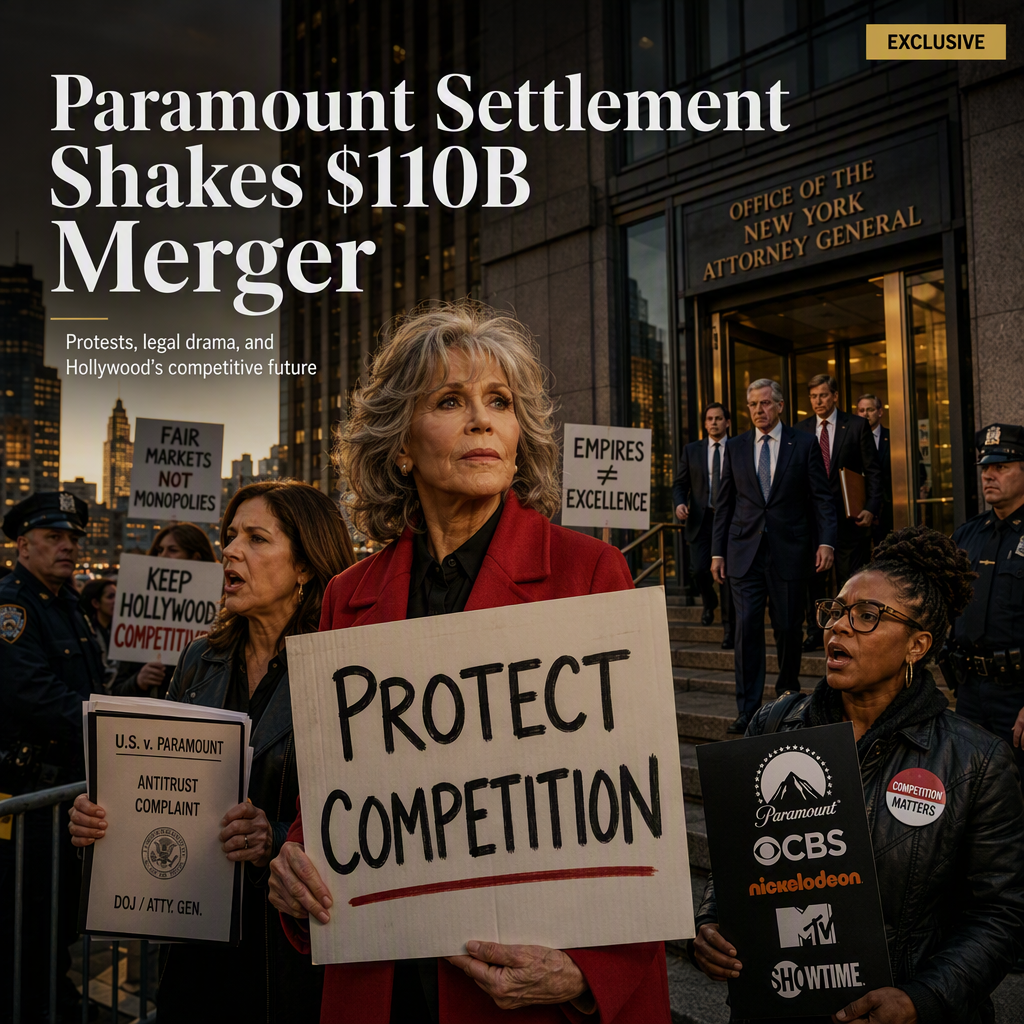
On Monday, approximately 20 opponents of the Paramount Skydance-Warner Bros. Discovery merger gathered outside the New York attorney general’s office to urge Letitia James not to settle the states’ legal challenge against the $110 billion deal, which they argue would 'extinguish competition' in Hollywood [1]. The protest was led by the Committee for the First Amendment, a free-speech advocacy group headed by actor Jane Fonda, and included producer Bruce Cohen, who stated, 'It’s bad for Hollywood, it’s bad for workers, it’s bad for democracy' [1]. Despite these efforts, reports circulated during the rally that a possible settlement between Paramount and the 12 states suing to block the merger had been reached [1].
The states, including New York and California, filed a 38-page complaint in July outlining their concerns about the merger’s impact on competition [1]. Paramount, led by CEO David Ellison, has consistently defended the deal as 'lawful, pro-competitive, and will benefit consumers, creators, workers, and the entertainment industry' [1]. Paramount executives are motivated to finalize the transaction quickly, as the company agreed to pay Warner Bros. shareholders a 'ticking fee' of 25 cents per share each quarter if the deal does not close by September 30—a penalty exceeding $600 million every three months [1].
Legal proceedings have intensified, with Paramount’s lawyers requesting Judge Araceli Martínez-Olguín to require merger opponents, including the Writers Guild of America (WGA), to post nearly $1.9 billion to cover costs of delays caused by the antitrust lawsuit [1]. The Justice Department has supported Paramount’s demand for a bond, and a hearing on the request was scheduled for September 24 [1]. Ellison reportedly threatened to relocate Paramount’s headquarters out of California unless Attorney General Rob Bonta opened settlement talks [1].
Multiple rallies opposing the merger have been organized, including events in Oakland and Los Angeles, highlighting widespread concern among industry workers and advocacy groups [1]. Representatives for Paramount and the attorneys general offices of New York and California did not respond to requests for comment regarding the reported settlement [1].
CONCLUSION
The reported settlement between Paramount and the states marks a pivotal moment in the $110 billion Skydance-Warner Bros. Discovery merger saga, with significant legal and financial stakes for all parties involved. Despite vocal opposition from industry groups and workers, Paramount appears poised to move forward, potentially avoiding costly penalties and delays. The outcome of the scheduled court hearing and any final settlement terms will be closely watched for their impact on Hollywood’s competitive landscape.