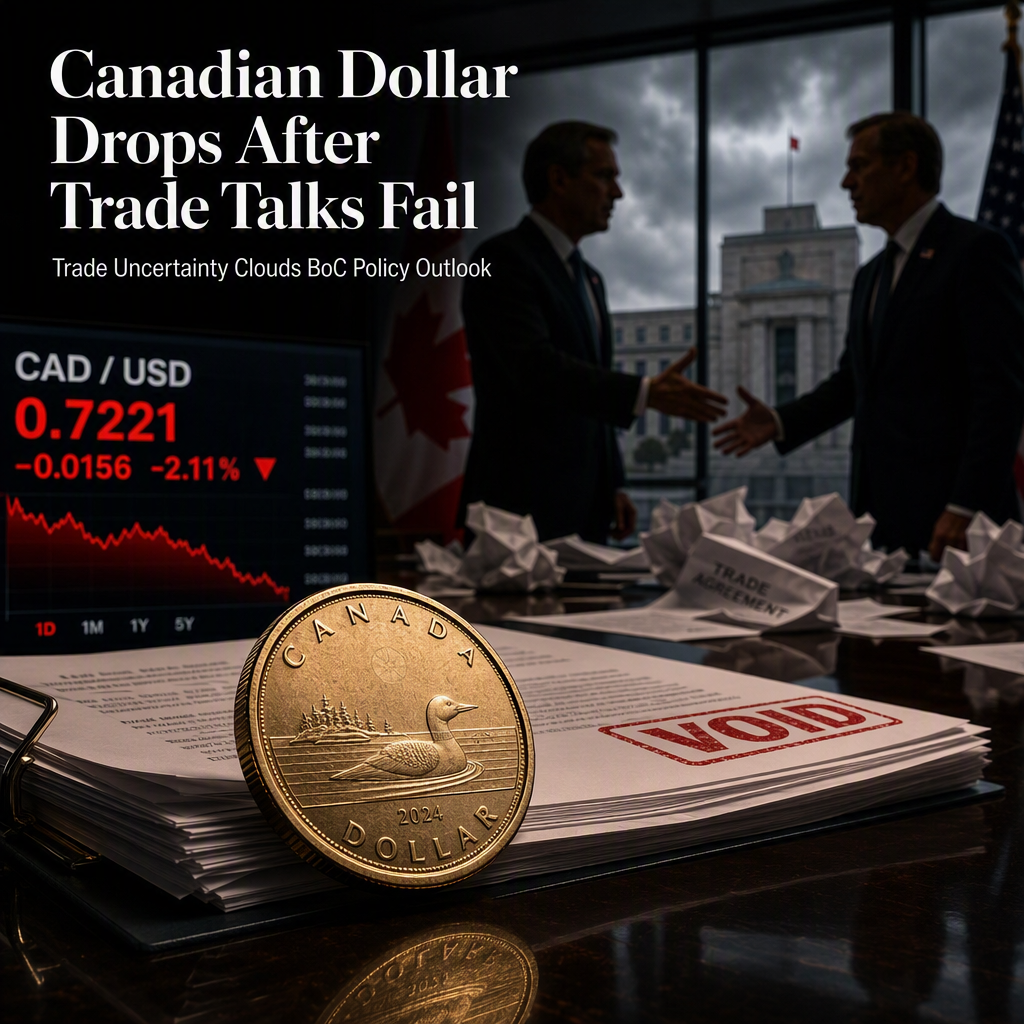
The Canadian Dollar (CAD) experienced notable underperformance among G10 currencies following the abrupt collapse of US-Canada trade talks at the eleventh hour on Friday, resulting in a 0.5% decline against the US Dollar (USD) [1]. This breakdown in negotiations has reversed the positive sentiment that had built around the CAD over the previous four weeks and introduced heightened uncertainty regarding the future of US-Canada trade relations [1]. In response to the latest round of US tariffs, the Canadian government pledged to respond 'dollar for dollar' and announced forthcoming domestic aid for provincial leaders, signaling a readiness for a prolonged trade dispute [1]. Scotiabank strategists indicated that while the broader USD/CAD downtrend remains intact, there is scope for short-term USD gains toward the mid/upper 1.39s, with the spot rate moving back to the 200-day moving average at 1.3844 [1].
Despite the trade shock, the initial market reaction in CAD was described as limited, suggesting that participants view the situation as fluid and are not ruling out the possibility of a deal emerging in the coming weeks [1]. However, the increased uncertainty is expected to keep the CAD on the backfoot against the USD and other major currencies in the near term [1].
On the monetary policy front, TD Securities projects that the Bank of Canada (BoC) will maintain its Overnight Rate at 2.25% through 2026, despite headline CPI being near the top of the BoC's 1-3% target range [2]. The bank anticipates a return to a neutral rate of 2.75% in 2027 via two 25 basis point hikes in January and March of that year, as excess supply is gradually absorbed and the impact of oil-driven inflation shocks is evaluated [2]. TD Securities expects the BoC to remain patient, awaiting greater clarity on geopolitical developments and their effects on domestic inflation, with the next policy decision scheduled for September 2 and meeting minutes to be published on September 16 [2].
Meanwhile, Brown Brothers Harriman (BBH) notes that the recent US Treasury buyback announcement initially weakened the USD and boosted gold, but expects the USD slump to stabilize this week due to the US's growth advantage over other major economies [3]. Futures markets imply a modest probability of further Federal Reserve tightening, but BBH sees risks skewed toward a dovish repricing as inflation and labor data remain contained [3]. US July PCE data is expected to show contained inflation and flat consumer spending, with headline PCE projected to rise 0.1% month-over-month and 3.6% year-over-year, while core PCE is expected to remain at 3.3% year-over-year [3].
CONCLUSION
The collapse of US-Canada trade talks has weighed heavily on the Canadian Dollar, introducing renewed uncertainty and prompting government pledges of retaliation and aid. While the Bank of Canada is expected to keep rates steady in the near term, the outlook for the CAD remains cautious amid ongoing trade tensions and a stabilizing US Dollar. Market participants are likely to remain watchful for further developments in trade negotiations and central bank policy signals.