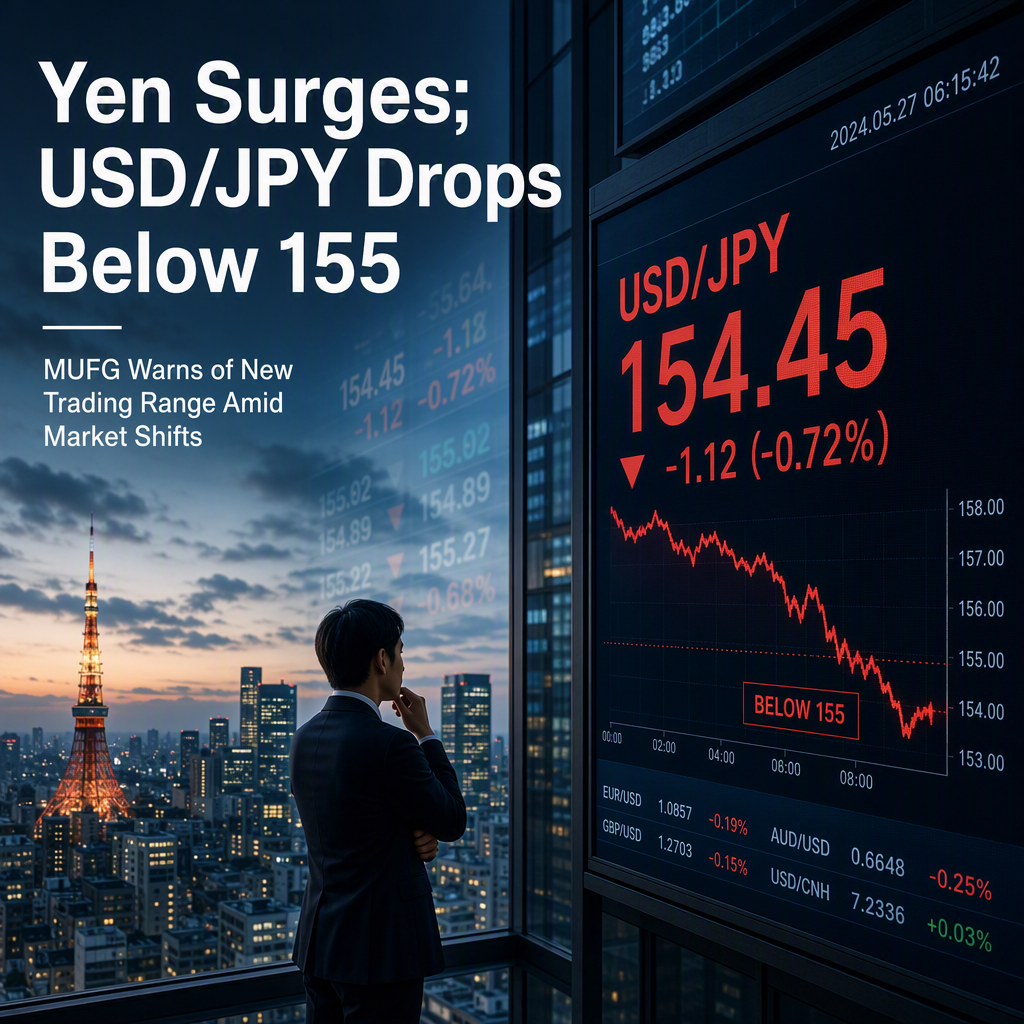
The Japanese Yen gained momentum against the US Dollar, with the USD/JPY pair falling below the 155 level, which MUFG had previously identified as the lower end of its forecast range [1]. On 7 September, USD/JPY broke below 155, and as of early trading on 8 September, it was trading under 154.50, testing key Fibonacci retracement levels [1]. The decline was further accelerated after the pair broke below 155.50, a level that had previously marked lows following interventions during the Golden Week holidays and at the end of July, resulting in a further drop of about 1 yen [1].
The report from MUFG’s Teppei Ino highlights a combination of Japan-specific factors supporting Yen strength and a decrease in Dollar-buying momentum linked to changing expectations regarding the US Federal Reserve [1]. Comments from US Treasury Secretary Scott Bessent at the G20, particularly his suggestion that Japan should move away from its reflationary policies, were cited as one of the catalysts for the shift in tone since mid-last week [1].
From a technical perspective, the pair briefly fell below the 38.2% retracement of its rise from the April 2025 low (above 139.50) to the July 2026 high (just below 164), with the next support levels identified as the January low (below 152.50) and the 50% retracement level (above 151.50) [1]. MUFG warns that unless USD/JPY quickly recovers above 155, markets may begin to treat 155 as the upper bound of a new trading range, though the bank believes it is too early to conclude that a definitive shift in the broader market narrative has occurred [1].
The catalyst for the recent sharp declines in USD/JPY remains unclear, but the unwinding of positions built on expectations of further Yen weakness could drive the pair lower toward the identified support levels [1].
CONCLUSION
The Japanese Yen's recent strength has pushed USD/JPY below the key 155 level, raising the possibility of a new trading range if the pair does not recover quickly. While MUFG notes that it is premature to declare a definitive market shift, technical and policy-driven factors are contributing to the current volatility.