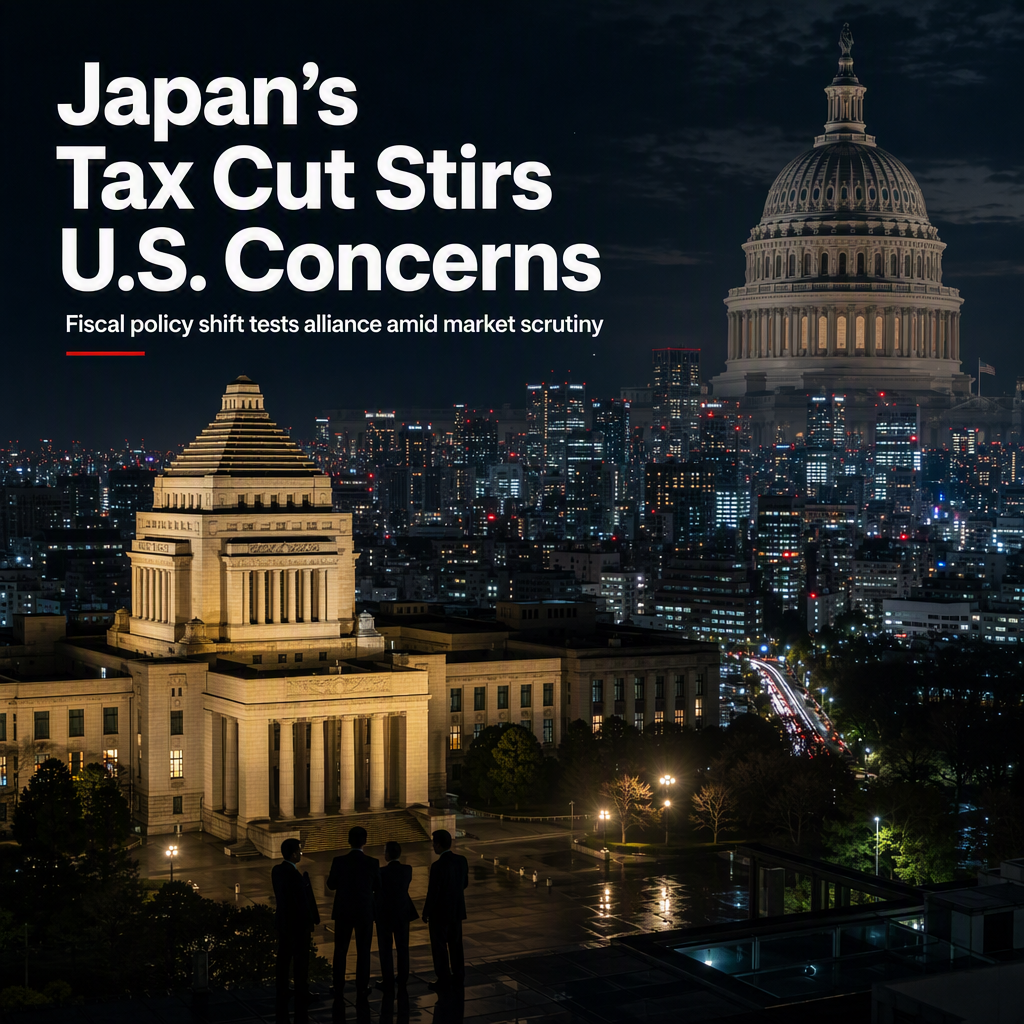
Prime Minister Sanae Takaichi's cabinet has approved a consumption tax cut, a move that has become a new source of potential tension in U.S.-Japan relations [1]. The tax reduction has drawn criticism from opposition parties in Japan, who are leveraging concerns from Washington to challenge the ruling Liberal Democratic Party [1]. Some lawmakers within the ruling coalition have expressed apprehension that this fiscal policy shift could undermine Japan's credibility with its key ally, the United States, especially as the U.S. emphasizes fiscal discipline amid ongoing global economic uncertainty [1].
The article notes that Japanese policymakers are closely monitoring the market's response to the tax cut, as well as any signals from Washington regarding expectations for bilateral fiscal policy [1]. No specific financial data, such as dates of implementation, percentage changes, or market figures, were provided in the article [1]. The development has become a focal point in political and economic discussions, highlighting the delicate balance Japan must maintain in its fiscal policy decisions in the context of its alliance with the U.S. [1].
No forward-looking statements or analyst opinions were included in the available article content [1].
CONCLUSION
The approval of the consumption tax cut by Prime Minister Takaichi's cabinet has heightened political and economic scrutiny, particularly regarding U.S.-Japan relations. While market reactions are being closely watched, the lack of specific financial data leaves the broader impact uncertain.