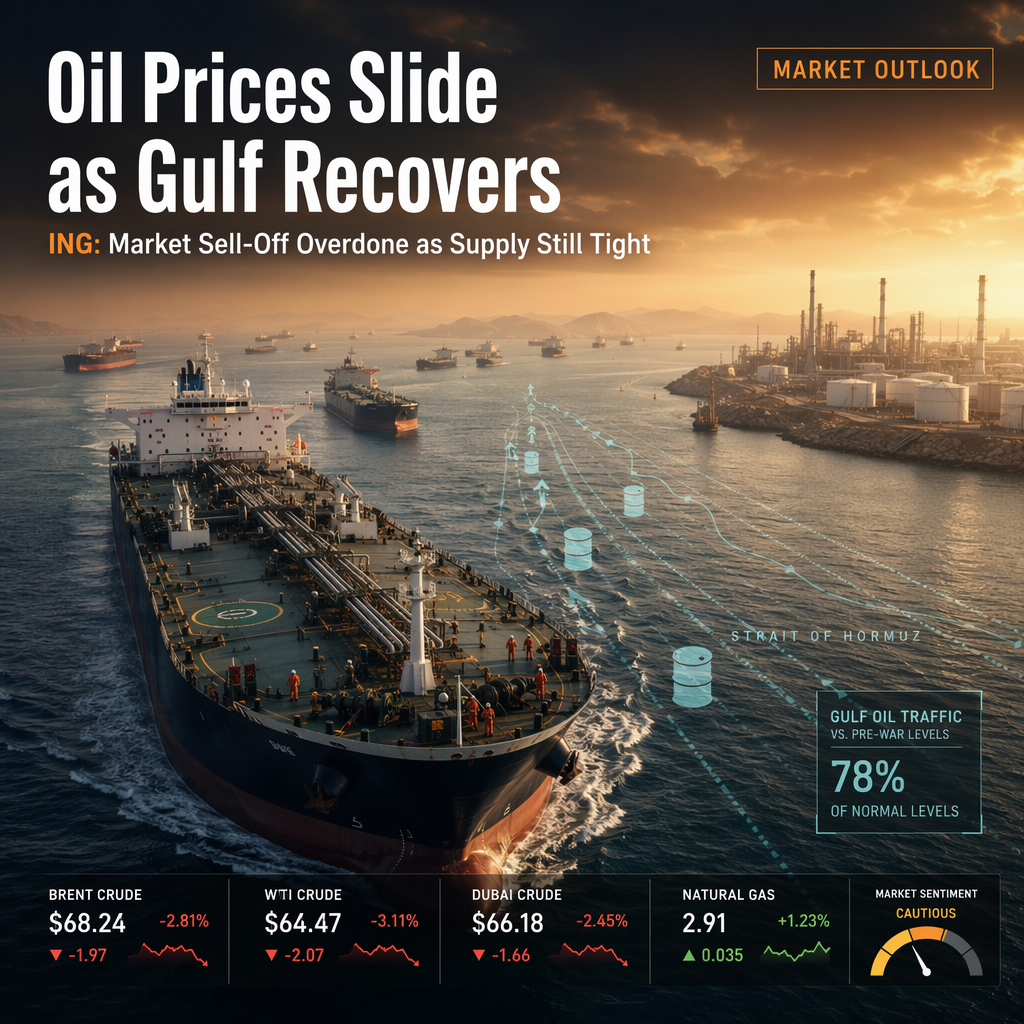
Oil prices have continued to decline, with ICE Brent settling over 1% lower, as optimism grows regarding the recovery of oil flows from the Persian Gulf through the Strait of Hormuz [1]. According to ING analysts Warren Patterson and Ewa Manthey, vessel crossings in the strait have increased in recent days, though they remain significantly below pre-war levels. Recent estimates indicate that approximately 6-7 million barrels per day (b/d) of oil are currently moving through the strait, compared to pre-war flows of around 20 million b/d [1]. However, due to pipeline diversions for Saudi Arabia and the UAE, a return to about 14 million b/d through the strait would be sufficient for Persian Gulf oil supply to reach pre-war levels [1].
Despite the recent price decline, ING analysts argue that the sell-off appears overdone, as the market remains tight and the recovery in Strait of Hormuz volumes is still limited [1]. The analysts note that price movements suggest the market is anticipating a rapid recovery in Persian Gulf oil supplies [1].
In the United States, the latest American Petroleum Institute (API) data shows that crude oil inventories fell by 800,000 barrels over the last week, while crude stocks at the WTI delivery hub in Cushing declined by 1 million barrels [1]. Meanwhile, concerns about refined product supply persist due to ongoing Ukrainian attacks on Russian energy infrastructure. Russia has already imposed export restrictions on gasoline and jet fuel, and there are reports that the government is considering a ban on diesel exports, which could further support middle distillate prices [1].
CONCLUSION
Oil prices are under pressure as Persian Gulf supply shows signs of recovery, but ING analysts believe the market is still tightening and the recent sell-off may be excessive. Ongoing geopolitical risks and refined product supply concerns, particularly from Russia, continue to influence market sentiment.