
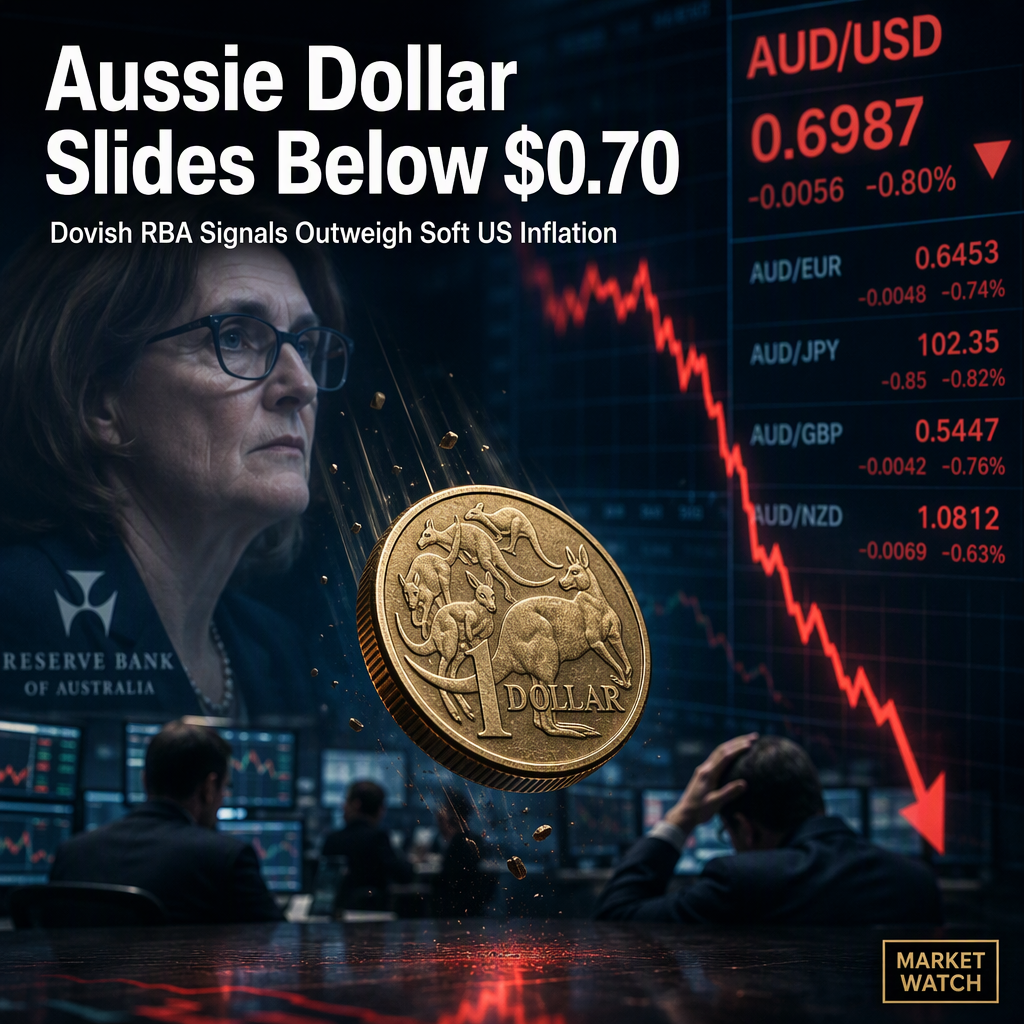
The Australian Dollar (AUD) declined by 0.57% against the US Dollar on Wednesday, falling below the $0.70 mark to trade at 0.6947 after reaching a peak of 0.6995 earlier in the session [1]. This drop occurred despite US inflation data that reduced expectations for further Federal Reserve rate hikes. The US Personal Consumption Expenditure (PCE) Price Index for August was reported at 3.4% year-over-year, below the estimated 3.7% and unchanged from July, while the Core PCE remained at 3% year-over-year, also below the forecast of 3.3% [1]. US GDP for Q2 rose to 2.2% quarter-over-quarter, surpassing estimates and indicating economic resilience [1].
Following the US inflation data, money markets shifted their outlook, now seeing a 61% chance that the Fed will hold rates in October, compared to a previous expectation of a 25 basis point hike [1]. However, the AUD/USD continued to weaken, primarily due to dovish comments from Reserve Bank of Australia (RBA) Governor Michele Bullock, who stated that "no further rate hikes may be needed if inflation declines" [1]. Australia's Trimmed Mean CPI rose to 3.6% year-over-year, unchanged and in line with economist expectations [1].
ANZ analysts noted that the August CPI aligns with their forecast for Q3 trimmed mean inflation to reach 1.0% quarter-over-quarter, which they view as a material upside surprise relative to the RBA's August Statement on Monetary Policy [1]. As a result, ANZ still anticipates another rate hike at the RBA's November meeting, potentially raising the cash rate to 4.85% [1]. Governor Bullock emphasized that Q3 data would reflect past conditions, and any further tightening would be based on future developments [1].
Technical analysis shows AUD/USD trading at 0.6946, maintaining a bearish near-term bias as it remains below key moving averages and support trend lines, with the Relative Strength Index (RSI) nearing oversold territory at 27, suggesting stretched downside momentum [1]. Upcoming events include the release of Australia's August Trade Balance and Financial Stability Review, while US traders await Fed commentary, jobless claims, and Friday's Nonfarm Payrolls report [1].
CONCLUSION
The Australian Dollar's decline below $0.70 was driven by dovish signals from the RBA, outweighing softer US inflation data that reduced expectations for Fed rate hikes. While ANZ analysts still foresee a potential RBA rate hike in November, the market remains cautious, with technical indicators pointing to continued downside momentum. Investors will be watching upcoming economic releases for further direction.