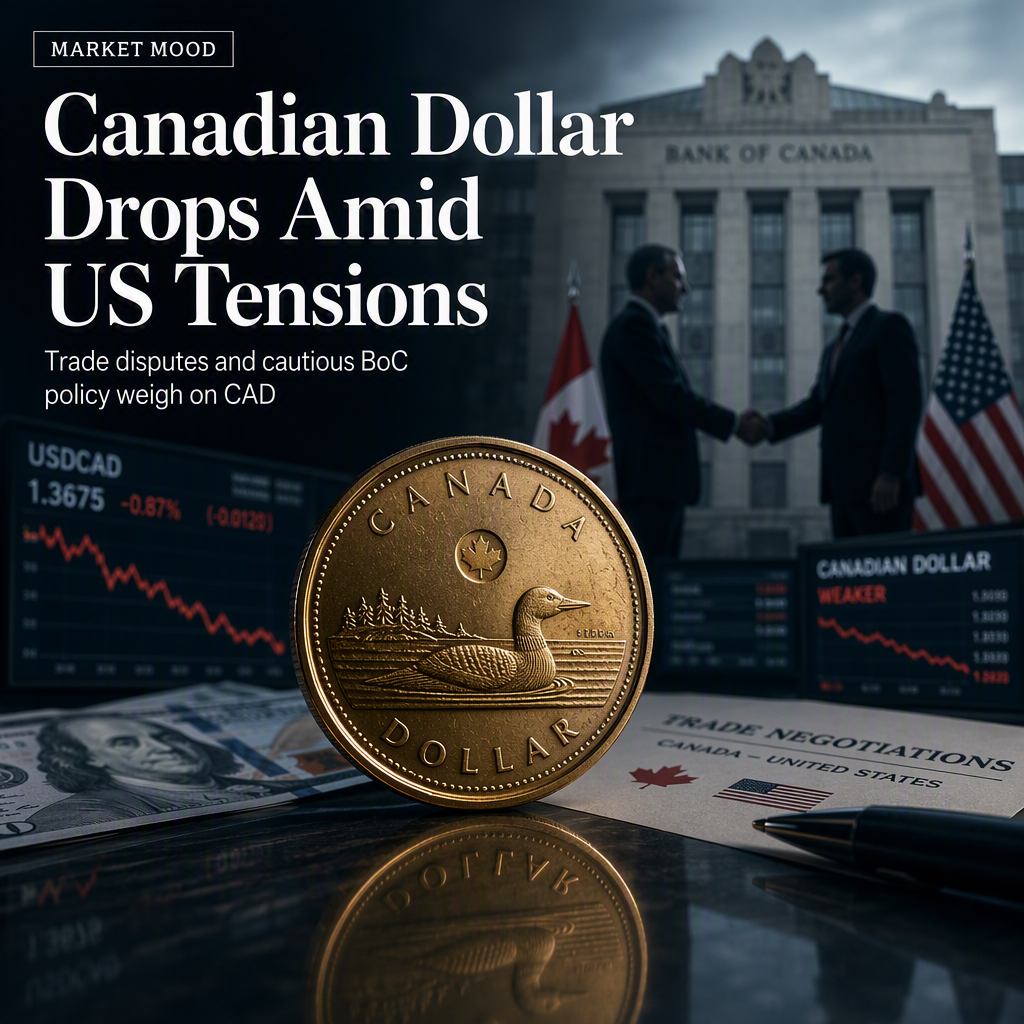
The Canadian Dollar (CAD) remains under pressure as weak fundamentals and strained relations with the United States overshadow domestic monetary policy ahead of the Bank of Canada (BoC) decision. BNY’s Geoff Yu notes that CAD positioning is weak, with USD/CAD flows dominating and cross-currency activity surprisingly limited. Recent CAD inflows were mainly mean reversion, and fundamentals offer little support, with a two-month rolling average of -0.29 in scored flow considered very weak by G10 standards. There is no sign of damage from escalating trade disputes with the US, nor from the BoC lagging G10 peers on rate hikes, but the challenge remains for USD/CAD to find selling interest based on CAD fundamentals, which are currently lacking [1].
Commerzbank’s Michael Pfister expects the BoC to hold its key rate at 2.25%, a move that is fully priced in with only a small chance of a hike. While officials may hint at tightening early next year, the CAD’s outlook is dominated by strained US relations, tariffs, and growth risks rather than domestic monetary policy. The Canadian real economy has slowly recovered, but the BoC remains cautious, and the labor market is likely to be affected by new tariffs, with growth expected to slow slightly. Until US relations improve, interest rate hikes are unlikely to be a priority, and market participants should be aware that CAD’s fate depends more on US relations than on Canadian monetary policy [5].
Meanwhile, broader market dynamics are influenced by hawkish Federal Reserve (Fed) expectations. OCBC highlights that higher oil prices and renewed US-Iran tensions have pushed global bond yields higher and strengthened the US Dollar, with markets fully pricing a 25bp Fed rate hike by October. Fed Governor Barr’s comments reinforce this hawkish backdrop, and OCBC remains modestly constructive on the USD through early 2027 [2]. TD Securities adds that Fed decisions in election years remain data-driven, and avoiding a hike for political reasons could push long-end rates and inflation swaps higher, especially if markets continue to price in nearly a full hike by October while the Fed remains on hold [6].
Despite trade tensions and the BoC’s cautious stance, there is no immediate sign of damage to CAD from the US dispute, but weak positioning and fundamentals continue to cap gains against the USD. The market is watching for any hints from BoC officials regarding future tightening, but the dominant narrative remains the impact of US relations and global monetary policy divergence [1][5].
CONCLUSION
The Canadian Dollar is weighed down by weak fundamentals and strained US relations, with the Bank of Canada expected to hold rates steady and offer only cautious hints at future tightening. Market participants are focused on USD/CAD flows and broader US Dollar strength driven by hawkish Fed expectations. Until US trade tensions ease or domestic fundamentals improve, CAD is likely to remain subdued.