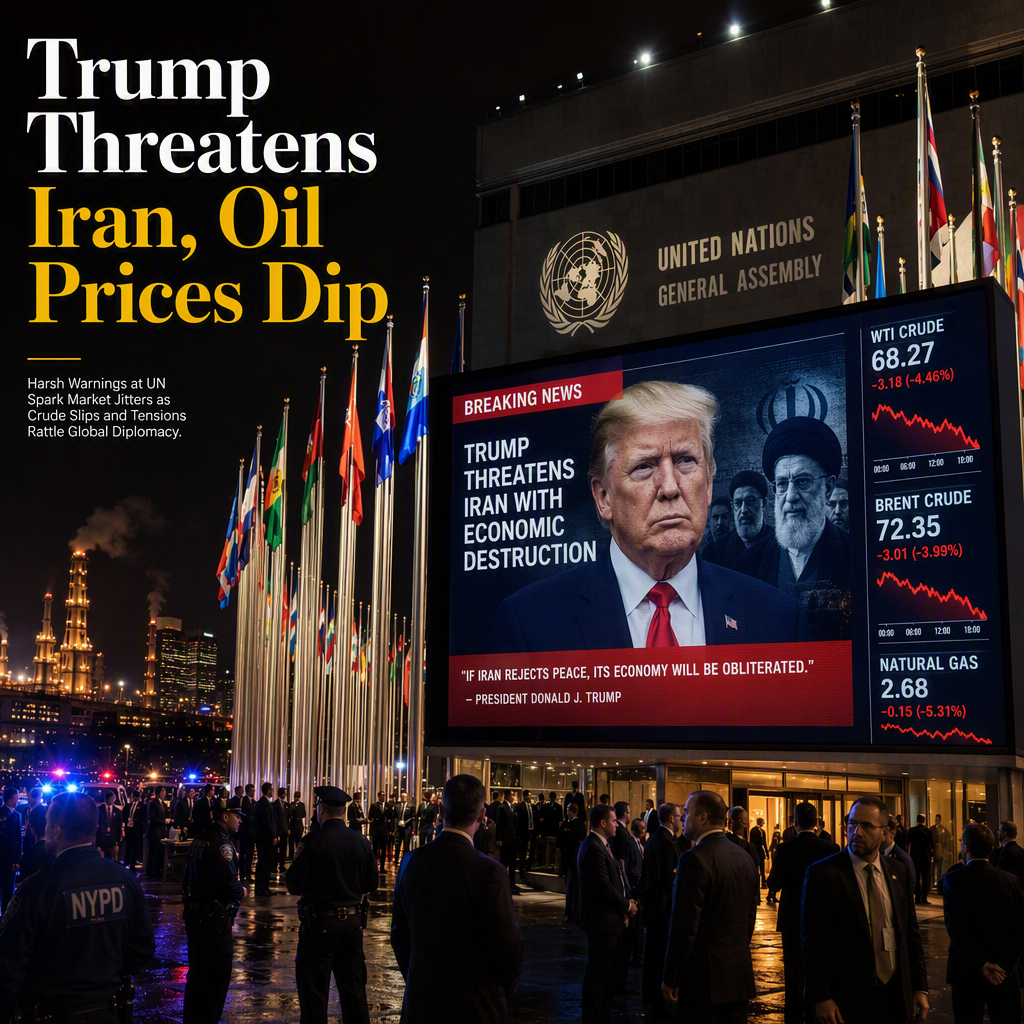
President Donald Trump escalated tensions with Iran ahead of the United Nations General Assembly, threatening to either destroy Iran's economy or eliminate its leadership unless Tehran agrees to a deal. Trump stated on Fox News that the only options were 'wiping Iran out' or letting its economy 'rot,' and indicated he was open to meeting Iranian President Masoud Pezeshkian during the assembly, though he remains in 'deciding mode' regarding potential military action [1].
Iran's military responded by warning of 'painful' retaliation across the Middle East if the U.S. or its allies initiate a strike, stating that all U.S. positions and interests in the region would be targeted. Regional countries supporting such a strike would also be considered parties to the conflict, according to the Khatam al-Anbia Central Headquarters of Iran [1]. The exchange follows the collapse of a June memorandum and marks a further escalation in the seven-month war, with Iranian officials set to attend the UN General Assembly and hold meetings with other country leaders [1].
The U.S. State Department issued a security alert, warning Americans of potential unforeseen escalation in the Middle East, advising increased vigilance and awareness of possible flight cancellations and airspace closures [1]. The warnings came after Iran-backed Houthi militants claimed missile and drone attacks on Riyadh, which Saudi authorities intercepted without casualties or damage. The Houthis also attempted to target civilians and infrastructure in several parts of Saudi Arabia, but those attacks were thwarted by Saudi-led coalition forces [1].
Despite the heightened hostilities, oil prices have pulled back recently. Brent crude futures fell 1.7% to $102.15 a barrel, while U.S. West Texas Intermediate dropped 1.8% to $98.46. Analysts at Eurasia Group noted that oil prices will remain high despite U.S. progress in moving oil through the Strait of Hormuz, as any rebound in oil flows would not be sufficient to address the overall market deficit. They forecast Brent prices to trade in a high range [1].
CONCLUSION
The escalating rhetoric between the U.S. and Iran, coupled with recent militant attacks in Saudi Arabia, has heightened geopolitical risks in the Middle East. While oil prices have temporarily dipped, analysts expect them to remain elevated due to persistent supply concerns. The situation remains fluid as both sides prepare for the UN General Assembly, with market participants closely monitoring developments.