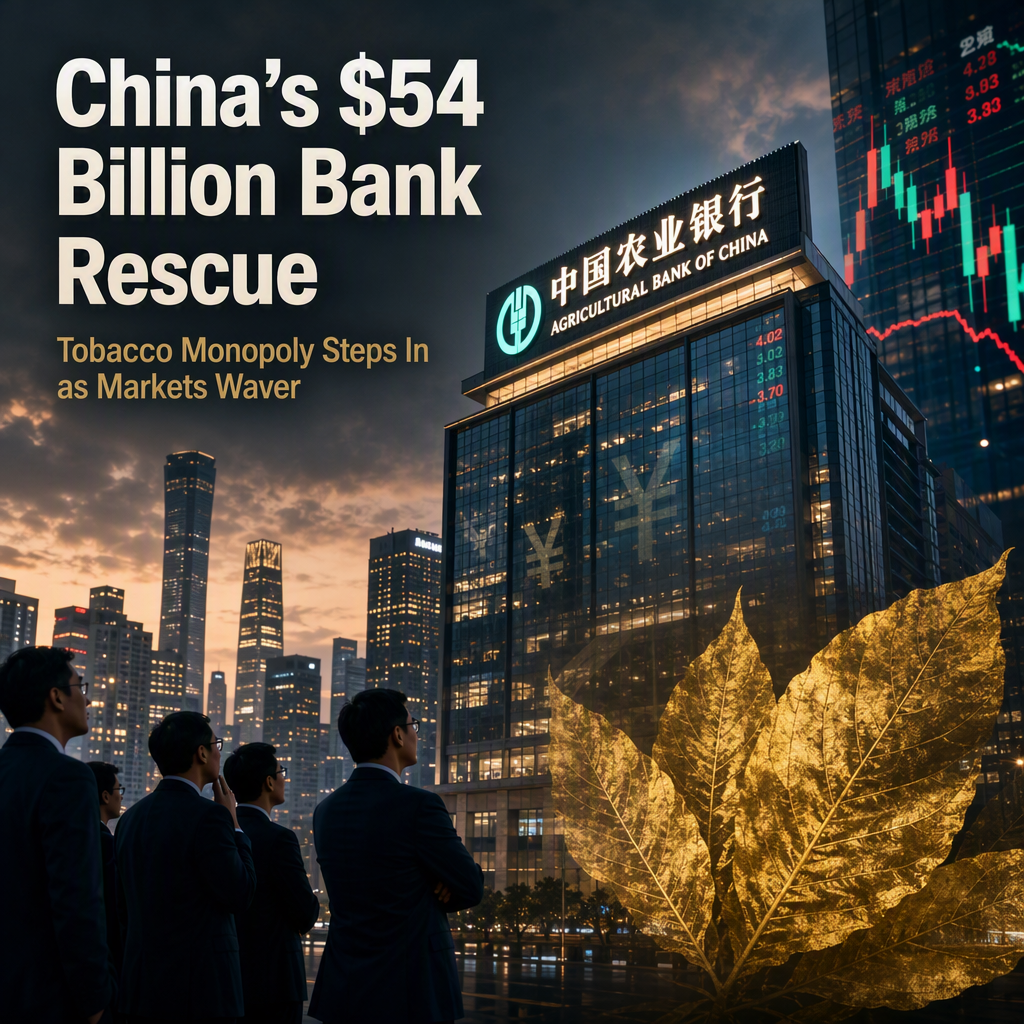
China's government has initiated a significant capital injection of 360 billion yuan ($53.6 billion) into eight major financial institutions, including the Agricultural Bank of China, as part of efforts to strengthen the capital base of state banks and insurers amid ongoing economic challenges [2]. The Ministry of Finance is leading this initiative, which comes in response to concerns over weak credit demand and sluggish economic growth [2].
A key feature of this round of recapitalization is the prominent role played by China's state-owned tobacco monopoly, which has leveraged its strong cash flow and profitability to act as a major investor and financial backstop for the banking sector [1]. The tobacco monopoly, described as a 'cash printing press' for the government, is supplementing the finance ministry's efforts to shore up the banking system, highlighting the continued importance of large state-owned enterprises in stabilizing critical sectors [1]. Financial analysts emphasize that such capital infusions are crucial for maintaining the solvency and lending capacity of state banks, especially as nonperforming loans have risen in recent years [1].
Despite the scale of the capital injection, market reaction was negative, with shares of state banks and insurers declining following the announcement [2]. Investors remain cautious, questioning whether the increased capital will effectively translate into stronger loan growth given the persistent weakness in credit demand and the broader real economy [2]. Analysts note that while these institutions are key drivers of growth, the uncertain outlook for China’s financial sector tempers optimism about the impact of the government’s intervention [2].
Industry observers are also watching how the tobacco monopoly’s growing influence in the banking sector may affect governance and risk management practices, as well as the broader balance between fiscal and financial policy in China [1]. Investors are advised to closely monitor credit demand trends and policy developments, as the ultimate effectiveness of the capital injection will depend on broader economic conditions and the willingness of banks to extend new loans [2].
CONCLUSION
China’s $53.6 billion capital injection into major state banks and insurers, with significant backing from the state tobacco monopoly, underscores the government’s commitment to stabilizing the financial sector. However, the negative market reaction and ongoing concerns about weak credit demand highlight persistent challenges for the banking industry. The effectiveness of this intervention will depend on improvements in the real economy and lending activity.