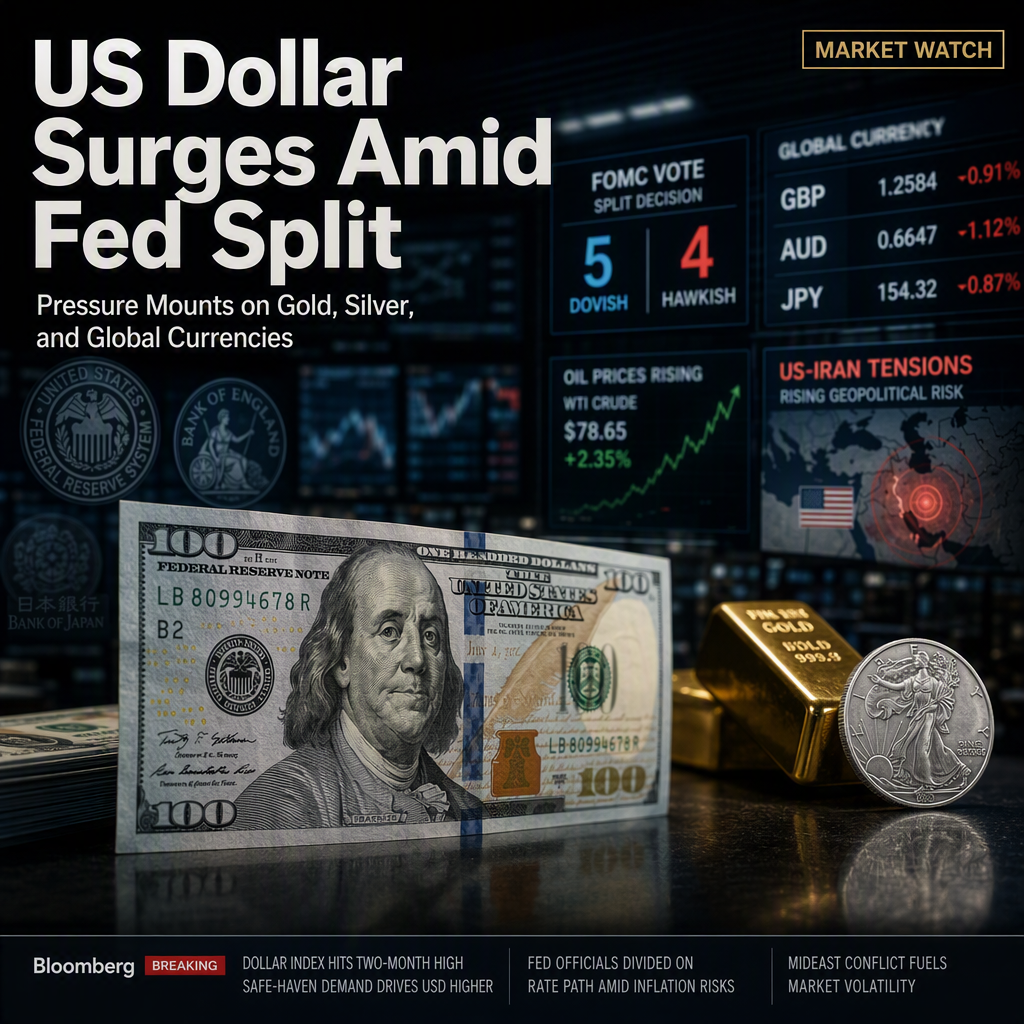
The US Dollar (USD) regained strength during the Asian session on Friday, reversing part of its recent losses as markets digested the Federal Reserve's decision to leave interest rates unchanged and the internal split within the FOMC. The Fed's 9-3 vote revealed significant divergence among policymakers, with strategists at HSBC highlighting the lively debate over the future policy path [4]. This hawkish pause, combined with persistent inflation risks from volatile crude oil prices due to ongoing US-Iran tensions, supported the USD and exerted downward pressure on non-yielding assets such as gold and silver [2][3].
Gold (XAU/USD) drifted lower, snapping a two-day winning streak and struggling to hold gains above the $4,100 mark as the USD recovered. The US Bureau of Economic Analysis reported that the US economy grew at an annual rate of 1.5% in Q2, down from 2.1% in the previous quarter, while the headline PCE Price Index fell 0.1% in June, the first monthly decline since April 2020. The yearly PCE rate decelerated from 4.1% to 3.7%, and the core PCE eased from 3.4% to 3.3% [2]. Despite these signs of cooling inflation, traders are still pricing in over an 85% chance of at least one more Fed rate hike this year, according to the CME FedWatch Tool [2].
Silver (XAG/USD) also declined, trading near $58.40, down almost 1% as the US Dollar Index (DXY) rose 0.23% to around 100.20. Brown Brothers Harriman strategists noted that the USD's earlier drop was due to markets unwinding odds of a July hike and Fed Chair Kevin Warsh's rhetoric failing to convince markets. However, elevated oil prices amid US-Iran military tensions are likely to keep inflation expectations high, limiting upside for silver and other non-yielding assets [3]. Technical analysis indicates silver remains in a bearish near-term tone below its 20-day EMA at $58.91 [3].
The British Pound (GBP/USD) fell to around 1.3450 as the USD strengthened. The Fed's internal policy split and hawkish pause supported the dollar, while the Bank of England's (BoE) own 6-3 vote to keep rates unchanged surprised markets. TD Securities noted that, aside from the vote split, the BoE committee appears comfortable holding rates steady due to a lack of clear inflationary pressures [4]. Positive diplomatic developments in the Middle East, including US-Iran negotiations and a historic agreement announced by US President Donald Trump regarding Hamas and Israeli forces, have reduced global risk aversion, which could eventually challenge USD strength [4].
In the Asia-Pacific region, the AUD/JPY cross built on its rebound, trading near 113.00 after the Bank of Japan (BoJ) left its short-term interest rate unchanged at 1.00%. The BoJ revised its real GDP forecast for fiscal 2026 to +0.6% (from +0.5%) and trimmed its core CPI estimate to +2.5% (from +2.8%). The wide interest rate differential between Japan and Australia continues to support the AUD/JPY, despite diminishing odds for an immediate RBA rate hike following a softer-than-expected inflation print [1]. Deutsche Bank analysts noted that annual core inflation in Australia edged up to +3.6% (below the +3.7% consensus), reducing the urgency for further RBA tightening after three hikes this year [1].
CONCLUSION
The US Dollar's rebound, driven by Fed policy uncertainty and geopolitical tensions, has pressured gold, silver, and major currency pairs. While softer US inflation data and central bank splits suggest a cautious outlook, persistent inflation risks and ongoing global tensions keep markets on edge. Investors remain focused on upcoming central bank meetings and geopolitical developments for further direction.